
A republic by insistence
Córdoba in 1031 had no caliph worth the title. A council of notables, led by the aristocrat Abu l-Hazm Jahwar ibn Jahwar, abolished the office and proclaimed a republic, says Britannica.[2] The Spanish Royal Academy of History adds that the family stabilised the situation with the support of other notables of the region.[34] He did not seize the job. The Turkish Islamic encyclopaedia (TDV) says he took over the government in early 1031 at the people's insistence.[1]
The word republic needs care. This was no assembly of citizens. It was a leading family and its peers running a city that had run out of rulers, and the label describes an absence of a throne more than a constitution.
What made the decision plausible was exhaustion. The fall of the Córdoba caliphate had been a slow humiliation, with caliphs raised and discarded in a few years. Dissolving the office was less a revolution than an admission that it could no longer be filled.
A ruined showpiece and a rival downriver
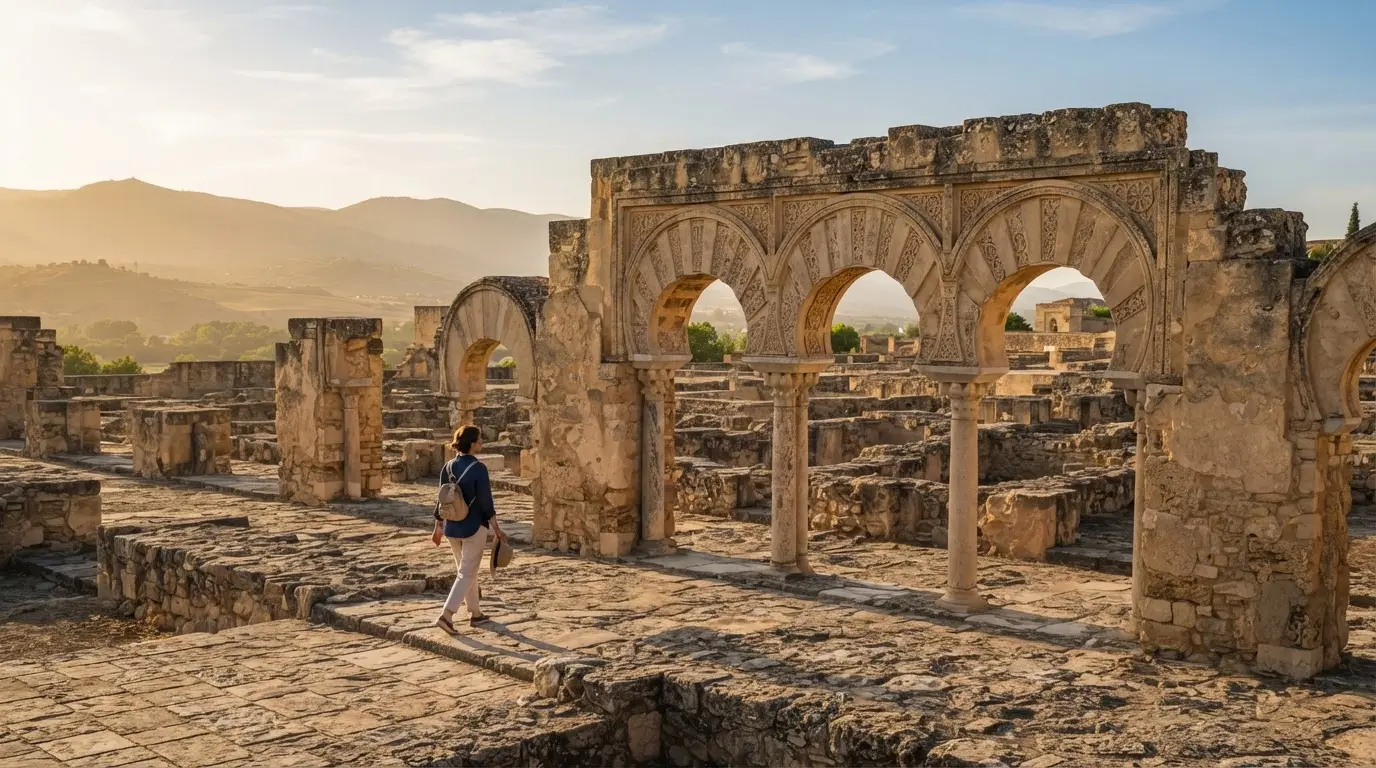
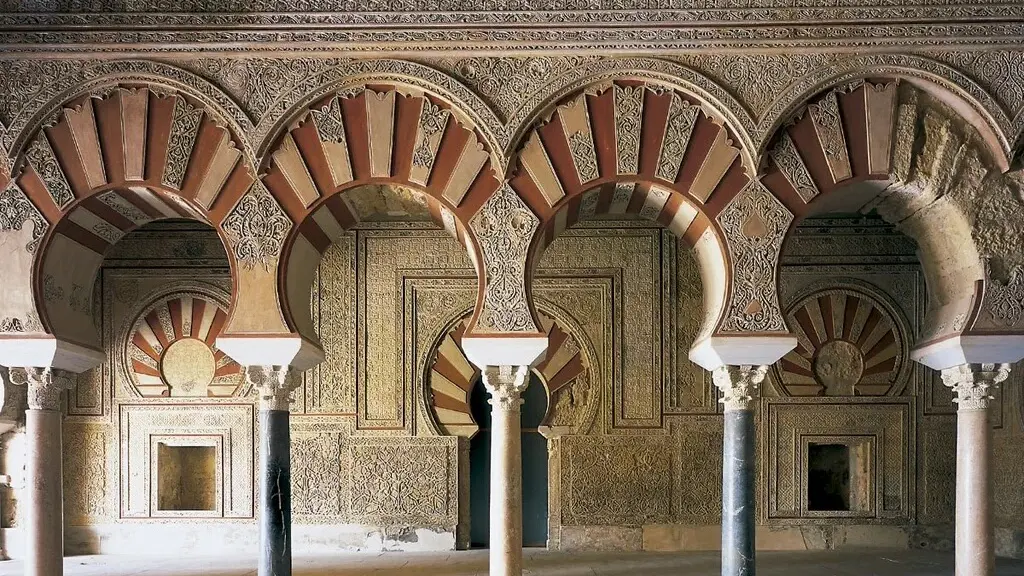
The council inherited a capital with a wrecked crown jewel. Medina Azahara, the palace-city outside Córdoba, had been laid to waste in the civil war of 1009 to 1010, some two decades before the republic began.[3]
Explore nearby · Monument
Medina Azahara
Medina Azahara is Córdoba's UNESCO listed Caliphate City: a 10th century palace 8 km from town, with the Salón Rico and award-winning museum. Plan your visit.
Downriver, Seville had already walked away. In 1023 its qadi, Muhammad ibn Abbad, declared the city independent of Córdoba,[4] eight years before the notables abolished the caliphate. His dynasty, the Abbadids, would become the republic's undertaker.
So the new government started with a ruined palace behind it, an ambitious Seville in front of it, and no caliph to give either problem a face.
One man or a committee?
Abu l-Hazm held power for twelve years, from 1031 to 1043, and Britannica credits him with restoring peace and economic prosperity.[5] The concrete evidence comes from TDV. The long fitna had left a Córdoba without order, with impoverished people and emptied houses.[26] Abu l-Hazm barred returning Umayyads from the city and armed the townspeople, tradesmen above all, to police themselves.[27] He also worked to end the conflicts among the taifa kings,[28] and his son Abu l-Walid kept up the programme and worked to revive economic life.[29]
Whether he did it alone depends on who is asked. Britannica calls him virtually an absolute sovereign, ostensibly assisted by a council.[6] TDV describes a shura administration staffed by the city's leading figures,[30] says he undertook nothing without the viziers' support,[31] and says he acted on the shura's decisions in matters of state.[8] Most taifas had one emir, while Córdoba under him was governed by "collective leadership".[7]
The title is the other clue. The Royal Academy of History's biography of Abu l-Walid says the Banu Jahwar took power but not the sovereign title, that Abu l-Walid followed his father in this, kept his rank of hajib and his private house, and never moved into the Umayyad alcázar.[32] TDV contrasts Abd al-Malik, who dropped his forebears' modest style and took two caliphal-style titles at once, al-Mansur-Billah and al-Zafir-Bifadlillah.[33] Seville, by contrast, was already turning a judge's family into a dynasty.
The sources split on the first two Jahwarids, and the likeliest reading is that both can be true. A council gave the notables a seat at the table and gave Abu l-Hazm a shield, since a hard choice could always be presented as the choice of the shura. His successors would find out how far that protection went.
Father, son and a murdered vizier
Abu l-Hazm's twelve years ended in 1043 and the job passed to Abu l-Walid Muhammad, known as al-Rashid, whose reign coin listings date to 1043–1058.[10] His talent was evasion. He is credited with keeping the Abbadids of Seville out of Córdoba through political chicanery,[9] which for a small republic between larger neighbours was the only foreign policy on offer.
The Jahwarid court of these years also frames the life of the poet Ibn Zaydun, whose career ran through the same corridors.
The next generation was worse at the game. Al-Rashid's son Abd al-Malik had a vizier killed, and the sources disagree on who and when. Britannica says al-Rashid had resigned his authority to the vizier Ibn al-Raqa, that his jealous son Abd al-Malik assassinated him in 1058, and that the father then rewarded the son with virtually caliphal standing.[35] TDV names the vizier Ibn al-Sakka, who had restored order, says the Abbadids insinuated that he meant to take over the dynasty, and dates the killing to 1063.[11] Neither account says whether the two names belong to one man, so they should not be treated as the same person.
A rivalry inside the family finished the job. Abd al-Malik and his brother Abd al-Rahman vied for dominance, and the conflict weakened Córdoba enough that Abd al-Malik went looking for an ally in al-Mu'tadid, the emir of Seville.[12] He had invited the rival state in.
Around 1070: how Seville took Córdoba
By the end the Cordobans wanted their rulers gone. Britannica has the Cordobans delivering Abd al-Malik, deeply unpopular, and his father to the Abbadids themselves,[16] a version that sits awkwardly beside the Toledan attack and riot reported in the Royal Academy of History's chronicle entry.
The collector was new. Al-Mu'tamid came to the throne of Seville on 27 February 1069, when his father al-Mu'tadid died.[14]
Then Toledo moved. Its army attacked Córdoba, a riot broke out against the Banu Jahwar, and they were beaten and exiled to the island of Saltés.[13] Al-Mu'tamid defeated the Toledan army and took the city, deposing Abd al-Malik, who went from a cell to exile.[15] TDV says Abbadid forces, sent to help against Toledo, entered in May 1070, and that Abd al-Malik realised too late he had been deceived.[17][37]
The date is the loose thread, and "around 1070" is the safest wording. The Royal Academy of History files the events under 29 July 1070,[13] and TDV says May 1070, so the two sources that date the occupation to a month agree on the year. Britannica splits: its Jahwarid entry says the Abbadids took the city in 1069,[36] while its Abbadid entry says 1071 and describes a precarious hold lasting only until 1075.[18] Neither entry explains the gap. Since al-Mu'tamid only acceded on 27 February 1069, the 1069 date may mark the Abbadid takeover rather than his occupation, and 1071 may reflect a later hold; that is an inference, not a documented reason.
After Seville: a city passed between kings
Annexation did not settle Córdoba. The decades after read as a list of owners:
- Around 1070: al-Mu'tamid of Seville annexes the city and the Jahwarids go to Saltés[15]
- Early 1075: a rebellion kills Abbad, al-Mu'tamid's governor, and Córdoba falls under Toledo[19]
- 1077 or 1078: al-Mu'tamid takes it back[20][21]
- 1091: Almoravids storm the city and a son of al-Mu'tamid dies in the attack[22]
Recommended tours
Tours are selected for quality, not commission. We earn a small fee if you book — at no extra cost to you.



Seville gained a city and, under al-Mu'tamid, became a brilliant centre of Spanish-Muslim culture.[23] It never gained a loyal one. Each time a stronger neighbour appeared, Córdoba changed hands.

Deep dive · Article
47 Metres Tall and Almost Unknown: Spain's Tallest Keep
Belalcázar Castle's 47 m keep is listed by the Junta de Andalucía as Spain's tallest. How it grew, what to see inside and how to book the free guided visit.
The Banu Jahwar had asked their city to run itself. Within a generation it was taken by Seville, taken from Seville by Toledo, and finally taken by Almoravid assault. The longer arc of Moorish Córdoba runs on from there.