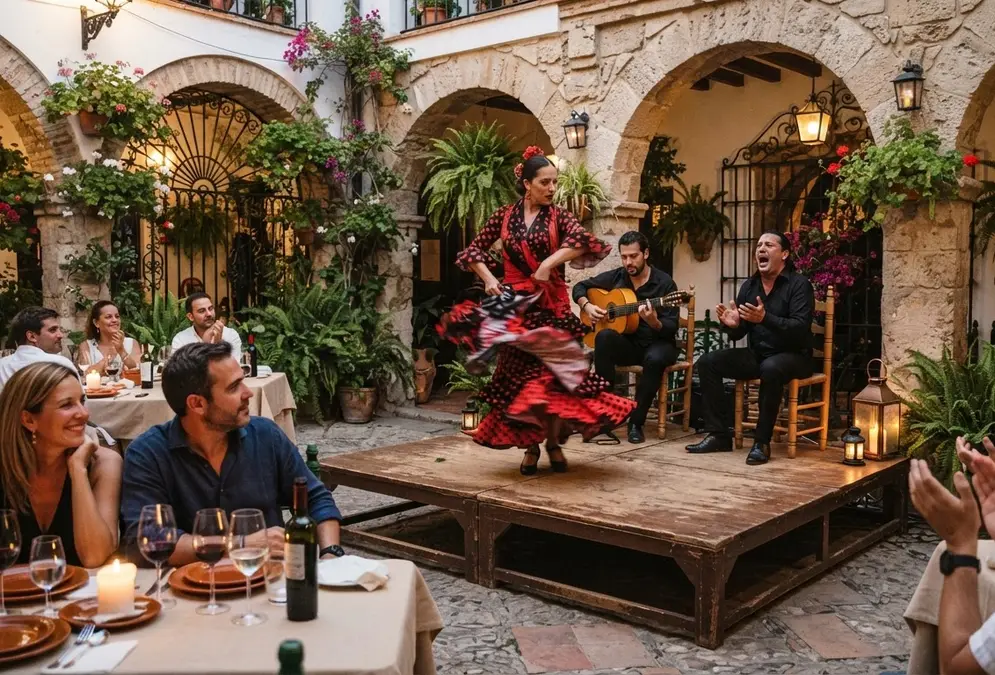

An evening built around a fixed curtain
Patio de la Judería runs its tablao on a schedule that never moves: dinner and a live flamenco set that begins at 20:45 every night, inside an 18th-century señorial house tucked into the Judería, roughly fifty metres from the Mezquita-Catedral's north wall. Booking the dinner-and-show format is a different decision from booking a table for dinner alone. You are choosing to eat inside the room where the cuadro flamenco — guitarist, singer, dancer — performs a few metres from your chair, not to eat first and walk somewhere else afterward.
That distinction matters more than it sounds. The venue presents itself as a tablao as much as a restaurant, so the sequencing follows from that: the compás arrives mid-meal, not as an encore after coffee.
What it's actually like to eat through a tablao set
The courtyard is small enough that there is no real back row. When the toque starts, the guitar fills the stone space directly — no amplification doing the work for it. You feel the baile's footwork on the tile before you consciously register the rhythm shifting into bulerías. Conversation drops on its own; nobody has to ask for quiet. Staff time the courses around the set rather than around your table, so a plate is as likely to land between songs as between courses. That's the real difference between this and ordering à la carte with a show running somewhere behind you: here, the cante and the meal share the same clock.
Where to sit relative to the stage
Tables ring the edge of the performance space rather than facing a raised stage in rows, so the gap between a good seat and an average one is a matter of a few metres, not sections. Ask specifically for a table facing the performance area when you book — a seat pushed back toward the entrance or the bar puts you behind the cuadro's backs for parts of the set. If the show matters as much as the food, say so when reserving. If the food is the priority, a slightly more removed table lets you eat without craning around a dancer's turn.
Booking the package versus eating à la carte
The flamenco itself is free — it comes with any à la carte order, provided you meet a €15 minimum consumption, and there's no separate show ticket to buy. A cuadro of guitarist, singer and dancer plays for roughly 45 minutes during the sitting. What the venue doesn't publish is a fixed price for a bundled set-menu dinner-and-show package, if one exists on a given night — menu and any package pricing shift by season. Confirm any set-menu option directly with Patio de la Judería before paying, but for anyone ordering normally from the à la carte menu, the show needs no separate booking beyond a table reservation. What doesn't change is the shape of the evening: dinner and performance share one room, on one clock, every night of the week.
For a full review of the kitchen — what's on the menu, what to order, what a plate of salmorejo or rabo de toro is like — see the restaurant's own page. This page covers the dinner-and-show evening as a format, not the food itself.
Building the rest of the evening around it
The Mezquita-Catedral is close enough to walk in a couple of minutes, and its night-visiting hours make it easy to see the mosque's forest of columns lit after dark, either before or after the show. The Judería's narrow streets are at their quietest once the day-trip crowds clear out, usually well before the 20:45 curtain — worth a slow walk on either side of dinner.