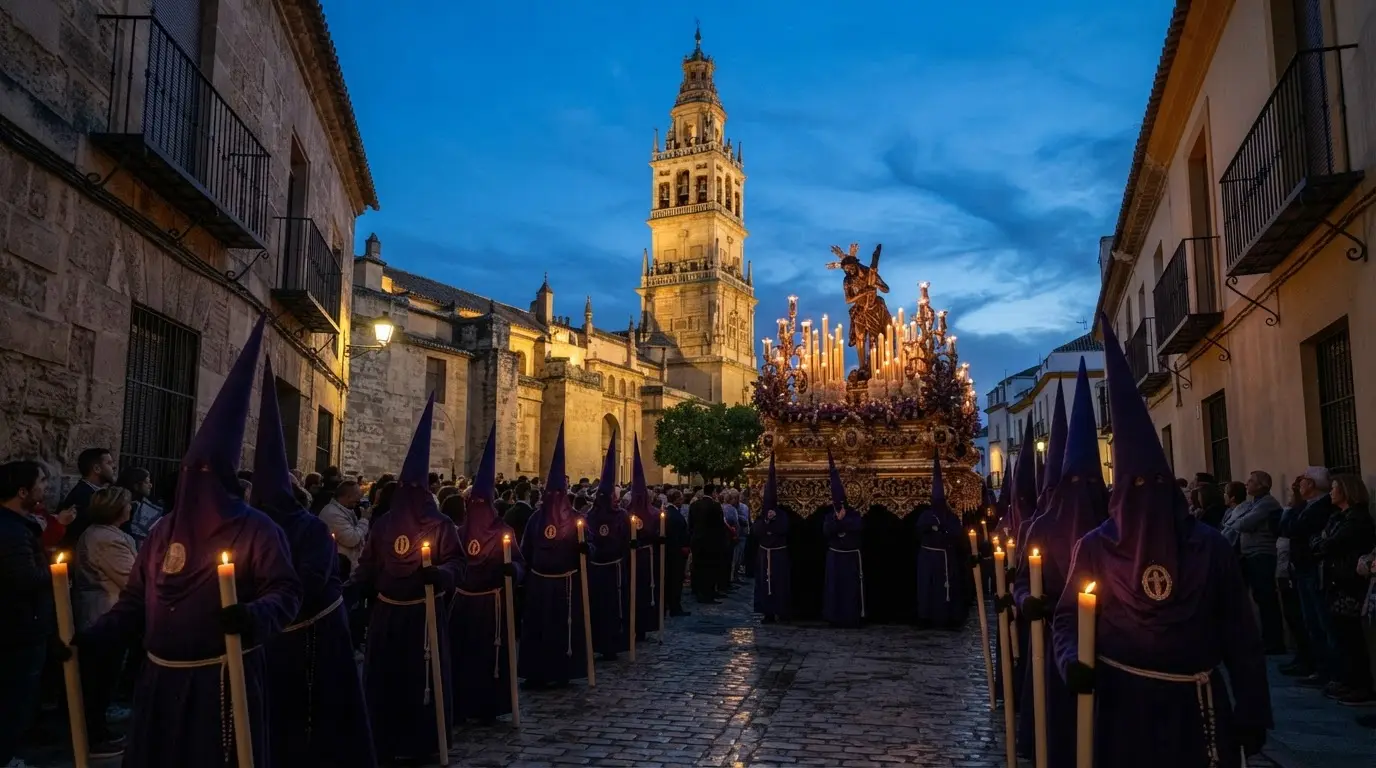

When Semana Santa 2027 Falls in Córdoba
Domingo de Ramos (Palm Sunday) opens Semana Santa Córdoba on 21 March 2027, since Palm Sunday is by definition the Sunday immediately before Easter[2]. The week closes eight days later with Domingo de Resurrección (Easter Sunday) on 28 March[1], the span running from the first paso to leave its parish church on Palm Sunday morning to the last brotherhood's return home after Easter Vigil. For comparison, Semana Santa Córdoba 2026 ran from 29 March to 5 April[3]. That puts 2027 a full week earlier than the year before it, and a week is not a rounding error here: it moves the whole event out of its more familiar April window and into the tail end of March, when Córdoba's climate, crowds, and hotel calendar all behave differently.
The scale involved is why that shift is worth tracking rather than shrugging off. Today 38 hermandades (religious brotherhoods) process through Córdoba's historic centre during Semana Santa[4], each completing the Carrera Oficial, the official route every procession must walk, before returning to its home church, often by way of streets around the Mezquita-Catedral. None of that itinerary changes because the calendar moved: the brotherhoods, the routes, and the pasos stay the same regardless of which week in spring they fall in. What changes is the week those 38 processions occupy, and with it, the weather a visitor should expect and how early the best hotel rooms disappear. Watching the queue at the Mezquita-Catedral's visitor entrance across a decade of Córdoba springs, one pattern holds regardless of temperature: it is the processions' rhythm, not the thermometer, that decides when the crowd thickens. For the full shape of the festival itself, see our Semana Santa overview.
Why Easter Moves: The Rule Behind the Date
Easter is a movable feast: its date is not fixed on the civil calendar but set by the Church's cómputo eclesiástico, a computation rule dating to the Concilio de Nicea in 325 CE. Under that rule, Easter Sunday falls on the first Sunday after the first full moon on or after the fixed equinoccio eclesiástico of 21 March[5]. That full moon, the luna llena pascual (Paschal Full Moon), can occur anywhere from the day after the equinox to nearly a full lunar cycle later, which is the entire reason Easter drifts across more than a month of the calendar from one year to the next, and why Semana Santa moves with it, since the two are locked together by definition.
Semana Santa Córdoba's own festival page states it plainly: the date 'coincides with the arrival of spring and depends on the lunar phases'[6]. Palm Sunday to Easter Sunday is always eight days, and in 2027 the Paschal Full Moon falls early within its possible window. Nothing about the brotherhoods, the silverwork, or the city changed to produce that; only the moon's position relative to the equinox did, which is worth remembering the next time a guidebook implies the Church picked an arbitrary date. It didn't. It picked a rule, and the rule occasionally produces a March that feels more like winter than spring.
How Rare Is a Late-March Semana Santa?
Western (Gregorian) Easter can fall anywhere between 22 March and 25 April[7], so 28 March sits close to, though not at, the early edge of that range. True calendar-early Easters are genuinely unusual: the earliest possible date, 22 March, last occurred in 1818, and the next time Easter falls that early will be 2285[8]. The next-earliest date, 23 March, is almost as rare. Measured against that scale, 2027's 28 March is not a historic record, but it sits well inside the early tail of the distribution, closer to the calendar's early extreme than the vast majority of years in living memory.
Explore nearby · Monument
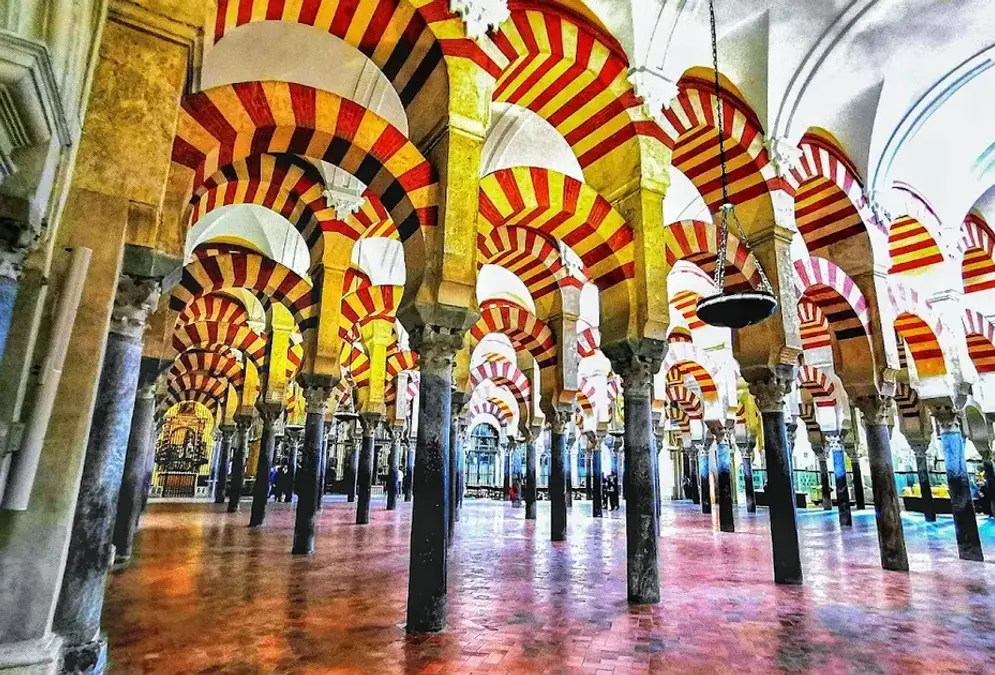
Mezquita-Catedral de Córdoba
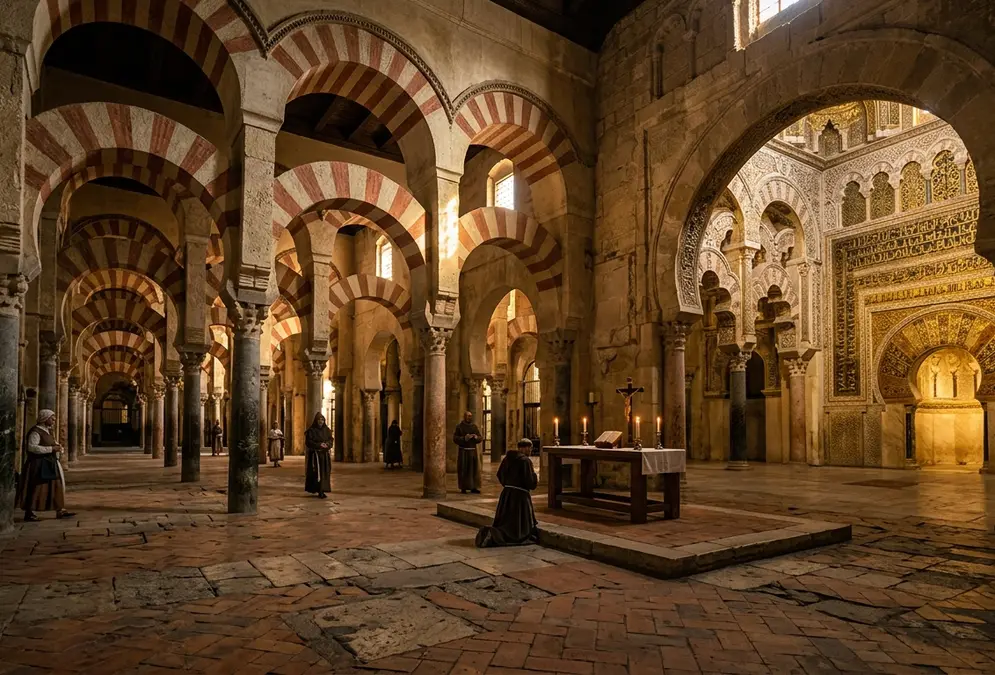
856 columns, 1,300 years of Islamic and Christian history. UNESCO monument in Córdoba, Andalusia. Red-and-white arches, Byzantine mosaics, a Renaissance nave.
That rarity is part of why the shift is worth planning around rather than dismissing as a technicality. Semana Santa Córdoba carries the official title of Fiesta de Interés Turístico Nacional (Festival of National Tourist Interest), awarded by Spain's Secretary of State for Tourism[9], recognition that reflects the scale of visitor interest the week already draws. An event of that size behaves differently depending on which week of the calendar it lands in, and the one variable a visitor can actually plan for is the weather.
Late March vs Mid-April: What the Weather Really Does
Córdoba's climate normals make the shift concrete rather than theoretical. AEMET's standard 1981–2010 averages put March at 14.4°C, with an average daily high of 21.3°C, a low of 7.4°C, 49mm of rainfall, and 4.9 rain days[10]. April averages 16.0°C, with a high of 22.8°C, a low of 9.3°C, and 55mm of rain spread across 6.7 rain days[11]. On paper the gap is modest, about 1.6°C on average, but it is the difference between an evening procession that needs a coat and one that doesn't, and between a March that is merely mild and an April that is reliably warm.
| Metric | March | April |
|---|---|---|
| Average temperature | 14.4°C | 16.0°C |
| Average high | 21.3°C | 22.8°C |
| Average low | 7.4°C | 9.3°C |
| Rainfall | 49mm | 55mm |
| Rain days | 4.9 | 6.7 |
Rain is the variable that actually decides whether a procession happens at all. Córdoba's processions, each an estación de penitencia (a brotherhood's station of penance), depend directly on dry streets: a wet forecast can force a paso to stay in its church, robes, candles, silver, and all, regardless of what the calendar says. Slightly fewer average rain days in March than in April is a mild point in late March's favour, but these are historical climate normals, not a forecast for the specific week of 21–28 March 2027; no one can promise dry skies six months out. What the numbers do support is planning Córdoba in March as its own season rather than assuming April's postcard weather arrives a few weeks early: pack layers, an evening jacket for after dark, and a compact umbrella that won't fight with a camera bag on a crowded street.
Recommended tours
Tours are selected for quality, not commission. We earn a small fee if you book — at no extra cost to you.
Booking and Packing for an Early Semana Santa
Hotel demand in Córdoba during Semana Santa has swung hard in recent years, and weather is a large part of why. Semana Santa 2025 hotel occupancy averaged 87% across the city, beating the local tourism board's own 80% forecast[12], a sharp rebound from 2024, a year whose numbers had been dragged down by persistent rain. On the peak days, Jueves Santo and Viernes Santo, many hotels reached 95–100% occupancy, with four- and five-star properties performing best[13], even though that particular week had opened with unstable conditions.
The pattern behind those figures is the useful part: weather is enough of a factor in Semana Santa planning that, as local tourism officials note, 'muchos visitantes lo dejan todo para el final para asegurarse el buen tiempo', many visitors hold off booking until the last moment specifically to be sure of good conditions[14]. That habit doesn't disappear just because Semana Santa 2027 falls earlier; if anything, cooler and less certain March odds make it more tempting to wait, which means the rooms that fill first are the ones booked by travellers who didn't wait.
Deep dive · Article
Mezquita Conversion 1236: What the Reconquista Actually Did
In 1236, Ferdinand III captured Córdoba and converted the Great Mosque into a cathedral, left untouched for three centuries until Charles V's architects.
How far ahead to book
Treat 2025's confirmed pattern as the working model until an official 2027 forecast exists: on the peak processions days, many hotels reached 95–100% occupancy, with four- and five-star properties performing best[13], and rooms at that tier moved well before the week arrived. Check the best time to visit Córdoba against your own priorities: a March date changes the weather calculus, not the demand calculus. If a specific balcony overlooking a procession route, or a room near the Carrera Oficial, actually matters to the trip, that is the tier to lock in early rather than gamble on late availability in a week that traditionally fills from the top down.
What actually changes in your suitcase
Packing for 21–28 March is a genuinely different exercise than packing for mid-April. Evenings sit close to Córdoba's average March low of 7.4°C, so a real layer for the night processions is not the optional extra it can feel like in a milder late April. Days are pleasant but noticeably less reliable than the sun-drenched version of Andalusian spring most visitors picture; that version belongs more to Córdoba in spring once April properly arrives, and a March Semana Santa doesn't quite reach it. A compact umbrella earns its space in the bag for a week when a dry forecast is a hope rather than a guarantee, and comfortable shoes matter more than usual: crowds move slowly along cobbled streets that can turn slick fast.