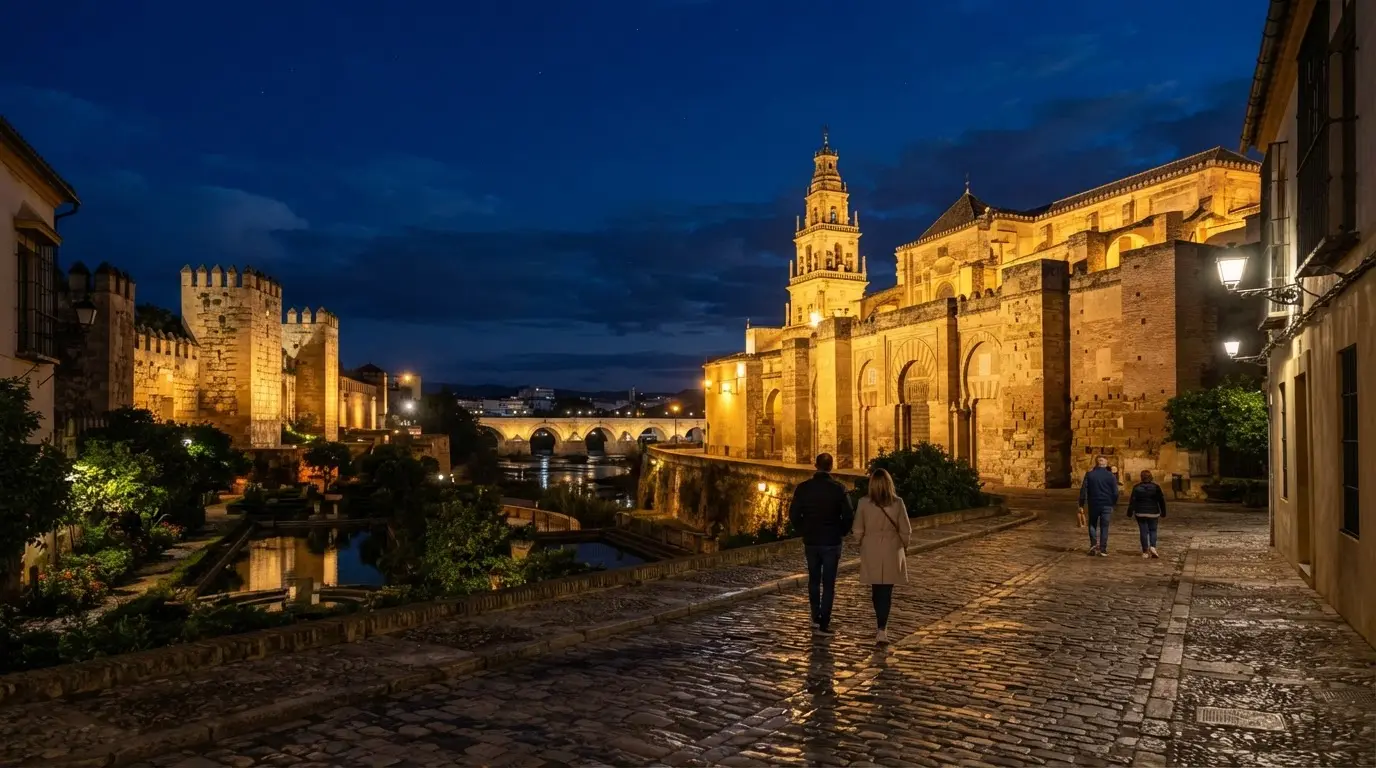

Two forces are switching Córdoba's monuments on after dark
Not long ago, an evening walk past the Mezquita-Catedral or the Alcázar meant looking at a floodlit facade and moving on. Now you can walk inside both after dark, watch Medina Azahara's ruins lit against the hillside, or catch a free night opening at one of the city's museums.
That shift did not happen by accident. It is the product of two forces meeting at once: a climate that makes summer afternoons dangerous, and a tourism board that decided to sell the night instead of fighting it.
Córdoba is regularly cited as Europe's hottest large city: a typical July afternoon reaches about 37°C, and in July 2022 the monthly average high hit 40.4°C, the highest ever recorded for a European city of over 100,000 people[1].
That heat is why the historic centre empties out between 2 and 6 p.m. every summer afternoon and fills again well after dark. The mechanics of it are covered in full in why Córdoba is so hot.
In spring 2026 the Ayuntamiento de Córdoba presented a new tourism campaign in Madrid, 'Visita Andalucía. Quédate en Córdoba', built explicitly around night culture and aimed at increasing overnight stays in summer[2].
The stated goal was to reduce the city's dependence on spring as its high season and position Córdoba as a year-round destination, pairing daytime rest with an evening cultural agenda designed around the summer heat[3].
Four experiences make up the shift:
- El Alma de Córdoba, the Mezquita's year-round night circuit
- Naturaleza Encendida, the Alcázar's nightly light and sound show
- Medina Azahara's summer night hours and free theatrical visit
- Free Thursday-to-Saturday openings at four municipal museums
El Alma de Córdoba: the Mezquita's permanent night circuit
El Alma de Córdoba is the one experience here that runs year-round[15], which makes it the anchor of the whole push. The one-hour circuit opens the Mezquita-Catedral after dark, walking small groups through the prayer hall under lighting designed for the building itself.
Capacity is capped at 80 people per session[4].
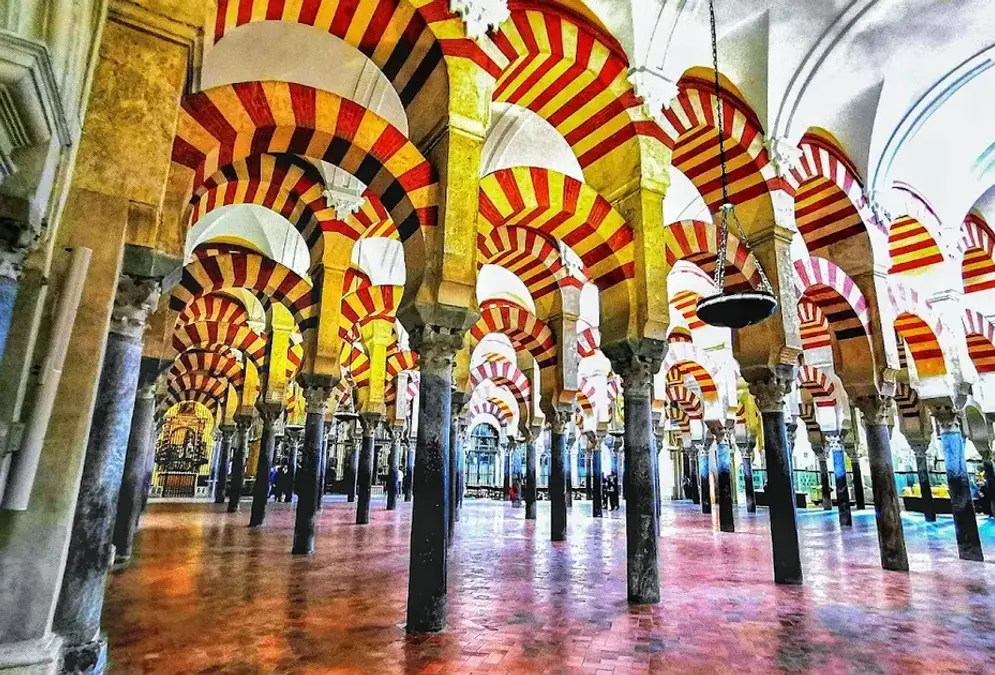
Explore nearby · Monument
Mezquita-Catedral de Córdoba
856 columns, 1,300 years of Islamic and Christian history. UNESCO monument in Córdoba, Andalusia. Red-and-white arches, Byzantine mosaics, a Renaissance nave.
Tickets run €25 general, €18 reduced[5] for over-65s, students up to 26, and children seven and older with accreditation. Book through the Mezquita night visit page.
Naturaleza Encendida: the Alcázar turns its gardens into a nightly spectacle
Where El Alma de Córdoba is about architecture, Naturaleza Encendida is about production. The show runs through the gardens of the Alcázar de los Reyes Cristianos, retelling Christopher Columbus's 1486 meeting with the Catholic Monarchs across three themed zones of laser grids, projection surfaces and sound design.
There is no guide and no fixed pace; you enter when your slot opens and walk the circuit at your own speed. The tour lasts approximately 45 minutes[7], short enough to combine with dinner or a second night visit the same evening.
Show times and pricing change by season and by day of the week, so check the current schedule on the activity page before booking rather than assuming last year's hours still hold.
The two experiences sit a five-minute walk apart, both inside or beside the Judería quarter. That proximity is exactly why the city's summer campaign bundles them into one evening's programme instead of promoting them separately.
Medina Azahara after dark: summer hours and a free theatrical visit
Medina Azahara runs its own version of the same shift. During summer months the archaeological site adds night hours, Tuesday to Saturday from 8 p.m. to midnight, separate from its 9 a.m.–3 p.m. daytime slot[8].
Recommended tours
Tours are selected for quality, not commission. We earn a small fee if you book — at no extra cost to you.
It's worth being precise about what that means: this is a summer programme layered on top of the site's regular hours, not a year-round night visit the way El Alma de Córdoba is.
For the palace's own nocturnal history and what the ruins look like once the lights are on, Medina Azahara at night covers the illuminated site in depth.
Alongside the paid night-hours slot, the Junta de Andalucía also runs a free theatrical night visit called 'El susurro del agua' on set summer dates, capped at 30 people per pass. Sign-up opens weekly, every Monday at 10 a.m., for the coming weekend[9].
Book Monday morning
El susurro del agua opens sign-up every Monday at 10 a.m. for that weekend's slots. It's free and capped at 30 people, so waiting until Thursday usually means missing it entirely.
Museums, patios and building an evening around the heat
The night strategy is not limited to headline monuments. During summer 2026, four municipal museums, including the Museo Julio Romero de Torres, the Posada del Potro, the Museo Taurino and the Baños del Alcázar Califal, opened free Thursday, Friday and Saturday nights from 9 p.m. to midnight, framed explicitly as a response to the heat[10].
The city's culture delegate summed up the intent bluntly: the programme exists because "Córdoba es visitable los 12 meses del año" — Córdoba is visitable twelve months of the year[11].
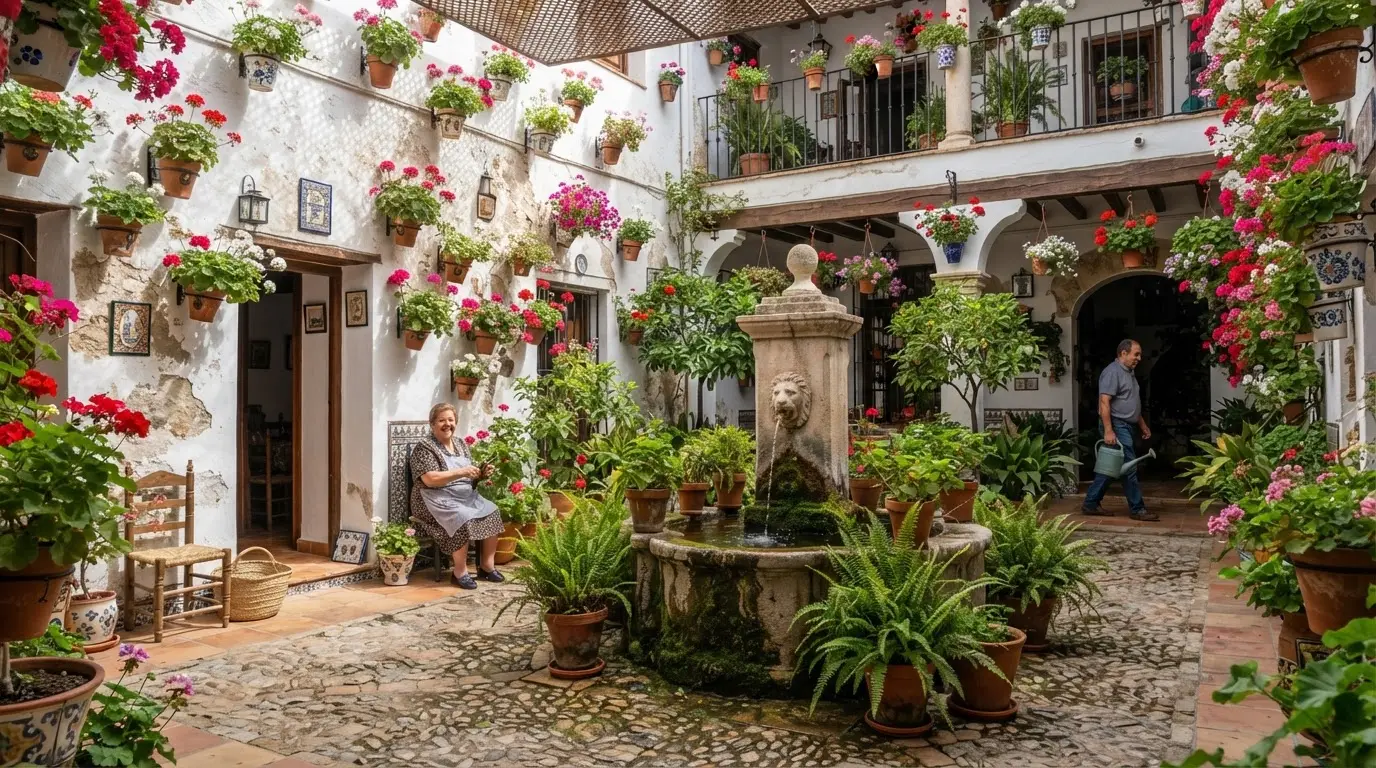
Córdoba's patios were never really a daytime-only tradition either. The courtyard house, adapted by Romans and later by Muslims to cope with the dry, hot climate, was built around a central patio, usually with a fountain, that cools the trapped air[12].
Deep dive · Article
Córdoba's Patios: Why They Exist and Endure
Córdoba's patios stay 10–15°C cooler than the street. Two thousand years of Roman, Moorish and Christian engineering explain why, and why they still work.
The Fiesta de los Patios runs annually, 4 to 17 May in 2026, when private courtyards across the old town open their doors[13]. It predates every night-visit product above by decades, and arguably supplied the design logic they're all now selling.
For a practical rundown of which of these to combine on a single evening, and how to sequence a Mezquita night visit with dinner or a flamenco show, the Córdoba at night planning guide covers the logistics this article leaves out.