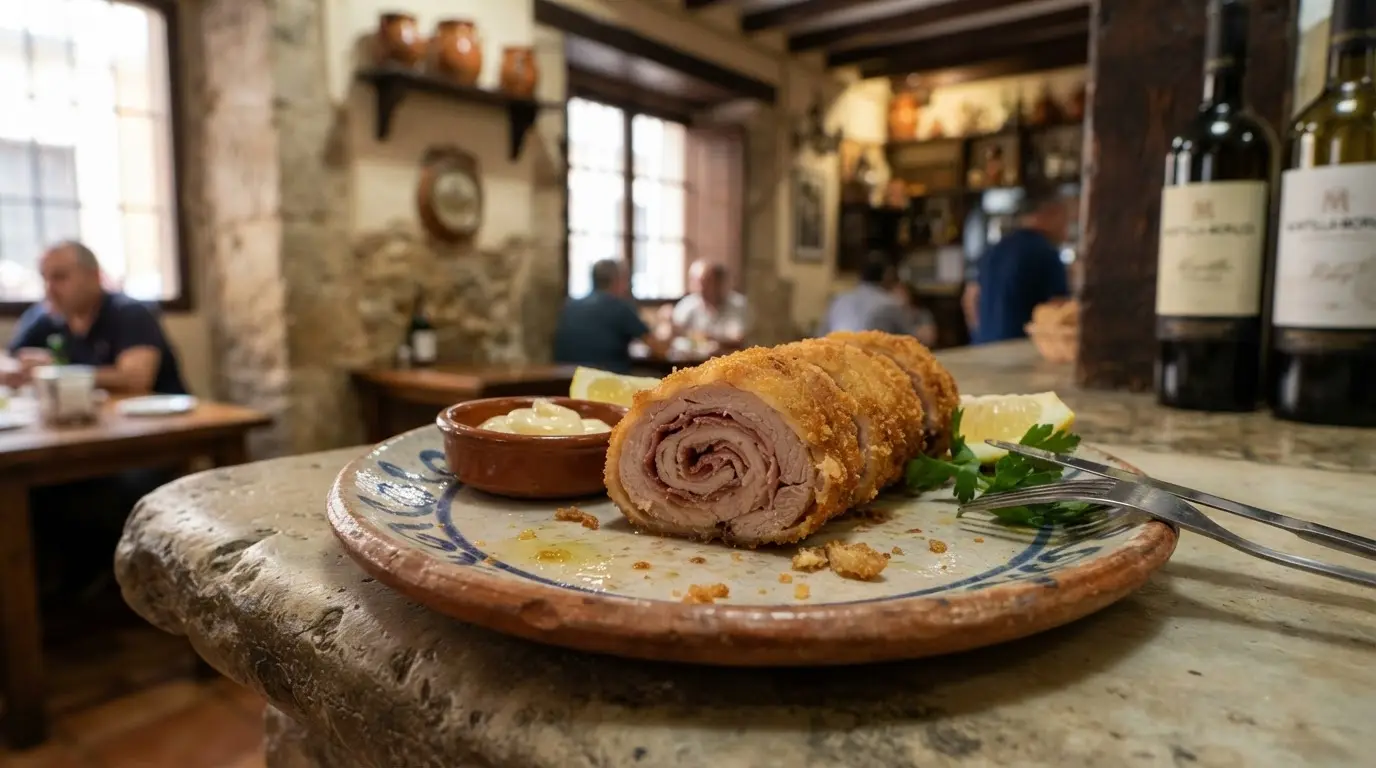

What flamenquín actually is
Pork loin (lomo de cerdo), pounded flat into a thin escalope, wrapped around two or three slices of jamón serrano, rolled tight, secured, then dipped in beaten egg and coated in fine breadcrumbs. Into hot olive oil it goes, deep enough to submerge it. Three to four minutes later you have a golden, crackling cylinder that leaks a thin trickle of cured-ham fat when you cut it.
That is the authentic version. No cheese, no mushrooms, no roasted peppers. Those are bar innovations from the last thirty years, and in Córdoba they tend to attract raised eyebrows from anyone over fifty. The flamenquín dish page covers the current landscape: the full-size bar versions, the mini pinchos, the places that insist on the classic formula. What this article is about is where the thing came from and why its birth certificate remains, after all this time, uncertified.
Accompaniments in the traditional format are simple: homemade mayonnaise, a wedge of lemon, a few lettuce leaves, and patatas fritas. Some tabernas add a small bowl of salmorejo on the side. That pairing makes sense. Both dishes are cold-warm contrasts — the thick cool tomato emulsion against the hot crunchy roll — and they share the same Córdoba tavern ecosystem that produced them.
1960s
Why 'little Flemish'? The Carlos I etymology
In March 1516, Carlos I was proclaimed King of Castile in Brussels, following the death of Ferdinand II — but he did not physically arrive in Spain until September 1517, landing at Tazones in Asturias.[5] He brought his Flemish court with him. The Spanish viewed these fair-haired northern Europeans with a mixture of fascination and resentment. They were foreign, they spoke no Castilian, and they occupied administrative posts that Spanish nobles considered their own.
The Flemish aides acquired a Spanish nickname: flamencos. The diminutive flamenquín entered the language as a way of referring to these blond newcomers, carrying a slightly teasing edge.
The theory linking the dish to this etymology is visual: the golden crust produced by the egg-and-breadcrumb coating, once it comes out of the oil, is the colour of Flemish hair. Pale, almost yellow, deepening to amber. Whoever named the dish was either genuinely struck by the resemblance or simply found the nickname too apt to resist.
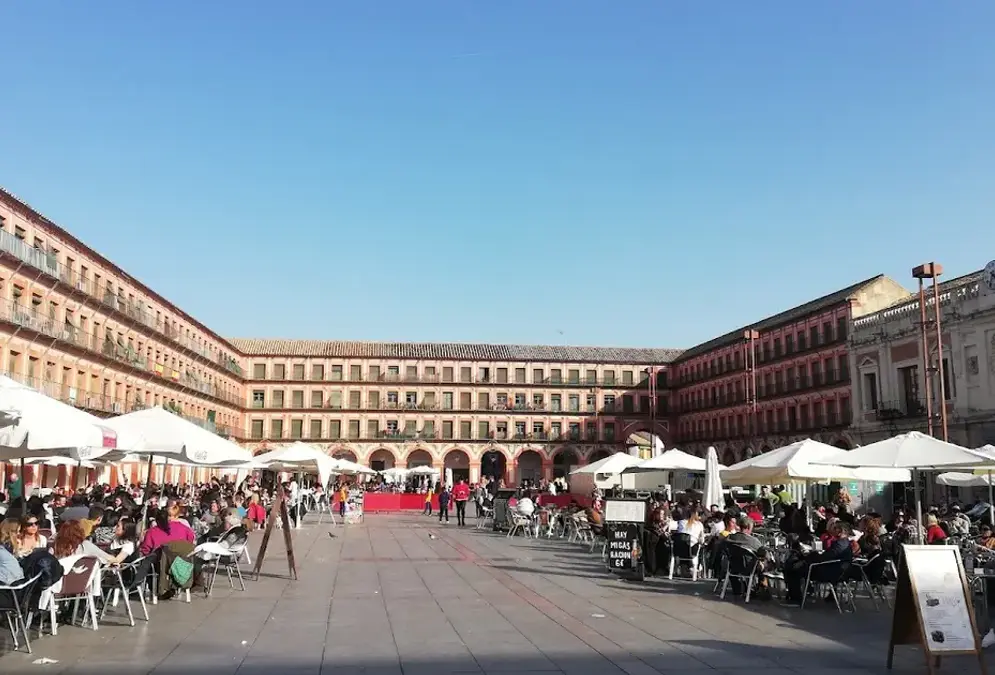
Explore nearby · Monument
Plaza de la Corredera
Andalusia's only Castilian arcaded square, built in 1683 over a Roman forum. Once a bullfighting ring, now lined with bar terraces and a Sunday flea market.
This remains a theory, not a documented origin. (Wikipedia) No 16th-century recipe calls the dish flamenquín, and the Carlos I court predates the modern preparation by several centuries. What the etymology explains is the name, not the dish's specific culinary history. It is also not the only theory in circulation — some tellings favour the flamingo-shape explanation instead, covered in the flamenquín dish page's FAQ.
The origin dispute: Bujalance versus Andújar
Here is where the story gets awkward. Córdoba claims the dish. So does Andújar, a town 75 kilometres to the northeast in Jaén province. Both claims have specific names attached.
The Córdoba-Bujalance claim rests on research by Alejandro Ibáñez, a gastro-archaeologist at the University of Córdoba. Ibáñez traces the dish's roots to Bujalance, a town in the eastern part of Córdoba province, among the first Christian settlers who arrived after the Reconquista. (TasteAtlas) The modern standardised version, he argues, came together in Córdoba's city-centre tabernas in the 1960s, when the dish acquired its current fixed form. (CordobaFreeTour)
The Andújar claim is more specific and more recent. According to local accounts, flamenquín was invented in the early 1940s at a bar called Madrid-Sevilla in Plaza del Sol in Andújar, credited to chefs Manuel Gavilán and Antonio Penalva. The timing is post-Civil War: 1939 or shortly after, when bar food in Andalusia was shaped by scarcity and the need to make cheap protein go far.
Recommended tours
Tours are selected for quality, not commission. We earn a small fee if you book — at no extra cost to you.
Both stories are plausible. Both are also impossible to verify with the certainty that would settle the argument. What the dispute reflects is something familiar across Andalusian food history: dishes that developed organically across a region, in multiple places simultaneously, eventually acquire a single named birthplace because that is what food tourism requires. The rabo de toro origin story has similar complications.
For what it is worth, Córdoba's claim has wider international recognition, and the dish is firmly embedded in the city's culinary identity in a way that Andújar's bar culture never achieved. The 1960s Córdoba taberna standardisation is the moment that gave flamenquín its fixed recipe and its profile as a signature tapa.
How it is made: the traditional recipe
The preparation is not technically difficult, but it requires attention at two points: the pound and the fry.
Start with pork loin cut about 1.5 centimetres thick, then pounded flat with a meat mallet until it is roughly 3 millimetres. Thin enough to roll, thick enough to hold together. Lay slices of jamón serrano across the surface, leaving a centimetre clear at one edge. Roll from the opposite edge, pressing as you go, then secure with two or three toothpicks.
The breading process uses beaten whole eggs, not egg wash with milk. Just eggs. The roll is dipped, drained briefly, then coated in fine pan rallado (breadcrumbs). Some Córdoba kitchens use a double coating: egg, breadcrumbs, egg again, breadcrumbs again. The second coat thickens the crust and gives it more structure.
Olive oil needs to be hot. If the oil temperature drops below 170°C when the roll goes in, the breadcrumbs absorb oil instead of crisping. The result is heavy and greasy rather than light and cracking. Most tabernas fry at 180°C and turn the roll once at the halfway point. Total fry time: three to four minutes for a full-size piece.
The roll comes out deep golden, rests for thirty seconds, and goes straight to the plate. Remove the toothpicks before serving. Serve immediately. A flamenquín that has been sitting for ten minutes under a heat lamp is not a flamenquín that anyone should order twice.
Authentic cordobés style has no cheese. This point is worth making directly. Contemporary bars in Córdoba and elsewhere offer versions with semicurado cheese melted inside, and they are popular enough. But the traditional recipe, the one from the taberna culture of the 1960s, is pork and ham, nothing else. Order the version without cheese if you want to taste what the dish actually is.
Variations and what they reveal
The oldest split is size. Full-size flamenquín, the length of a hand, is a ración or a main course. Mini pinchos, two bites each, are bar food: ordered three at a time with a glass of Montilla-Moriles, eaten standing at the counter. The small version is not a dilution; it serves a different purpose.
The cheese variation (jamón serrano plus semicurado cheese in the filling) became widespread from the 1990s onwards. It is now the version most non-Cordoban Spaniards picture when they hear the word. Some bars also use manchego or a mild local cheese. The cheese melts during frying and makes the interior richer and softer. The question of whether this counts as a legitimate flamenquín or a popular modification depends entirely on who you ask.
Other filling experiments include:
- Roasted red peppers with or without cheese (vegetarian-leaning)
- Chorizo or other cured meats alongside the jamón
- Chicken breast or veal in place of pork loin
| Version | Filling | Historical? | Where to find it |
|---|---|---|---|
| Classic cordobés | Pork loin + jamón serrano | Yes (1960s standard) | Traditional tabernas |
| Con queso | Pork loin + jamón + cheese | No (1990s onwards) | Most bars and tourist spots |
| Vegetariano | Roasted peppers, mushrooms | No (recent) | Modern restaurants |
| Mini pinchos | Classic filling, small size | Yes (parallel tradition) | Bar counters citywide |
| Pollo | Chicken breast, various fillings | No | Tourist menus |
None of these have the historical legitimacy of the original. Chicken flamenquín in particular appears on tourist menus as a lighter option, and while there is nothing wrong with it as a fried roll, calling it a flamenquín cordobés is a stretch.
The version worth ordering on a food tour in Córdoba is the straightforward one. The original recipe does not need improvement.
Where to eat flamenquín in Córdoba
The safest rule: avoid anywhere that lists it as 'traditional Andalusian food' alongside fifteen other things. Flamenquín done well requires the kitchen to be frying to order and serving immediately. It is not a dish that holds.
In the Judería, the tourist density is high enough that some bars optimise for volume over quality. The tells are familiar: a flamenquín sitting under a heat lamp, a cheese-heavy version labelled 'authentic,' an inflated price tag for a ración that turns out to be a shortened version. Not all of them are bad, but the odds require some scepticism.
The better addresses tend to be:
- Bars on or near Calle San Francisco and the surrounding lanes, where the local lunch crowd sets the standard
- Any taberna that also serves proper rabo de toro and writes its own price list on a chalkboard
- Neighbourhood bars in La Magdalena or San Lorenzo outside the tourist radius, where flamenquín is priced reasonably for a full ración rather than at inflated tourist prices
Deep dive · Article
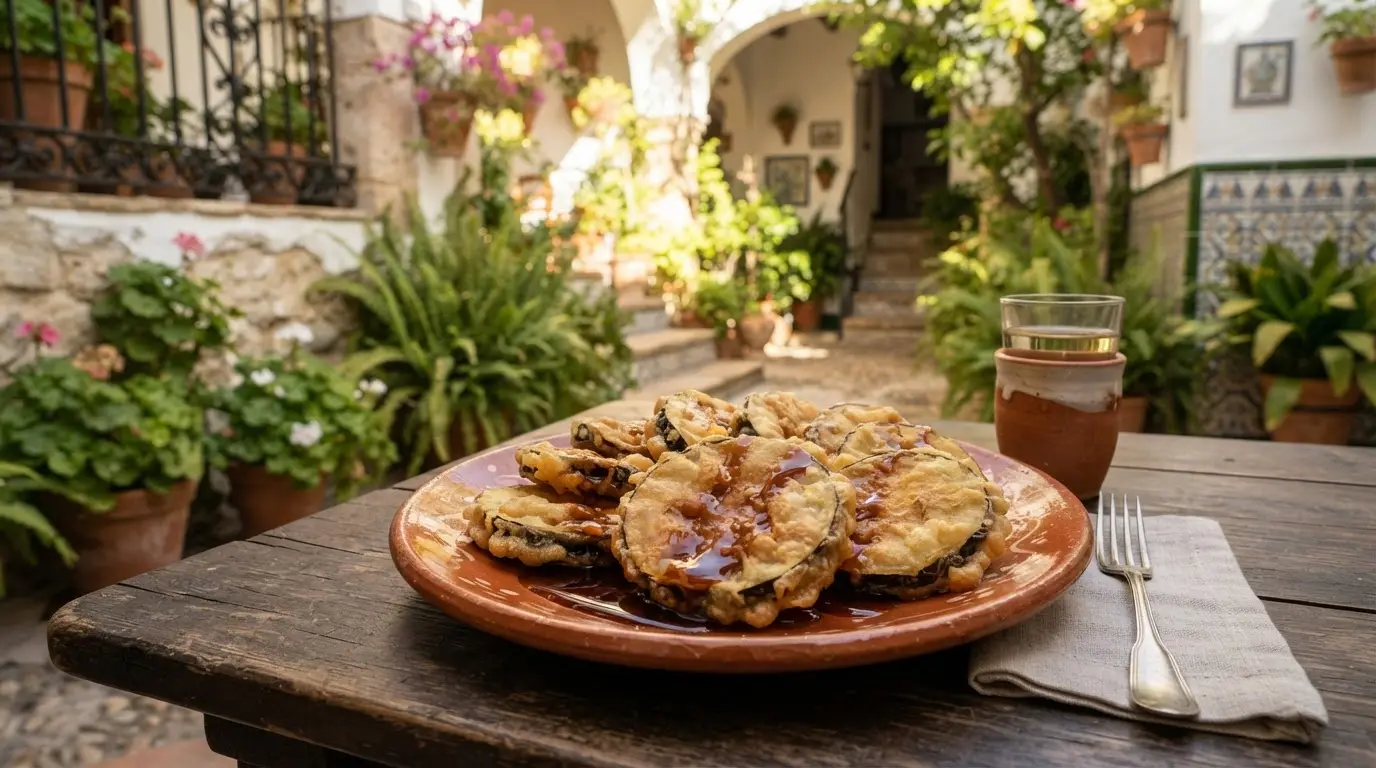
Berenjenas con Miel — Moorish Roots of Córdoba's Sweetest Tapa
The Moorish origin of berenjenas con miel traces to 8th-century Al-Andalus, where fried aubergines and honey defined sweet-savoury cooking in Córdoba.
Ask for it recién hecho (just made). Any kitchen worth its oil will fry it fresh. If they cannot, go somewhere else. After seven years of ordering flamenquín across the city, I judge one by ear before I judge it by taste: a fresh roll cracks the moment the knife goes in, a thin curl of steam and ham fat escaping through the cut. A tired one just gives, soft and quiet, no resistance at all.
The best time to order it is lunchtime, between 1:30pm and 3pm, when the kitchen is at full speed and the oil temperature stays consistent. A flamenquín ordered at 7pm for early dinner is not working against prime conditions. A cooking class in Córdoba will teach you to make it at home, which guarantees you are eating it at exactly the right moment.