Updated August 2026
What to do in Córdoba when it rains
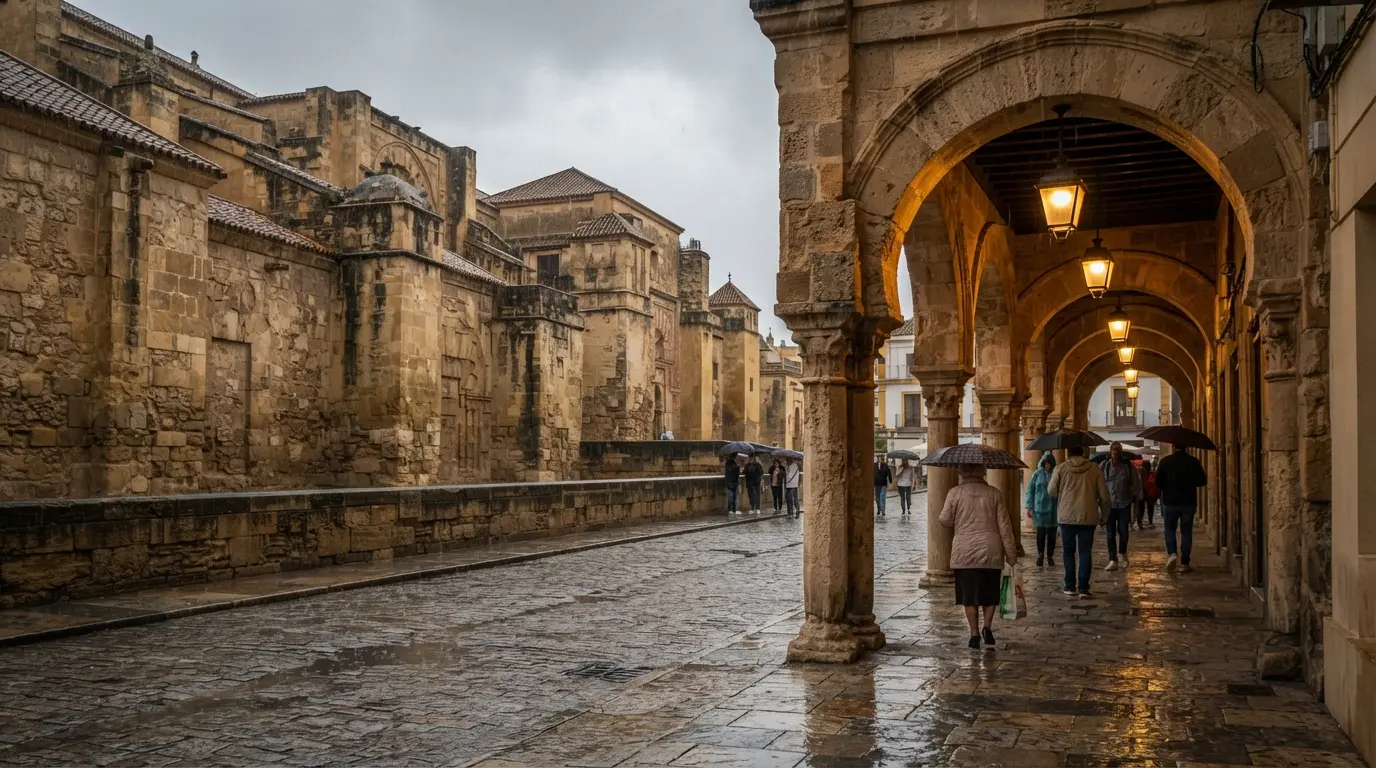
The Mezquita's whole route runs under one roof, two museums share a building, the hammam takes bookings all day. A washed-out day still fills itself.

Written by
María Fernanda González Ten years covering Córdoba's UNESCO heritage sites, sourcing from Junta de Andalucía documentation.
Published
Mezquita free
Mon–Sat 8:30–9:30am
Access cut off at 9:20
Monday trap
All 3 museums shut
Monuments stay open
Hammam sessions
Every 2 hrs, 11am–9pm
Book ahead on wet days
One roof, dinner too
Mercado Victoria
Open till 1am (2am Fri/Sat)
In this guide
Jump to a section
If it's raining right now: the top three picks
This page answers one question: it's wet outside and you're here today. The good news is that Córdoba's compact centre puts almost everything indoors within a 15-minute walk. These three absorb the most time for the least exposure.
Pick 1 Mezquita-Cathedral
The entire visit is indoors: the forest of 856 columns and double horseshoe arches sits under one vast roof, and the cathedral nave is vaulted. It's also the city's biggest single time sink at 60–90 minutes, which is exactly what you want when outdoor plans collapse. Buy online or arrive for the free window, Mon–Sat 8:30–9:30am.
Pick 2 Hammam Al Ándalus
Rain outside is what makes a hot-water ritual inside feel earned rather than indulgent. Sessions run at fixed times, so unlike museums they let you plan the whole day backwards from a 13:00 or 17:00 bath. It sits two minutes' walk from both the Mezquita and Plaza del Potro.
Pick 3 Julio Romero de Torres + Museo de Bellas Artes
Two museums under one roof at Plaza del Potro: Córdoba's Symbolist painter in his purpose-built museum (€4), and the fine-arts collection next door in the former Hospital de la Caridad. They open late (until 20:00 Tue–Fri in winter schedule), so they absorb any hour of a washed-out afternoon. Only if it isn't Monday.
One boundary note: everything below is about rescuing a single soggy day. If you're planning a winter trip rather than salvaging today, read our guide to Córdoba in winter instead; it covers temperatures, crowd levels and what the city feels like month by month.
The indoor monument circuit
Three monuments carry a full rainy morning between them, and none of the route needs more than a few minutes of exposure at a stretch.
Mezquita-Cathedral: the anchor
Every step of the visitor route is under cover, from the caliphal prayer hall to the Gothic-Renaissance nave. General admission is €15 (reduced €12 for over-65s and students aged 15–26), bought online or at the Patio de San Eulogio reception centre. Two queue-free entry windows matter on any weather day: online-ticket holders largely bypass the ticket line, and the free slot runs Monday to Saturday, 8:30–9:30, with access cut off at 9:20 sharp. Last admission is 30 minutes before closing, and published hours shift with seasons and event days, so check the official site the same morning. Our Mezquita tickets guide walks through both routes, and the full timetable lives in our opening-hours table. One detail: the Patio de los Naranjos is open-air, so if there's a dry gap when you arrive, walk the courtyard first and save the covered halls for after.
Synagogue: 15 dry minutes in the Judería
Entirely indoor and tiny: the square prayer hall measures under 40 m², which makes this a 15-minute stop between bigger shelters. Entry is free (non-EU visitors pay €0.30), open Tuesday to Sunday, 9:00–15:00, closed Mondays except holiday eves. The 1314–15 building's Mudejar plasterwork rewards a slow look, and the walk from the Mezquita is about 450 m through alleys narrow enough to stay mostly dry in drizzle.
Torre de la Calahorra: the "if the rain pauses" option
The Museo Vivo de al-Andalus inside the 12th-century fortress is fully indoors across several floors, ending on a covered viewpoint over the river. Tickets are €4.50 (€3 reduced) and it opens daily, Mondays included, which makes it the fallback when the museums are shut. The catch in steady rain: reaching it means crossing the exposed Roman Bridge. Go during a dry pause, or take a taxi or bus along Campo de la Verdad.
Museums & galleries: mind the Mondays
All three city art and archaeology museums close on Mondays. Julio Romero de Torres shuts every single Monday of the year; Bellas Artes and the Archaeological Museum close Mondays except the eve of a public holiday. On a rainy Monday, lean on the monument circuit above, the hammam and the market.
The other six days of the week, the trio covers a full afternoon easily. Full reviews and practical details are in our guide to Córdoba's museums; the essentials for a wet day:
- • Museo Arqueológico de Córdoba: built around the visible basement of a Roman theatre, fittingly in a gallery that has flooded in heavy rain before. Winter schedule (16 Sep–15 Jun): Tue–Sat 9:00–21:00, Sun 9:00–15:00; summer shortens to mornings.
- • Museo de Bellas Artes: Andalusian painting in the former Hospital de la Caridad, sharing the building (and the entrance plaza) with Julio Romero. Same Junta hours family: winter Tue–Sat 9:00–21:00, Sun 9:00–15:00.
- • Museo Julio Romero de Torres: the city's signature painter, his dark Symbolist portraiture best seen in dim weather anyway. €4 entry; winter hours run Tue–Fri 8:15–20:00, Sat 9:30–18:00, Sun to 14:45. Free windows Tue–Sat 18:00–20:00 and Sun/holidays 17:00–19:00. Capacity is capped, so buying ahead is wise on busy days.
A practical pairing: Julio Romero and Bellas Artes face the same small square, so treat them as one visit with a coffee break between. In winter schedule the Archaeological Museum's 21:00 close makes it the late-evening option if the day started badly.
“The best place to watch rain in Córdoba is from somewhere the rain cannot reach.”
Hammam Al Ándalus: the natural rainy-day anchor
Of everything on this page, the hammam converts the worst part of a wet day into the best one. Warm stone, steam and silence while rain drums on the Judería outside is the whole argument, and it doesn't need embellishing. What matters practically is that the hammam ritual is timed, unlike museums: sessions start roughly every two hours at 11:00, 13:00, 15:00, 17:00, 19:00 and 21:00, which lets you sequence the rest of the day around a booked slot. The hydrotherapy circuit moves you through the caldarium, tepidarium and frigidarium; massages cost extra on top of bath packages.
Find it at C/ Corregidor Luis de la Cerda 51, between the Mezquita and Plaza del Potro, i.e. inside the sheltered triangle this whole plan runs on. Book a specific session online in advance. On bad-weather days walk-in availability shrinks fast, because everyone stuck in the city has the same idea. Package prices change often enough that we'd rather send you to the official booking page than print a number: confirm current rates there before you go.
Book the rainy-day hammam session
Hammam Al Ándalus runs its full session schedule in any weather, so reserve your slot before wet days fill up.
Tours are selected for quality, not commission. We earn a small fee if you book — at no extra cost to you.
Covered market lunch and the bar-hopping fallback
Mercado Victoria is the zero-exposure lunch in town. It occupies a late-19th-century wrought-iron pavilion, the old Feria caseta of the Círculo de la Amistad, in the Jardines de la Victoria about five minutes' walk west of the historic centre. Under one roof you get roughly 30 stalls: salmorejo, flamenquín and rabo de toro alongside sushi, oysters and an Argentine grill. Hours suit a ruined schedule too: kitchen service runs Sunday–Thursday from midday to 01:00, Friday and Saturday to 02:00, with cafeteria breakfasts from 09:00. It was Andalusia's first gourmet covered food market, and on a grey afternoon the iron-and-glass hall fills with exactly the people who cancelled their walking plans.
If you'd rather keep the classic tapas format, swap the cross-town crawl for a vertical tapas crawl: pick one street with continuous awnings or arcades, around Plaza del Potro and Calle Rodríguez Marín near the museums, and commit to three stops within 200 m instead of crossing town between bars. Where to stop and what to order at each is our Córdoba tapas guide's job; the rain rule here is simply fewer metres, more courses.
One rainy day in Córdoba: hour-by-hour plan
A workable sequence assuming the rain is steady rather than torrential. Distances are short: Mezquita to Synagogue is about 450 m, Synagogue to hammam about 400 m, Plaza del Potro to Mercado Victoria 1.1 km (bus lines along Ronda de los Tejares or a short taxi ride keep even that leg dry).
08:30–10:00
Mezquita-Cathedral: free window (Mon–Sat) or first slot with a pre-bought ticket. Start here whatever the sky is doing; the entire route is under roof.
10:00–10:30
Coffee under the arcades near the east side of the Mezquita / Puerta del Puente: under 200 m of total exposure, and terraces cluster their awnings here.
10:30–11:30
Judería and Synagogue (free, 15 minutes). The alleys stay mostly dry in drizzle; if a real shower hits, duck into the Casa Andalusí.
11:30–14:30
Hammam Al Ándalus, booked for the 13:00 session. Prefer museums? Push the bath to 17:00 and take the museum block now instead.
14:30–16:00
Long lunch: Plaza del Potro tabernas, or in steady rain head to Mercado Victoria's 30 stalls under one roof.
16:00–20:00
Museum block (never on a Monday): Julio Romero de Torres plus Bellas Artes together at Plaza del Potro, or the Archaeological Museum, open until 21:00 in winter schedule.
Evening
Sojo Mercado cocktails inside the market pavilion, or the three-stop vertical crawl on one awned street. The market keeps serving past midnight on Fridays and Saturdays.
Practical tips for a wet day
- • Rainfall seasonality works in your favour: Córdoba collects about 573 mm a year, most of it between October and April, with December the wettest month (around 91 mm) and July effectively dry at 0.5 mm. A rained-out summer day is a genuine rarity.
- • Check the Mezquita's hours the same morning; they change with seasons and special events, and last entry is 30 minutes before closing.
- • Book the hammam session before you set out, not when you arrive. Wet-day capacity goes first.
- • If today is a Monday, skip the museum block entirely: the monuments, the tower, the baths and the market are your day.
- • Cobblestones in the Judería turn slick fast. Shoes with actual grip beat sandals, whatever the season.
Frequently asked questions
Is Córdoba worth visiting in the rain?
Yes, with one adjustment: shift the weight of the day indoors instead of cancelling. The city's headline sight, the Mezquita-Cathedral, keeps its whole visitor route under one roof, and the second tier (museums, synagogue, hammam, covered market) is unusually dense for a city this size. Rain also thins the day-tripper queues. The honest caveat: the patios, the Roman Bridge and Medina Azahara are open-air, so save those for a dry spell or another trip.
Which Córdoba monuments are indoors?
Fully roofed: the Mezquita-Cathedral visitor route, the Synagogue (tiny, 15 minutes), the Torre de la Calahorra's Museo Vivo de al-Andalus museum, and the vaulted bath chambers of Hammam Al Ándalus. Partially exposed: the Alcázar de los Reyes Cristianos (the gardens are the point) and Palacio de Viana's patios, which are open-air by design.
Is the hammam open when it rains?
Yes. Hammam Al Ándalus runs its normal timed sessions (roughly 11:00, 13:00, 15:00, 17:00, 19:00 and 21:00) in any weather. The baths sit in vaulted, cave-like chambers where rain is irrelevant. Book your session time ahead on wet days: walk-in availability shrinks fast because everyone else has the same idea.
What museums close on Mondays in Córdoba?
The big three all close on Mondays: the Museo Julio Romero de Torres (every Monday of the year), plus the Museo de Bellas Artes and the Museo Arqueológico (both except the eve of a public holiday). A rainy Monday still leaves you the Mezquita, the Synagogue, the Calahorra Tower, the hammam and Mercado Victoria.
Is the Mezquita-Cathedral good on a rainy day?
Arguably better than on a sunny one. The columned prayer hall is completely covered, the dim light suits the building, and crowds drop. Use the free window, Monday to Saturday 8:30–9:30 (access cut off at 9:20), or buy a ticket online to bypass the ticket line. The Patio de los Naranjos is open-air, so walk it first if there's a dry gap.
Does it rain much in Córdoba?
No. Córdoba averages about 573 mm of rain a year, concentrated between October and April. December is the wettest month (around 91 mm) and July is nearly bone-dry (0.5 mm). Summer rain is rare enough that a wet day in July or August is genuinely exceptional; the showers most likely to trigger this guide arrive in autumn and spring.
What can you do in Córdoba on a rainy evening?
More than in most cities this size. Mercado Victoria serves food until 01:00 (02:00 on Friday and Saturday), with the Sojo Mercado cocktail bar going later. The Julio Romero de Torres museum runs free evening hours Tuesday to Saturday from 18:00 in winter schedule. And the hammam's 19:00 and 21:00 sessions cover the night owls.
Further reading
Official sources
6 references Show Hide
- Mezquita-Catedral de Córdoba (opens in a new tab)
Official ticket prices, the free 8:30–9:30 window and last-admission rules
- Junta de Andalucía — Museos (opens in a new tab)
Opening hours and Monday closures for the Bellas Artes and Archaeological museums, plus the Synagogue
- Museo Julio Romero de Torres (opens in a new tab)
Year-round Monday closure, seasonal hours and free-entry windows
- Torre de la Calahorra (opens in a new tab)
Daily opening hours and ticket prices for the Museo Vivo de al-Andalus
- Hammam Al Ándalus Córdoba
Official booking portal for timed sessions, address and phone
- Mercado Victoria (opens in a new tab)
Official market hours, breakfast service and stall information