Self-guided · 45–90 min · Free to walk
Judería Solo Morning Walk
The Jewish Quarter between 8 and 10 am: empty lanes, low light on whitewashed walls, and a 14th-century synagogue that costs thirty cents to enter. A 600-metre circuit through the oldest part of the city.
Judería neighbourhood guide
Best: 8–10am · ~600m circuit

Written by
María Fernanda González Ten years covering Córdoba's UNESCO heritage sites, sourcing from Junta de Andalucía documentation.
Updated Published
On this page
Jump to a section
At a glance
8–10am best window
~600m walking circuit
€0.30 Sinagoga entry (free EU)
5 stops 45–90 min total
Why mornings work in the Judería
The Judería is Córdoba's most visited neighbourhood and also its most compact, just four blocks wide at most. By 10:30 am in high season, the lanes around Calleja de las Flores fill with guided groups moving in clusters of thirty. The same streets at 8:30 am have birdsong and the smell of bread from the café on Plaza del Potro.
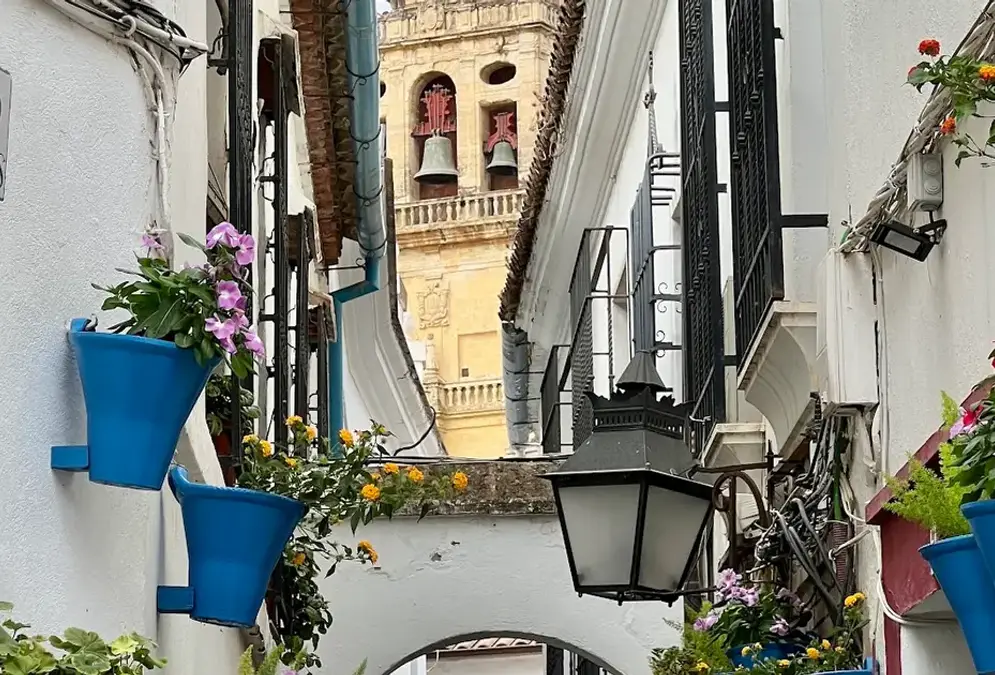
The Mezquita opens at 8:00 am. Tour buses from Seville and Granada don't arrive until 10:00 am at the earliest. That two-hour gap is yours. The light at this time of day is horizontal and warm, landing at an angle that makes the whitewashed walls look almost amber. Calleja de las Flores (the alley that gets a thousand identical photographs every day) looks different at 8:45 am than at 11:00 am, and it's not just the crowds.
Solo travel suits this neighbourhood particularly well. The lanes are disorienting in a pleasant way: you will get briefly turned around, then pop out somewhere you recognise. The Mezquita's campanario is visible above the rooflines from most of the quarter and works as a compass bearing. You're never more than four minutes from a street you know.
Use the tower as your compass
The Mezquita's bell tower (built on the original minaret) is visible above the rooflines from most of the Judería. If you lose your bearings in the narrow lanes, look up, find the orange-and-white tower, and you'll know which direction to walk.
Starting point: Plaza de Tiberíades
Start at Plaza de Tiberíades, the small square where the bronze statue of Maimonides sits. Maimonides (philosopher, physician, and one of the great intellectual figures of medieval Judaism) was born in Córdoba in 1138, in a house a few streets from here. The statue has a worn left foot: locals and visitors rub it for good luck, a tradition that has become genuinely ingrained in how Cordobans relate to the square.
From the Maimonides statue, Calleja de las Flores is a five-minute walk north along Calle Judíos. The route is straightforward: stay on Calle Judíos past the ochre doorway of the Sinagoga, then turn right at the first narrow lane you reach. You'll see the geraniums before you see the alley sign.
Getting to the starting point
- From the train station: 20 minutes on foot south along Avenida del Gran Capitán, then into the historic centre. Or bus line 3 to the Mezquita stop.
- From the Mezquita: Plaza de Tiberíades is a three-minute walk west. Head towards the Alcázar, turn right on Calle Judíos, and the square is on your left.
- Parking: Cars cannot enter the Judería. The nearest parking is at the Alcázar underground car park on Avenida del Alcázar.
The route: five stops
The full circuit covers roughly 600 metres and takes 45 to 60 minutes without stops inside. Add time for the Sinagoga (15–20 minutes) and Casa de Sefarad if you choose it (45 minutes). The stops are close enough that you can decide at each one whether to go in or move on.
01
Calleja de las Flores · 5 min from start
The most photographed alley in Córdoba. Terracotta pots of geraniums line both sides; at the far end, the Mezquita's bell tower frames the view. Visit before 9:30 am to have any chance of an unobstructed frame. After that the crowd builds fast.
It's a dead end, so you'll come back out the way you went in. That's fine; the lane looks different on the return walk, with the light at a different angle and the tower behind you.
02
Sinagoga de Córdoba · 3 min walk · opens 9am
Built in 1315, the Córdoba synagogue is one of only three medieval synagogues surviving in Spain; the other two are in Toledo. The building is small: a single prayer hall, an upper women's gallery, and a courtyard. The Mudejar plasterwork in the upper gallery is the detail worth slowing down for: geometric interlace patterns and Hebrew inscriptions cut into white stucco.
Admission: €0.30 for non-EU visitors, free for EU citizens. Opens at 9:00 am Tuesday to Saturday, 9:00 am to 3:00 pm Sunday. Closed Monday. Time your walk to arrive here after the Calleja.
03
Casa de Sefarad · 3 min walk · optional · €4
Jewish cultural museum in a 14th-century house on Calle Judíos, formerly connected to the Synagogue by an underground passage. Nine thematic rooms trace seven centuries of Sephardic life in Córdoba: music, ritual objects, costume, the Inquisition, the 1492 expulsion, and the Sephardic diaspora.
If you're short on time: skip it and return on another morning when you have more time. The Sinagoga is the non-negotiable stop on this route.
04
Zoco Municipal · 5 min walk · free to browse
Craft market in a whitewashed courtyard off Calle Judíos. Leather goods, ceramics, silverwork, and hand-painted tiles. Vendors set up in the mornings; the courtyard is peaceful before the day heats up. Free to enter and browse; prices are fixed, not haggled. A good place to look for something small and not airport-generic.
05
Plaza Judas Leví · final stop
Small square with a central fountain and stone benches. Named after the medieval Hebrew poet Judah Halevi. Still quiet at this hour before the café chairs scrape and the school groups arrive. A good place to sit and decide where to go next: the Alcázar is ten minutes south, the Mezquita five minutes east.
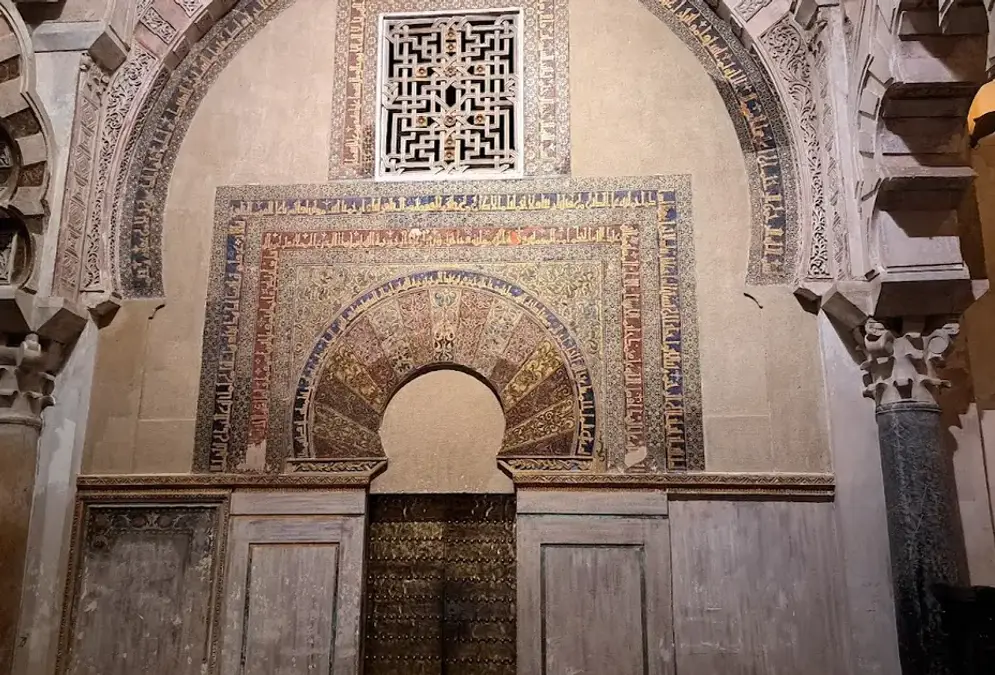
The Sinagoga de Córdoba, built in 1315. One of only three medieval synagogues still standing in Spain. Admission €0.30, one of the best-value entries in the city.
Coffee stop
Café Sociedad Plateros on Plaza de San Francisco (five minutes east of the Judería) is where Cordobans go for breakfast. A café solo costs €1.80. The pastry case has tostadas with tomato and oil, and the odd slice of pastel cordobés (the local puff pastry filled with cidra). Marble counter, high ceiling, slightly sticky floors. Open from 7:30 am.
Alternatively, the small café on the corner of Calle Judíos and Calle Deanes opens at 8:00 am and is the closest option to the walking route. The coffee is good. The terrace has four tables and fills up by 9:00 am.
Breakfast culture in Córdoba
Most Cordobans have breakfast between 9:00 and 10:30 am: a tostada and a coffee, standing at the bar or at a small table. Sitting at a restaurant terrace and ordering a full English-style breakfast is a tourist-only pattern. Follow local habits: stand at the bar, order a café con leche and a tostada con tomate, pay €2–3, move on. It works better than it sounds.
“The lanes are disorienting in a pleasant way. You will get briefly turned around, then pop out somewhere you recognise.”
Photography notes
The Judería produces good photographs all morning, but the window for the Calleja de las Flores is specific. Morning light enters the alley from the east between roughly 8:30 and 9:30 am, landing on the geraniums and the Mezquita tower simultaneously. After 9:30 am the light angle shifts and the direct illumination is gone. After 10:00 am, there are enough people in the frame that you're shooting around them rather than the place.
Best shots on this route
- Calleja de las Flores: Shoot from the entrance looking in. The tower fills the frame at the end of the alley. Use a 35mm or 50mm equivalent; anything wider distorts the proportions.
- Sinagoga courtyard: The small patio outside the main door catches good morning light before 10:00 am. Ochre walls, terracotta pots, iron gate.
- Calle Judíos at 8:30 am: The lane itself is the photograph: empty, white walls, the light barely awake. Walk it slowly and look up at the ironwork balconies.
Practical notes
- Golden hour starts late in Córdoba; the old town faces west, so the best morning light in the Judería is soft and indirect, not harsh. This is good for colour and detail.
- In July and August, the sun rises early and the light in the alley is already strong by 8:30 am. Aim for 7:45–8:15 am in high summer.
- Many of the whitewashed walls and patios along the route still belong to residents. Don't block doorways or photograph through open windows.
Practical logistics
The Judería is built for walking and doesn't require much preparation. A few specifics worth knowing before you go:
Opening hours (key stops)
- Mezquita-Catedral From 8:00 am daily
- Sinagoga de Córdoba 9:00 am (closed Mon)
- Casa de Sefarad 10:00 am daily
- Zoco Municipal 10:00 am (mornings)
Entry costs
- Walking the route Free
- Sinagoga (non-EU) €0.30
- Sinagoga (EU citizens) Free
- Casa de Sefarad €4
For a fuller morning, the walk pairs naturally with the Mezquita. If you plan to go inside, the Mezquita-Catedral opens at 8:00 am; the first 90 minutes are the least crowded of the day. Do the Judería circuit first, then the Mezquita, and you'll be done by 11:00 am before the heat builds and the buses unload. For the full picture of how day-tripper schedules create quiet windows across the city — including the Alcázar and neighbourhood rhythms beyond the Judería — see the slow travel timing guide.
If you want a guided perspective before or after doing the route solo, a free walking tour of the Judería runs daily and covers the same ground with a local guide. Pay at the end what you think it was worth.
Frequently asked questions
Is the Judería safe for solo travellers?
Yes. The Judería is one of the safest parts of Córdoba at any hour. The lanes are active during the day and well-lit at night. The main thing to watch is pickpocketing around the Mezquita entrance during peak season (April to June), the same as anywhere with heavy tourist foot traffic. For a broader picture of safety in Córdoba, see the safety tips guide.
How long does a solo Judería walk take?
The walking circuit itself is about 600 metres and takes 45 to 60 minutes at a relaxed pace. Add 20 to 30 minutes if you go inside the Sinagoga, and another 45 minutes if you visit the Casa de Sefarad. Most solo travellers do the full circuit, including the Sinagoga, in under 90 minutes.
What time should I visit the Judería?
Between 8:00 and 10:00 am. The Mezquita opens at 8:00 am and tour buses start arriving around 10:00 am. In those two hours the lanes are quiet, the light is low and angled, and Calleja de las Flores is empty enough to photograph without strangers in the frame. Early evening after 6:00 pm is the other good window.
Is the Córdoba Sinagoga worth visiting?
Yes, especially at this price. Admission is €0.30 for non-EU visitors and free for EU citizens. The 14th-century synagogue is one of only three medieval synagogues still standing in Spain. The Mudejar plasterwork in the upper gallery takes about ten minutes to look at properly. It opens at 9:00 am, so time your route to arrive there after the Calleja.
What's the easiest way not to get lost in the Judería?
Keep the Mezquita tower visible overhead as your compass bearing. The quarter is only about four blocks wide, so a wrong turn puts you into the same pocket of streets rather than sending you far off course. If you lose your bearings, head for the orange-and-white tower; you'll be back on the map within a minute.
Planning your morning in the Judería?
The route takes 45 to 90 minutes depending on how many stops you go inside. Arrive by 8:30 am for the best light at Calleja de las Flores and an empty Sinagoga.
Further reading
Official sources
3 references Show Hide
- Sinagoga de Córdoba: official Junta de Andalucía page (opens in a new tab)
Opening hours, admission prices, and accessibility information
- Casa de Sefarad: official site (opens in a new tab)
Museum information, opening hours, and cultural programming
- Córdoba Tourist Office (opens in a new tab)
Official tourism information for Córdoba including the Judería