
The dish you cannot order in a restaurant
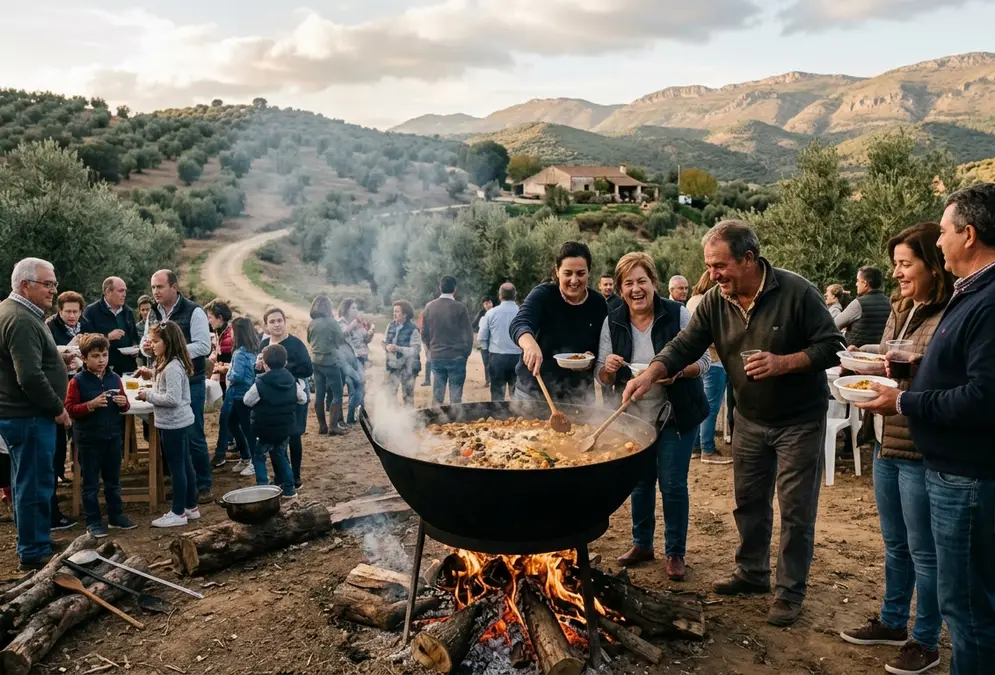
Ask a Córdoba local what the perol cordobés is and you will get two answers. The first is that it is a hemispherical metal cooking pot, wider at the top, somewhere between a paella pan and a wok in profile. The second, given with slightly more impatience, is that it is an all-day outdoor gathering in the countryside where that pot is the centrepiece.
You will not find it on a restaurant menu. That is not an accident. The dish exists, and it is worth knowing what goes into it before you search for it in the wrong places. Rice, saffron, olive oil, a variable combination of chicken, rabbit, and vegetables, sometimes cured meats. But the perol cordobés as a dish is inseparable from the event that produces it. Ordering a restaurant plate of rice and calling it a perol is like ordering a takeaway curry on New Year's Eve and claiming you had the party.
What makes this worth understanding for anyone visiting Córdoba is that it clarifies something about the city's relationship with food. Córdoba does not only eat. It uses food as the architecture of social occasions. The perol is the clearest example of this, and it runs deeper than any individual recipe.
A 2021 study on food patrimony presented by the Cátedra de Gastronomía de Andalucía found that only 6% of respondents in Córdoba city have never attended a perol gathering — a figure that places participation close to universal among the city's adult population[4]. That number would be unremarkable if the same were true of, say, gazpacho. But gazpacho does not require fifty people, a field, and a morning's worth of collective cooking to exist. The perol does.
6%
San Rafael Day and Córdoba's October 24 date
The perol season opens on October 24. That date matters more to Córdoba than to anywhere else in Spain. The archangel Raphael is venerated across the country, but most regions celebrate his feast on September 29. Córdoba celebrates on October 24, a date it retained from the pre-1969 universal liturgical calendar rather than adopting a dispensation unique to the city; a handful of other Spanish towns, such as Hellín, kept the same older date. What made Córdoba's observance stick was crediting San Rafael Arcángel with protecting it from a historic epidemic.
The formal vow came in 1651. The city council and church authorities made a civic pledge to observe the day permanently after the plague had passed without the scale of devastation seen in other Andalusian cities. Whether San Rafael actually intervened is a matter of faith; what is historical fact is that Córdoba has been marking October 24 ever since, and that this date became the anchor for the perol tradition.
The practical effect is that Córdoba empties into its surroundings every October 24 in a way that surprises visitors who arrive without knowing what day it is. Los Villares, the Sierra Norte hills north of the city, fills with smoke from a hundred fires before noon. The Arenal enclosure on the eastern edge of the city, where Córdoba's municipal government provides tents, portable toilets, fencing, and waste infrastructure for the occasion, hosts dozens of simultaneous perol gatherings across several hectares of ground.
Explore nearby · Monument
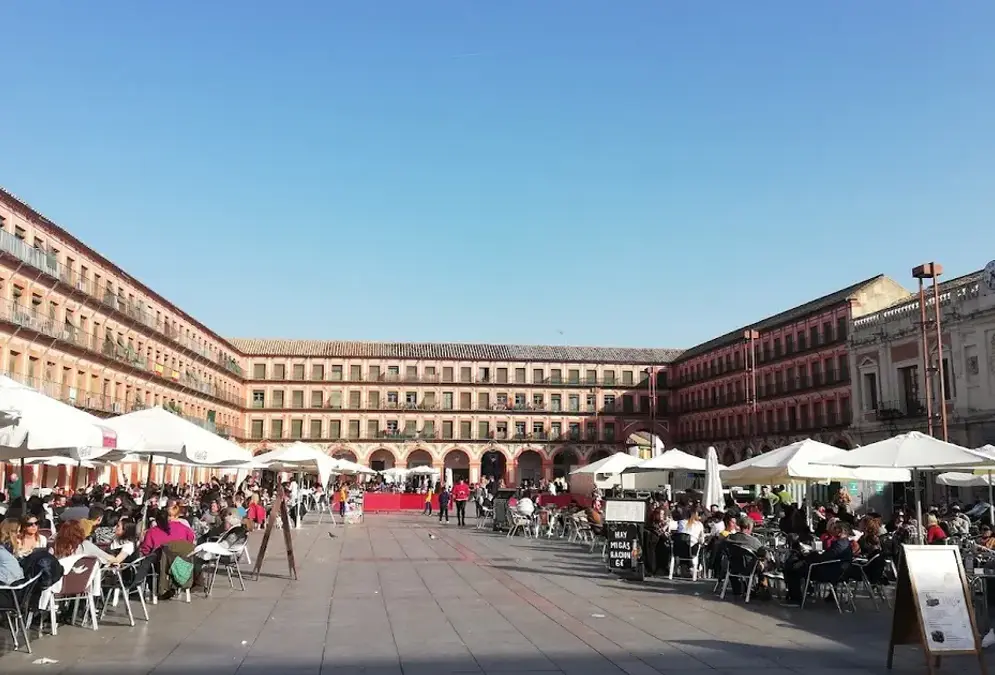
Plaza de la Corredera
Andalusia's only Castilian arcaded square, built in 1683 over a Roman forum. Once a bullfighting ring, now lined with bar terraces and a Sunday flea market.
This is not a tourist event. There are no tickets, no guides, no organised programme. It is simply what families in Córdoba do on this day, and have been doing since before anyone kept records of it.
San Rafael's presence in Córdoba is visible year-round. Statues of the archangel appear at several of the city's historic bridges and gate arches, including the Triunfo de San Rafael column in the plaza outside the Mezquita. The church dedicated to him, the Iglesia de San Rafael, stands in the San Lorenzo neighbourhood. On October 24, these points become nodes in a celebration that runs from the streets to the countryside and back.
From guild banquets to family fields
The perol did not begin as a family tradition. It began as a professional one.
Originating in the 13th century, artisan guilds in Córdoba organised annual banquets to celebrate the feast days of their patron saints[3]. Silversmiths, leather workers, weavers, coopers, each guild had its saint, its date, and its collective meal. These gatherings were formal enough to have rules about attendance and contribution, and outdoor enough to require the large communal vessels that gave the tradition its name.
The 1812 Constitution dissolved the formal guild structure across Spain. The legal framework that had organised these annual celebrations disappeared overnight, but the habit of gathering for a communal outdoor meal around a shared pot did not. What happened instead was a gradual migration of the practice from professional associations to cultural societies, neighbourhood groups, and family networks. The guild patron saint was replaced by San Rafael. The formal corporate obligation was replaced by informal social custom.
This evolution is worth noting because it explains why the perol tradition is simultaneously so widespread and so difficult to pin down. There is no governing body, no official recipe, no competition season, no certification. It persists because it is genuinely embedded in how Córdoba families and friend groups organise time together. It has come to function as a customary, defining feature of Córdoba city life, one that gradually expanded beyond the city as its inhabitants moved to surrounding areas.
Recommended tours
Tours are selected for quality, not commission. We earn a small fee if you book — at no extra cost to you.
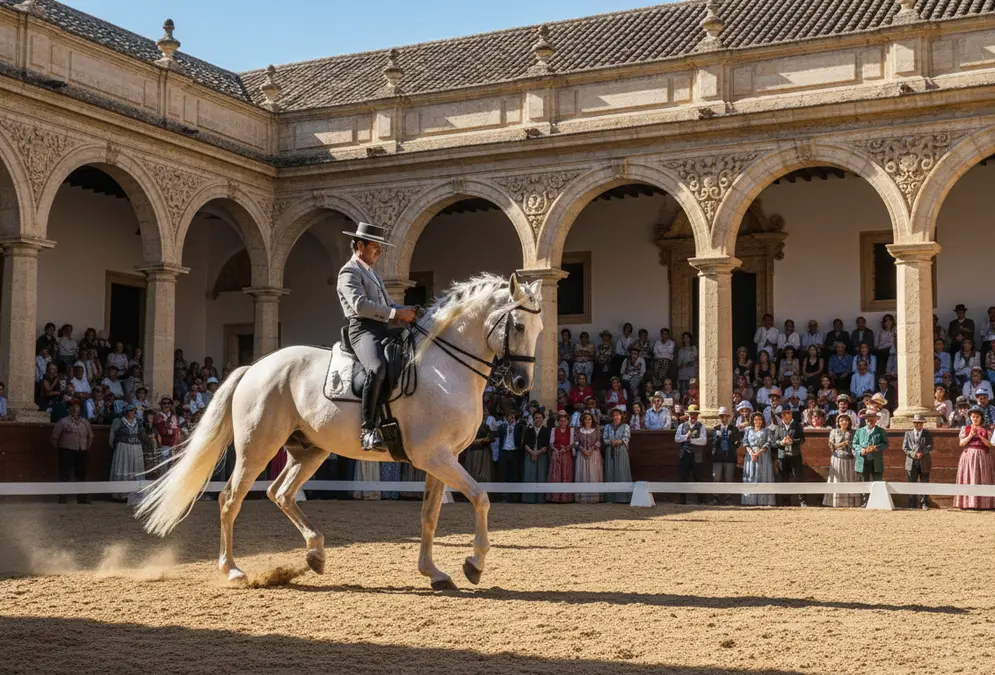
The vessels themselves carried through this transformation. The same hemispherical iron pot that fed guild members in a walled courtyard feeds extended families in an olive grove on the edge of Los Villares today. The continuity is more material than symbolic.
How the gathering works
The logistics of a perol are not complicated, but they are specific enough that understanding them changes how you interpret what you see.
A typical perol group numbers several dozen people, though groups of over 100 exist. Costs are pooled in advance: each adult household member contributes a fixed amount to cover the ingredients, the fuel, and whatever else the group decides to bring. Nobody is catered to individually; the perol feeds everyone from the same pot, and that shared dependency is part of the mechanism.
Cooking duties rotate or are assigned by reputation. There is usually one person, rarely a professional cook, who is trusted to handle the actual preparation, with the rest of the group on support roles: fetching water, keeping the fire, chopping, washing up. The cooking itself takes most of the morning. Rice goes in last, after the meat, vegetables, and broth have been working for a while, and the timing of that final stage is the thing that generates most of the commentary and occasional anxiety.
The eating ritual is the part that most clearly marks this as a communal practice rather than a shared meal. The traditional format, still observed in more formal perol groups, is "una cucharada y atrás": one spoonful and step back. Each person takes a single spoon's worth from the outer edge of the pot, then moves away to let the next person do the same. The logic is equitable distribution: nobody serves themselves a bowl, nobody gets more than their share of the best bits from the middle. The rotation continues until the pot is empty.
In practice, many groups now ladle portions into individual plates. But the one-spoonful format persists in the older, more tradition-conscious gatherings, and it is worth seeing if you can. The choreography around a large communal pot, twenty people moving in and out, is genuinely unlike anything else in Spanish food culture.
One spoonful and step back. The rotation continues until the pot is empty. Nobody gets more than their share of the best bits from the middle.
I have stood at the edge of one of these pots most late Octobers, and the same small pause happens every time: a crowd that has been talking since nine in the morning goes quiet for the three or four seconds it takes the first spoon to taste and nod. Then the rotation starts properly and the noise comes back.
After the meal: music, cards, walking, children running in whichever field or hillside the group has claimed. A perol is a day, not a lunch. Groups that arrive at the Arenal at nine in the morning are still there at six in the evening. The food was finished four hours ago.
Why the tradition persists in the 21st century
You might expect a tradition requiring 50 people, an open field, and a day off work to be in decline. It is not.
The October 24 gatherings at Los Villares and the Arenal have, if anything, grown in recent decades. Córdoba's city authorities expanded the Arenal infrastructure precisely because demand kept outpacing available space. The tradition has also spread into the calendar beyond its San Rafael Day anchor: perol gatherings now happen at Easter, around All Saints' Day, and at other points in the year when a family or group of friends decides the occasion calls for it.
Two things explain this persistence better than nostalgia does. The first is that the perol solves a genuine social coordination problem. Organising a meal for 60 people with a single chef and a restaurant booking is expensive and logistically difficult. Organising a perol for 60 people with pooled costs, assigned roles, and a field costs a fraction of the same gathering in any venue. The tradition is also infrastructure-light in ways that formal catering is not.
The second is that the Córdoba gastronomy culture, of which the perol is the most communal expression, is something the city takes seriously as identity rather than tourism. Academic researchers have classified the perol alongside other elements of Córdoba's intangible food heritage, and the city government treats October 24 as a day with real civic weight. Visitors exploring Córdoba gastronomy quickly find that the city's relationship with food is not primarily about restaurants.
What the research captures, and what any Córdoba local will confirm without needing an academic framework, is that the perol is a self-reinforcing social institution. People go because they went last year and the year before, because their parents took them as children, because not going would require an explanation to the group. The food is good. The day is long. But neither of those things is why the tradition survives.
What a visitor can actually do
Guidebooks treat the perol as a local secret and then offer no practical advice beyond "ask a local." That is lazy. Here is what you can actually do.
If you are in Córdoba on October 24, go to the Arenal enclosure in the morning, between nine and eleven. You will find dozens of simultaneous gatherings in progress, fires lit, pots on, the smell of saffron and wood smoke mixing in the October air. Nobody will object to you watching. This is a public space and a public tradition. What you will not do is eat from a pot that is not yours: showing up and expecting to be fed by strangers is the one thing that would genuinely register as rude.
The smarter move, if you have any connection in the city, is to mention to a Cordoban that you are visiting in late October. The invitation to join a perol is, in many families, automatic. Córdoba people are not shy about including visitors in traditions they are proud of, and the perol is something most locals actively want outsiders to understand properly.
If October 24 falls outside your visit, the Villares hills north of the city are worth the trip anyway on any clear October or November weekend. You will see perol gatherings in progress at picnic spots along the road from the city to the sierra. The season extends into November and sometimes beyond.
Deep dive · Article
Caliphate Food in Córdoba: How Noor Rebuilt a Lost Kitchen
Paco Morales spent years in medieval manuscripts before opening Noor. What caliphate food córdoba actually was — and how he rebuilt it without a single tomato.
For the dish itself, out of its communal context, a food tour of Córdoba is the most direct way to taste the rice preparation in a form that the guide can contextualise properly. Some tour operators now include a stop or tasting specifically because visitors ask about the perol, and a knowledgeable guide can explain the communal mechanics in a way that a restaurant plate by itself cannot.
What you should not do is photograph strangers' family gatherings at close range without asking. The Arenal is public, and people expect to be seen from a distance. Walking into the middle of a family's setup with a camera raised is a different matter. Use common sense. From forty metres back, with a decent lens or a phone with optical zoom, you will get everything you need.
The October 24 tradition is also the context for understanding why the Córdoba gastronomy culture sits where it does in the city's self-image. The city is genuinely proud of this one, and that pride is the thing a visitor takes home more reliably than any recipe.