Pastel Cordobés: The Pastry Named After a Bullfighter
Flaky pastry filled with candied pumpkin, the pastel cordobés has Moorish roots. A Córdoba confectioner named the miniature Manolete version in the 1940s.
Seven years covering Córdoba's gastronomy, taberna culture, and the Montilla-Moriles DO.
Updated Published
food-lovers
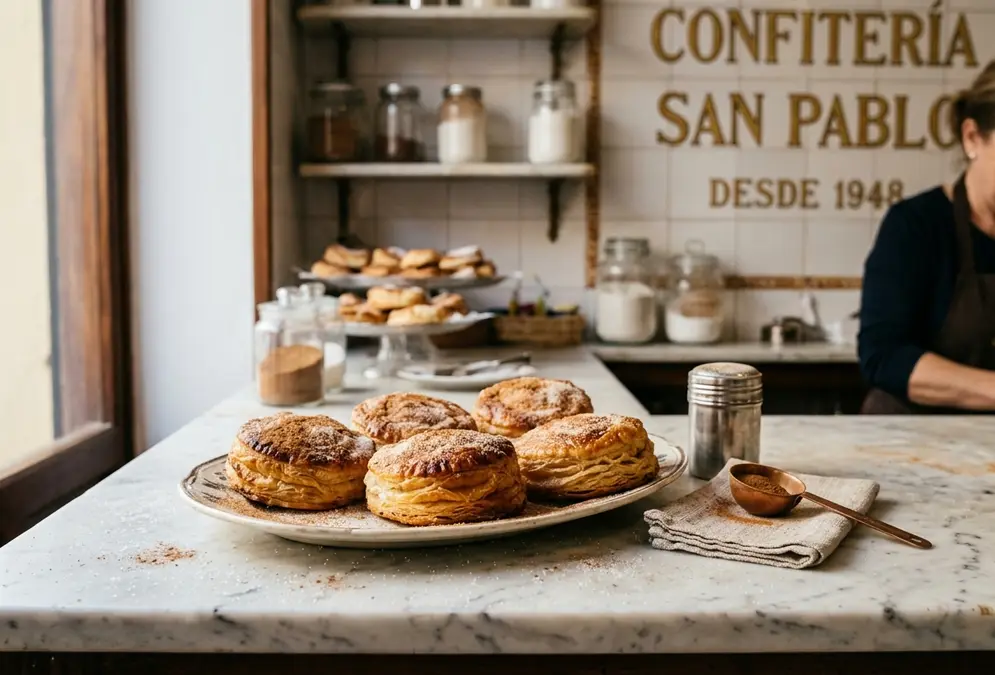
The pastel cordobés is a round, laminated pastry filled with cabello de ángel — candied spaghetti squash pulled into threadlike golden strands — sealed in buttery puff pastry and dusted with cinnamon and sugar. Its roots go back to medieval Andalusia. Its most famous edition, the hand-sized Manolete, was created in a Córdoba confectionery on Calle Concepción for the city's most celebrated bullfighter.
In this article
Jump to a section
⌄
What you are eating: the anatomy of the pastry
Pick one up at any Córdoba confectionery and you have a compact round disk, roughly 25 to 30 centimetres across for the full-size version, light enough to carry in a paper bag but dense with layers once you break through the crust. The pastry is flaky puff pastry (hojaldre), buttery and slightly brittle, the kind that dusts your shirt when you bite into it.
Inside is cabello de ángel (angel's hair), a preserve made from cidra cayote (Siam pumpkin or spaghetti squash) cooked slowly with sugar until the flesh separates into long, amber, honeyed strands. The name is apt. The texture is silky and slightly sticky, sweet without being cloying, carrying a faint vegetal depth that stops it reading as pure confection. A dusting of cinnamon and sugar goes on top before baking.
Some versions add a layer of Iberian or Serrano ham alongside the angel's hair, a savoury-sweet combination that sounds unlikely and tastes logical once you try it. This ham variant became standard in the 19th and early 20th centuries[1], but the older form, just the squash preserve, is still the baseline. The pastel cordobés dish page covers the current landscape: where to buy it, what the variations look like, what a proper one costs.
The individual-sized version, about the width of a fist, is what people in Córdoba call a Manolete. It costs around a couple of euros in most city-centre confectioneries.
~€2
Rough price of an individual Manolete pastry in Córdoba's city-centre confectioneries. The full-size pastel cordobés, large enough to share, costs more and requires advance order at some bakeries.
A medieval foundation: Arab dough, Christian lard
The pastel cordobés in its large format goes back to the period when Córdoba was the Caliphate's capital. In the 10th and early 11th centuries, the city was the largest in western Europe and its kitchens were working from an Arab confectionery tradition that drew on Persian and Levantine techniques.[3] Candied pumpkin, honey, delicate dough layers: these are shared territory with baklava and other Levantine pastries, and the connection is not metaphorical. Córdoba's confectioners were working in the same tradition.
After the Christian Reconquista reached Córdoba in 1236, the recipe changed in the way recipes tend to change when one culture displaces another in a kitchen: the incoming group adds its preferred fat. Lard (manteca de cerdo) replaced the neutral oils of Moorish baking.[1] It was also a statement. Pork products were a marker of Christian identity in post-Reconquista Andalusia, a way of demonstrating allegiance that operated through daily food choices.
The pork fat gave the pastry a different quality. Hojaldre made with lard is slightly richer, less neutral than butter-only versions, with a faint savouriness that cuts the sweetness of the angel's hair. By the 19th century, Iberian ham had entered the filling alongside the preserve, which pushed the sweet-savoury balance further.[1] The version sold in Córdoba today is the product of all three layers: Arab preserve technique, Christian fat, 19th-century ham addition, assembled over roughly a thousand years.
For anyone tracing Córdoba's layered culinary identity through its food, the pastel cordobés is an unusually legible case. The Córdoba gastronomy page maps the broader picture: the dishes, the influences, the neighbourhoods where you still eat the oldest recipes.
San Pablo street: Alejandra, Francisca, and the original recipe
The pastel cordobés in its recognisable modern form is attributed to two women, Alejandra and Francisca, who ran a confectionery on Calle San Pablo in Córdoba.[1] The street sits in the old city, a few minutes' walk from the Mezquita. The precise dates of their operation are not documented in sources that have survived, but the attribution is consistent across the accounts that engage with the pastry's history.
What Alejandra and Francisca did was standardise. The ingredients — hojaldre, cabello de ángel, sugar, cinnamon — existed in Córdoba's cooking before them. The specific formula, the layering technique, the proportions, the round format that has remained unchanged: those belong to their version of the pastry, and it was their version that spread to other confectioneries in the city and then across Andalusia.
Cabello de ángel as a preserve has its own lineage in Andalusian cooking. The Siam pumpkin used for it (cidra cayote) is a large, marbled gourd with dry, fibrous flesh that does not dissolve into mush when cooked but pulls apart into strands, which is how it got its name. The cooking process is slow: the flesh is simmered with sugar, sometimes with a piece of lemon rind, until the strands are translucent and amber. The result keeps well without refrigeration, which made it a practical filling for a pastry that needed to travel. That practicality became relevant later.
Recommended tours
Tours are selected for quality, not commission. We earn a small fee if you book — at no extra cost to you.
Calle San Pablo is not a tourist street. Visiting it today gives you a sense of the neighbourhood where the pastry was standardised: ordinary, residential, lined with buildings that predate the confectionery and will outlast it. No plaque marks the spot.
Casa Mirita and the pastry chef who named a format
In the 1940s, the most important confectionery in Córdoba for the pastry's story was Casa Mirita, on Calle Concepción.[1] Its pastry chef was José Delgado, and his most illustrious regular customer was Manuel Rodríguez Sánchez, the matador known as Manolete.
Manolete was born in Córdoba in 1917, in the Santa Marina barrio. By the early 1940s he was the most famous bullfighter in Spain, fighting 92 corridas in 1944, his peak season.[4] He was also, by multiple accounts, a devoted customer of Casa Mirita and its pastel cordobés.
The traditional pastel cordobés at the time was a large-format pastry — the kind you bring to a gathering or slice at a table. What Manolete preferred was something he could eat alone, without ceremony, in whatever city he happened to be in between corridas. José Delgado began making individual single-portion versions specifically for him, smaller than the full-size pastry but using the same recipe, the same dough, the same cabello de ángel filling.[1]
Delgado named this individual format Manolete (also Manoletes in the plural) in honour of the bullfighter who had become the standard client and, in some sense, the reason the format existed at all.[1] The name stuck. Other confectioneries in Córdoba adopted it. Today every Córdoba pastry shop sells Manoletes, and most customers do not know, or need to know, that the name refers to a specific person.
For context on the must-try dishes in Córdoba, the Manolete sits alongside salmorejo and rabo de toro as one of the three things people actually regret not eating before they leave.
Why Manolete: two accounts, one pastry chef
There are two versions of why José Delgado made the miniature. They are not contradictory, and both centre on the same man at the same confectionery, but they emphasise different things.
The first account, and the simpler one, is that Manolete ordered the small format regularly throughout his career in the 1940s.[1] He was a local who wanted his city's pastry in a size he could eat alone. José Delgado made them for him. The format became associated with the client and eventually took his name. This version positions the Manolete as a natural evolution from a loyal regular's preferences, the kind of thing that happens in any long-running confectionery relationship.
The second account, attributed to Rafael Jordano, former Director of the Andalusian Gastronomy Chair at the University of Córdoba, adds a specific context: that Manolete had tasted a Mexican sweet called chilacayote during his 1946 season in Mexico, found the similarity to the cabello de ángel filling striking, and asked José Delgado to prepare small individual versions that he could bring back as gifts for his Mexican friends and colleagues.[1] Under this account, the miniature format was created specifically for transport — for the journey between Córdoba and Mexico, or as a souvenir of the city.
Both accounts deserve to be taken seriously, and both may be true simultaneously. Manolete was in Mexico in 1946[4]; that part is not disputed. The question is whether the miniature format emerged from long-standing personal preference, from a specific gifting request, or from some combination of the two across the course of the 1940s. Sources do not give an exact year for the creation of the format, only the decade.
What the two accounts agree on is everything essential: José Delgado at Casa Mirita made them, Manolete requested them, and Delgado named the format after the bullfighter. The miniature pastel cordobés exists because a matador from Santa Marina had an appetite for his city's pastry and a pastry chef willing to accommodate it.
Manolete died on August 29, 1947, gored by the Miura bull Islero at a corrida in Linares. He was thirty. The pastry with his name on it has outlasted him by nearly eighty years.
The timeline below traces the pastry's evolution from medieval Córdoba to the named Manolete format.
Timeline
10th century
Arab confectionery in Caliphal Córdoba
Candied pumpkin, honey, and layered dough arrive with the Moorish baking tradition during Córdoba's peak as Caliphate capital.
Post-1236
Christian reconquista modifies the recipe
Lard replaces neutral Moorish oils. Pork fat becomes a daily marker of Christian identity in post-Reconquista Andalusia.
19th century
Ham enters the filling
Iberian or Serrano ham is added alongside the angel's hair, creating the savoury-sweet version still sold today.
19th–early 20th century
Alejandra and Francisca standardise the formula
Two confectioners on Calle San Pablo fix the recipe, format, and proportions that spread to bakeries across Córdoba and Andalusia.
1940s
José Delgado creates the Manolete
The pastry chef at Casa Mirita makes individual single-portion versions for bullfighter Manuel Rodríguez Sánchez and names the format after him.
Where to buy it in Córdoba today
Every confectionery in Córdoba sells Manoletes. That is not a figure of speech. The pastry is as embedded in the city's bakery culture as churros are in Madrid's. You can pick one up at Pastelería San Rafael on Calle Cardenal Portocarrero, at the various branches of Roldán, or at smaller neighbourhood confectioneries scattered through the old city. San Rafael's lineage connects directly to the Confitería San Rafael that José Delgado worked in. The name, at least, has continuity.
The practical notes matter here:
Manoletes (individual size) are sold ready-made and do not require advance ordering. They cost around a couple of euros each.
Full-size pasteles cordobeses are often made to order, especially for larger versions intended for sharing. Call ahead.
October is the peak season, when the pastry appears everywhere in connection with the festivities for San Rafael, Córdoba's Custodio (guardian).[5] Confectioneries bake larger volumes and often offer seasonal presentations, but the recipe does not change.
The ham variant (pastel cordobés con jamón) is worth trying if you want the savory-sweet version. Some shops also sell small ham-topped variations called manolillos, distinct from the sweeter Manolete.
Buying one from a neighbourhood confectionery outside the Judería tourist radius usually means a better price and a fresher product. The pastry does not need to be eaten warm; room temperature is correct, but a Manolete that was baked that morning is noticeably better than one that has been sitting in a display case since the previous day.
Seven years of buying Manoletes off marble counters across this city have taught me a small habit: press the paper wrapping before you open it. A faint translucent patch means the hojaldre is still shedding butter. A dry wrapper is not a disaster, just a quieter pastry, the angel's hair a touch less silky than it should be. It is a two-second check.
The pastry keeps reasonably well. Manolete's appeal to it, if the Mexico tour account is believed, was precisely that it travelled. A box of Manoletes is still the most logical souvenir to carry out of Córdoba.
Frequently asked questions
What is a pastel cordobés?
A pastel cordobés is a round Andalusian pastry made of flaky puff pastry filled with cabello de ángel — a preserve of candied spaghetti squash or Siam pumpkin cooked into long amber strands with sugar. It is finished with a dusting of cinnamon and sugar. Some versions include Iberian or Serrano ham alongside the sweet filling. The pastry is closely associated with Córdoba and is sold in two formats: a larger shareable size and individual single-portion rounds called Manoletes.
Why is the individual pastel cordobés called a Manolete?
The individual-portion format was created by pastry chef José Delgado at Casa Mirita, a confectionery on Calle Concepción in Córdoba, in the 1940s. Delgado made small personal versions of the pastry for the Córdoba-born bullfighter Manuel Rodríguez Sánchez, known as Manolete, who was a regular customer. Delgado named the format after him. The name spread to other confectioneries in the city and has remained ever since.
Did Manolete request the miniature pastry for his Mexico tour?
Possibly. There are two accounts. One says Manolete simply ordered small individual portions regularly throughout the 1940s, and the format gradually took his name. The other, attributed to Rafael Jordano of the University of Córdoba's Andalusian Gastronomy Chair, says Manolete specifically asked José Delgado to prepare small portable versions to bring as gifts during his 1946 Mexico City season. Both accounts centre on the same pastry chef and the same bullfighter; what they differ on is the specific moment the miniature format was created. Sources do not give an exact year.
What are the Moorish origins of the pastel cordobés?
The large-format pastry traces its origins to the period when Córdoba was the Caliphate's capital in the 10th and 11th centuries. The technique of using candied pumpkin in layered dough comes from the Arab confectionery tradition, which shared methods with Levantine pastries like baklava. After the Christian Reconquista in 1236, lard replaced the neutral oils used in Moorish baking, and by the 19th century Iberian ham had been added to the filling. The pastry as it exists today is the product of all three historical layers.
Who created the pastel cordobés recipe?
The modern standardised recipe is attributed to two women called Alejandra and Francisca, who ran a confectionery on Calle San Pablo in Córdoba. They fixed the formula, the layering technique, and the round format that has remained standard. The individual Manolete portion was created later, in the 1940s, by José Delgado at Casa Mirita on nearby Calle Concepción.
When is the best time to eat a pastel cordobés in Córdoba?
October is the peak season, when production increases for the San Rafael festivities honouring Córdoba's Custodio (guardian). But Manoletes are sold year-round at every Córdoba confectionery. Buy from a neighbourhood bakery outside the Judería for a fresher product and a better price. There is no need to order in advance for the individual size. Full-size pasteles cordobeses made to order sometimes require advance notice.
How much does a Manolete pastry cost?
An individual Manolete costs around a couple of euros at most Córdoba confectioneries. Prices are broadly consistent across city-centre bakeries, though tourist-facing shops occasionally charge slightly more. A full-size pastel cordobés is more expensive and varies by bakery.