
The name that got away
The Denominación de Origen Montilla-Moriles was formally established in 1932[1], making it one of the older protected wine designations in Spain. The DO covers a southern chunk of Córdoba province, centred on the towns of Montilla and Moriles. The grape is almost exclusively Pedro Ximénez, which accounts for over 95% of vineyard plantings. The climate is semi-continental Mediterranean: 2,800 to 3,000 hours of annual sunlight[1], dry summers that concentrate sugars without irrigation, and albariza soil (calcium carbonate-rich chalk, the same geological formation that gives Jerez its reputation).
Given those conditions, Pedro Ximénez reaches natural alcohol levels of 15 to 17%. No chaptalisation, no added grape spirit. The wine gets there on its own, which is why Montilla-Moriles produces unfortified wines at strengths that Jerez achieves only by adding brandy. That distinction matters commercially and stylistically, but it has not translated into international name recognition.
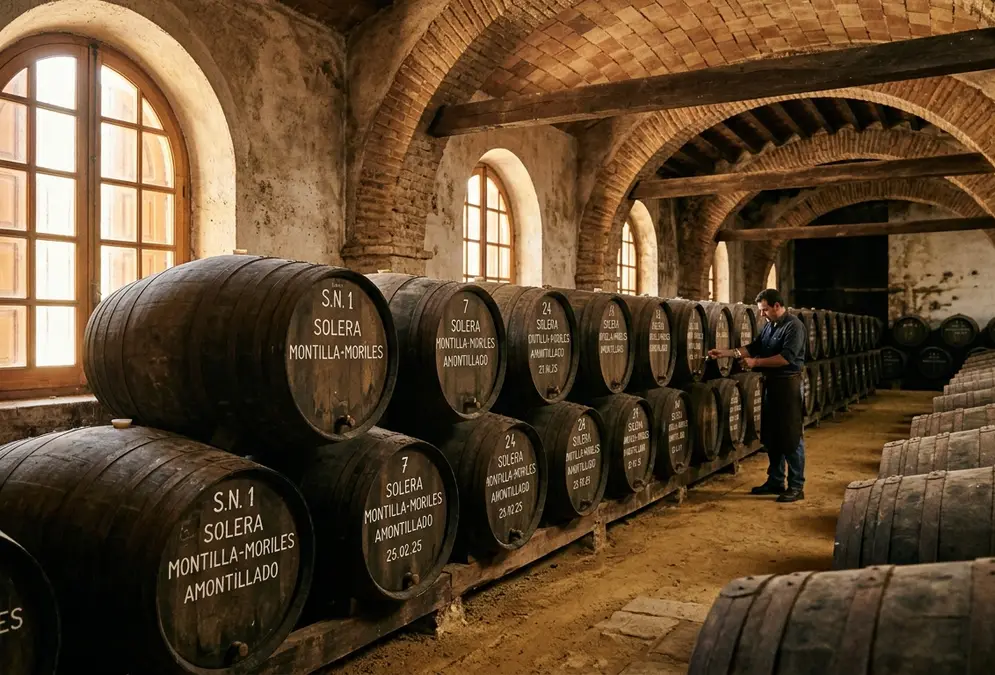
What Montilla-Moriles cannot do, despite being the historical source of the style, is label its wines amontillado. The word belongs to Jerez under DO regulations. Montilla-Moriles producers can make a wine aged under flor yeasts in a solera system, aged further through oxidative aging after the flor dies, with a hazelnut and thyme character distinct from anything Jerez produces at the same stage. They just cannot call it by the name it was originally given.
95%+
The commercial consequence is that the wine gets sold to Jerez bodegas instead of under its own identity. Nearly all Pedro Ximénez used to refresh Jerez soleras[2] is sourced from Montilla-Moriles. The region produces the raw material; Jerez takes the credit. It is a supply chain paradox that has been running for about two centuries.
What Poe's story tells us
In November 1846, Edgar Allan Poe published "The Cask of Amontillado" in Godey's Lady's Book.[3] The story's narrator lures a wine-obsessed rival named Fortunato into underground catacombs by exploiting his vanity as a connoisseur: he claims to have acquired a rare cask of amontillado and wants Fortunato's expert opinion. Fortunato cannot resist. The narrator walls him in alive.
The mechanism only works if amontillado is expensive, exclusive, and worth crossing a city at night to verify. Poe's readership in 1846 Philadelphia would have understood that immediately. The wine had reached transatlantic cultural prominence as a marker of sophistication, the kind of thing a gentleman collector might accumulate and a rival might kill to taste. That status, across the Atlantic in an American literary magazine, suggests the reputation was already solid by the 1840s.
The style had travelled from Montilla to Jerez, picked up the Sherry marketing machine, and crossed the ocean. Poe never specifies the origin. To his readers, amontillado meant Sherry country. The Córdoba connection had been commercially obscured before the story was even written.
The irony is durable: a wine the region of Córdoba invented, named after one of its towns, achieved global literary immortality attributed to a different place. The Montilla-Moriles wine page has a full breakdown of styles and how to read a Montilla label today.
Explore nearby · Monument
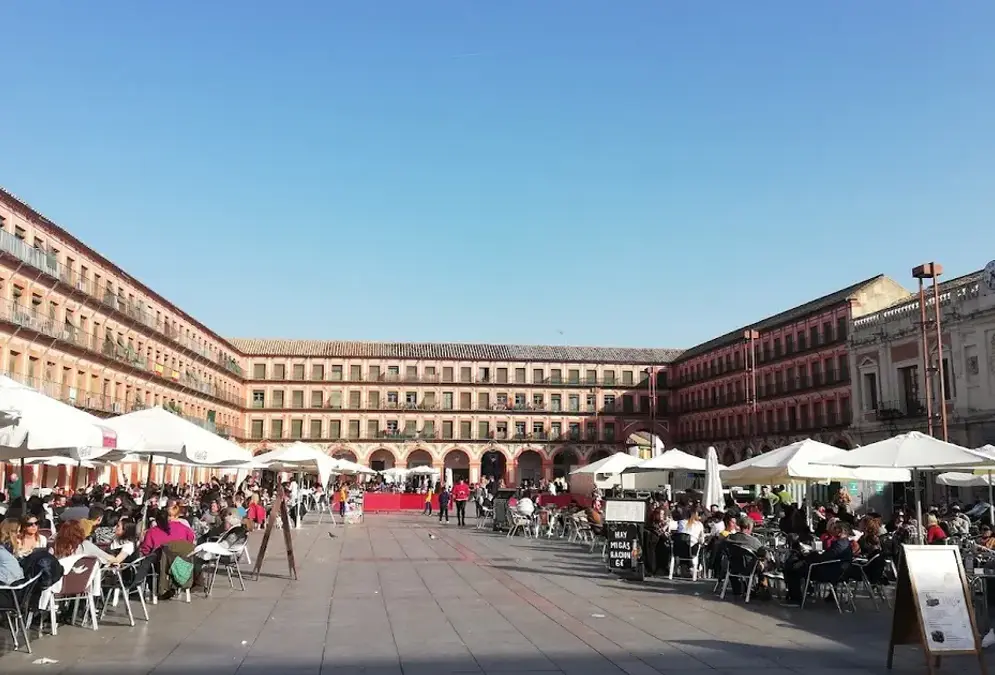
Plaza de la Corredera
Andalusia's only Castilian arcaded square, built in 1683 over a Roman forum. Once a bullfighting ring, now lined with bar terraces and a Sunday flea market.
Al estilo de Montilla — the etymology
Amontillado means, in Spanish, something made al estilo de Montilla: in the Montilla style. The construction follows the same pattern as enamorado (in love, literally "in the manner of amor") or aplatanado (Canary Islander slang for being slow or lazy, in the manner of a banana). Stick a- on a place name, add -ado, and you have a geographical adjective.
The term appears to have been coined in the 18th century, when winemakers in Jerez noticed that some of their finos were developing differently after extended aging: losing the protective flor yeasts, oxidising slowly, gaining colour and nuttiness. The reference point for that style was Montilla, where the same transformation happened naturally because Pedro Ximénez grapes, with their higher sugar content, produced wines strong enough to kill the flor without fortification. Jerez winemakers were producing something that looked like the Montilla product. They called it amontillado.
The name stuck in Jerez, spread through the English wine trade (which was Sherry-dominated throughout the 19th century), and gradually detached from its geographic origin. By the time EU Denominación de Origen law formalised wine region protections, amontillado was legally a Jerez term. Montilla-Moriles, the place the word literally refers to, was left out.
Recommended tours
Tours are selected for quality, not commission. We earn a small fee if you book — at no extra cost to you.


Current Montilla-Moriles producers label equivalent wines using terms like fino, palo cortado, or just list the aging method. Some export under generic wine category names. The solera system they use is the same as Jerez: barrels arranged in rows, fractional blending across vintages, the older wine feeding the younger. The method is identical; only the rules on naming differ.
Unfortified, naturally strong
The practical difference between a Montilla-Moriles fino and a Jerez fino starts with the grapes. Jerez uses Palomino Fino, a neutral variety that requires fortification to reach fino strength. Montilla-Moriles uses Pedro Ximénez, which in the Córdoba semi-continental climate builds enough sugar to ferment past 15% naturally.
The soils are the other variable. Albariza in Montilla-Moriles is the same chalky calcium carbonate formation as in Jerez's best vineyards, and it functions the same way: absorbing winter rain, releasing it slowly through the dry season, keeping vine stress at the level that concentrates flavour without killing the plant. But the distance from the coast changes the temperature profile. Montilla sees more extreme summer heat and colder winters than the coastal Atlantic climate of Jerez. That continental character comes through in the aroma: thyme, rosemary, dried herbs alongside the expected hazelnut, where Jerez fino tends toward salinity and almonds.
Both produce fino, oloroso, sweet PX wines, and the amontillado-style aged wine. Both use the solera system. The key production split is fortification: Jerez adds grape spirit to stabilise and raise alcohol; Montilla-Moriles does not because the wine doesn't need it.
For drinkers used to Sherry, switching to Montilla-Moriles means recalibrating expectations slightly. The lower acidity produces a fuller body. The continental aromatic profile is more savory and herb-inflected. The unfortified character means the wine integrates differently with food: it doesn't cut through fat the same way a fortified fino does, but it pairs more naturally with anything containing thyme, rosemary, or local spices, which covers most of the Córdoba kitchen.
| Feature | Montilla-Moriles | Jerez |
|---|---|---|
| Primary grape | Pedro Ximénez (95%+) | Palomino Fino |
| Fortification | None — 15-17% natural alcohol | Fortified to 15-20% with grape spirit |
| Soil | Albariza (chalk) | Albariza (chalk) |
| Climate | Semi-continental, 2,800-3,000 sunlight hours/year | Coastal Atlantic, more humid |
| Fino character | Hazelnut, thyme, rosemary, fuller body | Almond, salinity, lighter body |
| Aging system | Solera (fractional blending) | Solera (fractional blending) |
The Jerez shadow
Sherry's commercial dominance over Montilla-Moriles is not the result of better wine. It is the result of the British wine trade.
Throughout the 18th and 19th centuries, British merchants controlled Jerez exports. The solera bodegas of Jerez were often British-owned or British-partnered: Harveys, Williams & Humbert, Sandeman. The wines were shipped directly to England, where they became embedded in the British drinking culture as "Sherry" (a corruption of Jerez). Montilla-Moriles, further inland, without a coastal port or Anglo-Spanish commercial infrastructure, sat outside that distribution network.
The supply relationship developed instead: Montilla-Moriles grapes and bulk wine went to Jerez to enrich and refresh soleras. Pedro Ximénez from Montilla was, and still is, the standard choice for Jerez PX wines because Montilla's continental climate produces richer, more concentrated fruit than the Palomino country around Jerez. The irony is that many premium Jerez PX wines, which sell under the Sherry DO at internationally recognised bodegas, are built on Montilla-Moriles raw material.
Deep dive · Article
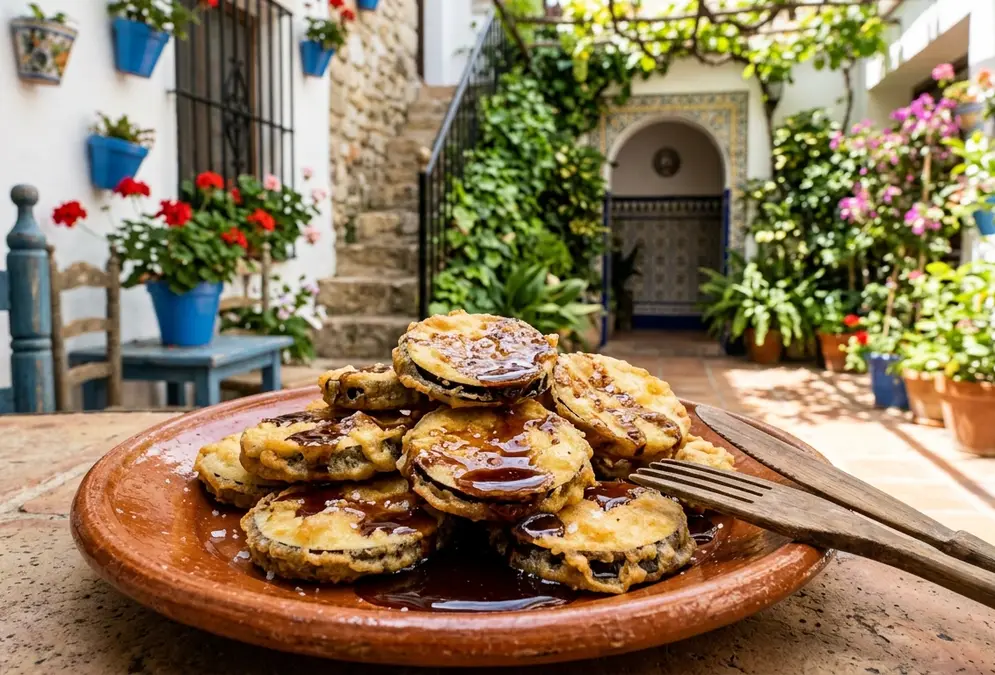
Berenjenas con Miel — Moorish Roots of Córdoba's Sweetest Tapa
The Moorish origin of berenjenas con miel traces to 8th-century Al-Andalus, where fried aubergines and honey defined sweet-savoury cooking in Córdoba.
The EU DO framework formalised this commercial hierarchy. When geographic indications were codified, amontillado stayed in Jerez because that was where the international trade recognised it. The legal instrument protected the status quo rather than the historical origin.
For travellers, this matters because it explains the pricing anomaly: a comparable quality level in Montilla-Moriles costs significantly less than Sherry because the brand premium attached to Jerez has no equivalent here. The Montilla-Moriles wine tasting experience in Córdoba covers the full spectrum from fino through oloroso, with direct comparison tastings that make the differences concrete rather than theoretical.
Drinking it today: the wine route from Córdoba
Montilla is 45 km south of Córdoba on the A-45. The drive takes 35 minutes; there are bus connections from the central bus station several times daily. The town sits at 371 metres elevation[6] in a landscape of white-painted bodegas and rolling vineyards. The harvest happens in August and early September, earlier than almost anywhere else in Spain because of the heat.
The Montilla-Moriles wine route covers both Montilla and the smaller town of Moriles to the south, plus a dozen intermediate bodegas. Most bodegas accept visits by appointment; a few have walk-in cellar tours. The typical visit runs 90 minutes and covers the solera system, barrel inspection, and a tasting of three to four wines across the style range. Prices are low by any wine-region standard.
I've driven the A-45 to Montilla often enough over seven years that I no longer check the map before the turnoff, and the one thing that still catches me is how much the same fino changes with the season. Poured in August heat it reads tighter and more astringent; the same barrel in January comes across rounder, almost savory. These days I stop ordering fino by name at Córdoba tabernas and just ask what's coming off the barrel that week.
In Córdoba city, the wine appears on menus at traditional tabernas and bodegas, rarely at tourist-facing restaurants. Order un montilla and you'll typically get a chilled fino or amontillado-style wine served in a small copita glass at temperatures around 8-10°C. The must-try dishes of Córdoba pairs naturally with Montilla-Moriles: the hazelnut character in the wine cuts through salmorejo and amplifies the herb notes in local stews.
For the sweet end of the range, the PX wines from Montilla-Moriles are thick enough to stand a spoon in, with dried fig and raisin concentration that comes from sun-drying the grapes before pressing. These are not dessert wines in the international sense. They are a specific category of their own, legitimate across cultures in a way that suggests the region's potential if the naming problem ever resolves.
The full tasting context, with recommendations for specific bodegas and what to order at each style level, is covered in the wine tasting activity.