Medina Azahara: tickets, shuttle, and how to plan the visit
Abd al-Rahman III's 10th-century palace city sits 8 km from Córdoba — entry costs €1.50 (free for EU citizens), but getting there requires a mandatory shuttle bus from the visitor centre. This guide covers booking, transport, seasonal hours, and why the on-site museum deserves 45 minutes before you set foot on the ruins.
Ten years covering Córdoba's UNESCO heritage sites, sourcing from Junta de Andalucía documentation.
Updated Published
Medina Azahara (Madinat al-Zahra) was built from 936 CE as Abd al-Rahman III's statement to the Islamic world: a complete palace city of marble, carved stone, and running water, rising from the lower slopes of the Sierra Morena. At its height it housed the Umayyad court, some 15,000 people, and a bureaucratic apparatus that governed much of the Iberian peninsula. By 1013 it had been sacked and abandoned. The ruins were only rediscovered in the early 20th century.
UNESCO added it to the World Heritage List in 2018. The designation came with a proper visitor centre and an award-winning museum that finally gives the site the infrastructure it deserved. Entry costs €1.50 for non-EU visitors; EU and EEA citizens enter free. The catch — and it is an important one — is that no private vehicles reach the ruins. Everyone takes a mandatory shuttle bus from the visitor centre, €3 each way.
This guide covers ticket prices and booking, how free EU entry actually works, all transport options from central Córdoba, what to prioritise on site, and the Friday and Saturday night visits. It also cross-references the Medina Azahara monument page for the architectural and historical detail.
At a glance
Entry fee
€1.50 non-EU · Free for EU/EEA citizens
Hours (standard)
Tue–Sat 9am–6pm · Sun & holidays 9am–3pm · Closed Mon
Hours (Jul–mid Sept)
Tue–Sun 9am–3pm · Closed Mon
Visit duration
2.5–3 hours with museum · 3–4 hours with guided tour
Admission is managed through the Junta de Andalucía's booking platform. Entry is time-slotted in 30-minute windows — you choose your arrival window when you book, and the system limits capacity per slot. The shuttle bus ticket (€3) is purchased separately on arrival at the visitor centre.
Category
Price
Notes
Non-EU/EEA adult
€1.50
General admission, all days
EU / EEA citizens
Free
All days — advance booking still required
Shuttle bus
€3.00
Mandatory for all visitors, charged separately
Night visit (adult)
€15.00
Fri & Sat, 9pm, includes shuttle
Night visit (child 6–12)
€6.00
Under 6 free
Self-guided entry €1.50 (free EU)
Guided tour from €18
Shuttle bus included
€3 extra
Included
Transport from Córdoba
Arrange yourself
Included
7-day booking race
Yes (free slots fill in hours)
Skip it
English guide included
✗
✓
Free cancellation
N/A
✓
Official booking portal
Book at museosdeandalucia.es — the Junta de Andalucía's museum booking platform. Choose your date and 30-minute arrival window. Slots open 7 days in advance. EU citizens booking free entry must still complete the booking process and show their passport or national ID at the entrance.
Shuttle bus tickets (€3) are bought at the visitor centre on the day, not through the online portal.
For visitors who want a guided experience with transport included, GetYourGuide offers a 3-hour guided tour from Córdoba rated 4.7/5 by 474 visitors, covering transport, entry, and expert commentary on the Umayyad caliphate.
EU free slots open 7 days ahead and fill within hours — book a guided tour to skip the availability race entirely.
EU and EEA citizens pay nothing for admission, and this applies on all open days — not only Tuesdays, as some older travel sites still claim. The free entry policy came with the UNESCO designation and covers nationals of all EU member states plus Iceland, Liechtenstein, and Norway.
Free does not mean walk-up. You must book a time slot at museosdeandalucia.es, select the free entry category, and bring valid ID (passport or national identity card) to prove citizenship at the entrance. Without the booking, you will be turned away.
Book your free slot 7 days in advance
Slots open exactly 7 days before the visit date. Go to museosdeandalucia.es, select Medina Azahara, choose your 30-minute time slot, and pick the EU/EEA free entry category.
Step by step
Visit museosdeandalucia.es exactly 7 days before your planned visit
Select Medina Azahara and your preferred date and 30-minute time slot
Choose the EU/EEA free entry category — the system will request your nationality
Complete the booking and save the confirmation email with the QR code
On arrival, show your QR code and EU passport or national ID
Pay the shuttle bus fee (€3) at the visitor centre ticket desk
During peak season — April through June and September through October — free slots fill within 2 to 4 hours of opening on the 7-day window. If you are flexible, midweek mornings have better availability than weekends. Tuesdays go first because that is the day most visitors check, not because it is the only free day.
Opening hours
Medina Azahara runs on three distinct seasonal schedules. The spring/autumn extended hours (April through June) push evening closing to 9pm — a rare opportunity to visit in lower light and cooler temperatures. Summer contracts sharply to 3pm closings to avoid the heat.
Season
Days
Hours
Standard Oct – Mar & mid-Sept
Tuesday – Saturday
9:00am – 6:00pm
Sunday & holidays
9:00am – 3:00pm
Spring/extended April – June
Tuesday – Saturday
9:00am – 9:00pm
Sunday & holidays
9:00am – 3:00pm
Summer July – mid-Sept
Tuesday – Sunday
9:00am – 3:00pm
Monday (all seasons)
Closed (year-round)
Closed on January 1, January 6, May 1, December 24–25, and December 31. The last shuttle to the ruins leaves approximately 30 minutes before the posted closing time.
If your visit falls in April or May, the 9pm closing is worth using. The late afternoon light across the terraces is different from the harsh midday glare, and the ruins are quieter after 5pm.
For a side-by-side look at all major Córdoba monuments — and which close on Mondays — see the opening hours & Monday closures guide. Turning up on a Monday, or expecting a restored palace rather than an active excavation, are two of the planning slips covered in our first-trip mistakes to avoid.
Getting there from Córdoba
Medina Azahara is 8 km west of Córdoba's city centre. One logistic applies to every visitor regardless of how they arrive: the mandatory shuttle bus. Private vehicles are not permitted beyond the visitor centre car park. The ruins are 2 km further up a private road, served by the site's own shuttle.
Transport options
Tourist bus
Paseo de la Victoria · Tue–Sun · ~€10 return adults
Taxi
~€15–20 one way · ~15 min · No taxis waiting at site
Rental car
Free parking at visitor centre · West on A-431
Mandatory shuttle
€3 per person · Every 15–20 min · Visitor centre to ruins
For the tourist bus, confirm schedules with the Turismo de Córdoba office as times change seasonally. For a taxi, give the driver the address — Ctra. Palma del Río, km 5 — and arrange the return in advance as no taxis wait at the site.
Guided tours cover the museum, the Salón Rico, and the terraces in about 3 hours — transport and entry included.
What to see
The standard approach — arrive, take the shuttle, walk directly to the ruins — is the wrong order. Start in the museum. Forty-five minutes there will transform what you see on the archaeological site from scattered masonry into a coherent picture of how the palace city once looked and functioned.
The museum (visit first)
The on-site museum won the Aga Khan Architecture Prize in 2010, and the building deserves that recognition. It sits underground, carved into the hillside, with a ramp that descends through the exhibition at the pace of the narrative. The collection covers the excavation history, reconstructed architectural elements, and a scale model of the palace city at its 10th-century peak — showing the extent of what has been lost. Allow 45 minutes before boarding the shuttle.
Salón Rico (the Rich Hall)
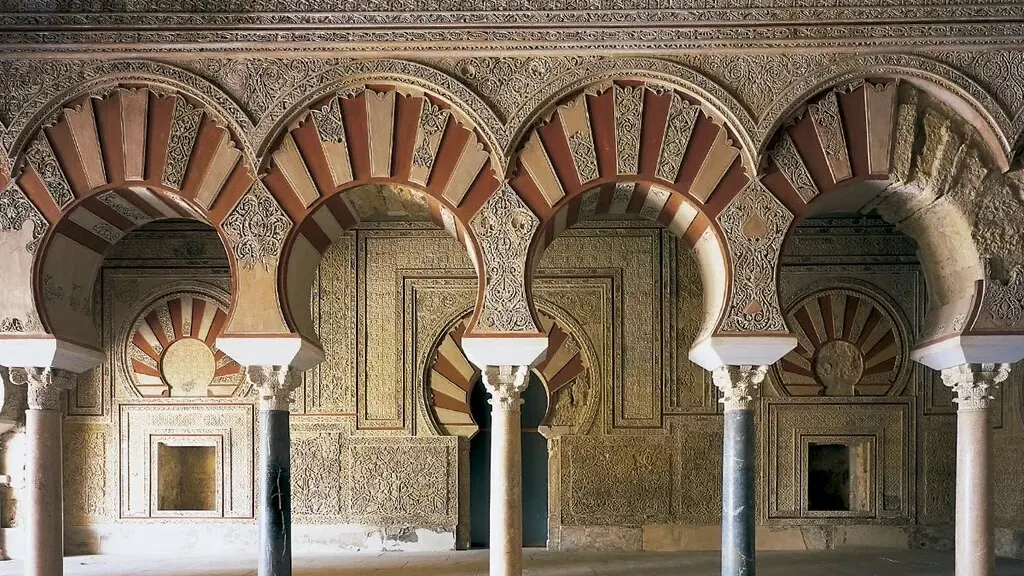
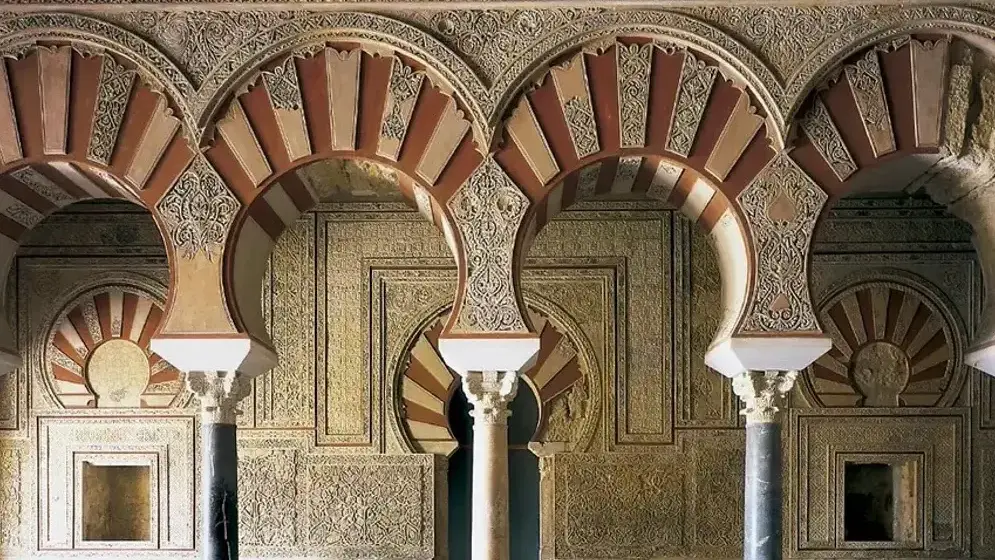
The reception hall where Abd al-Rahman III received foreign delegations is the most extensively restored section of the ruins. Three marble arches divide the space, with carved stone panels covering the lower walls — geometric and vegetal patterns of considerable precision. The caliph sat at the far end; natural light from the horseshoe-arched windows would have filled the room in the afternoon. Even partially restored, it gives the clearest sense of how the palace functioned at its height.
House of Yafar
The vizier's residence lies on the upper terrace, close to the main entrance from the shuttle drop-off. It is less restored than the Salón Rico but the floor plan is legible: reception rooms, private quarters, a garden courtyard. The carved marble capitals salvaged from this building are among the finest in the museum collection — several with the distinctive palm-leaf and acanthus hybrid that Cordoban craftsmen developed specifically for Medina Azahara.
The terraces and views
Medina Azahara was built across three terraces of the Sierra Morena slope. The upper terrace held the palace; the middle terrace, the mosque and administrative buildings; the lower terrace, housing and barracks. Standing at the top and looking south, the Guadalquivir plain spreads out below, with Córdoba's tower visible on a clear day. This elevated position was deliberate — the caliph's city was meant to be seen from the plains below and to look down on everything beneath it.
Guided tours
Medina Azahara rewards a good guide more than almost any site in Córdoba. Most of what stands has been reconstructed from fragments, and the archaeology is complex enough that the context a guide provides changes what you're looking at entirely. The caliphate politics behind the construction, the speed of the abandonment in 1013, and what the various building phases represent — none of this reads from the stones alone.
Most popular option
Medina Azahara 3-Hour Guided Tour
Guided tour from Córdoba with transport included. Rated 4.7/5 by 474 visitors on GetYourGuide. Duration: 3 hours including travel. Expert guide covers the Umayyad caliphate, the excavation history, and the palace's architectural innovations.
The excursion activity page covers additional tour operators and options, including some that combine Medina Azahara with other sites.
Night visits
Since 2017 the ruins have been illuminated for evening visits on Fridays and Saturdays at 9:00 PM. Groups of 2 to 20 people enter together; the visit covers the main areas of the archaeological site by guided night tour, with the carved stonework picked out in warm light against the dark hillside.
Night visits last 1.5 hours. The on-site museum is closed during these sessions — this is a purely exterior experience. The shuttle operates for night visits; the cost is included in the night ticket price.
Night visits at a glance
Days
Friday and Saturday
Start time
9:00 PM
Duration
1.5 hours
Group size
2–20 people
Adult ticket
€15 (shuttle included)
Children 6–12
€6 · Under 6 free
Night visit slots sell out during high season. Book at museosdeandalucia.es as far in advance as possible if you want a Friday or Saturday evening slot in spring or autumn.
Practical tips
Address
Ctra. Palma del Río, km 5, 14005 Córdoba
Phone
+34 957 10 49 33
Photography
Permitted throughout the site and museum. No flash in the museum. Tripods are allowed in the archaeological area.
Accessibility
The visitor centre and museum are fully accessible. The archaeological site has varied terrain with some sections on uneven stone — wheelchair access is partial. Call ahead on +34 957 10 49 33 to discuss specific needs.
What to bring
Water (at least 1 litre per person in summer), a hat, and sturdy shoes with grip. The ruins are exposed on a hillside with almost no shade and uneven stone paths. In July and August, midday temperatures on the terraces regularly reach 45°C.
Best season
October through December for mild temperatures, shorter queues, and low-angle light that emphasises the carved stone. Spring is good but busier. Avoid July and August midday entirely.
Combine with
Read the Medina Azahara monument page before visiting for architectural context. Visitors often pair it with the Alcázar on the same day. The day trips guide covers how to fit Medina Azahara into a broader itinerary.
Frequently asked questions
How much does Medina Azahara cost?
Entry is €1.50 for non-EU/EEA visitors. EU and EEA citizens enter free on all days — not just Tuesdays, as some older sources claim. You still need to book a time slot at museosdeandalucia.es even if you're entitled to free entry. The mandatory shuttle bus costs an extra €3 per person each way.
Is Medina Azahara free?
Yes, for EU and EEA citizens. Entry is free on all open days — you do not need to wait for a specific free day. You do need to book a time slot in advance at museosdeandalucia.es. During peak season (spring and early autumn), free slots fill within 2 to 4 hours of becoming available, exactly 7 days before the visit date. The shuttle bus (€3) is always charged separately.
How do I get to Medina Azahara from Córdoba?
Three options. The tourist bus from Paseo de la Victoria runs Tuesday to Sunday with departures at 10:00 AM and 10:45 AM — around €10 return for adults. A taxi costs roughly €15–20 one way for the 8 km journey. By rental car, there is free parking at the visitor centre. In all cases, a mandatory shuttle bus (€3) runs from the visitor centre to the ruins every 15–20 minutes — no private vehicles are permitted beyond that point.
How long should I spend at Medina Azahara?
Allow 2.5 to 3 hours: around 45 minutes in the on-site museum, 10–15 minutes each way on the shuttle, and 1.5 hours walking the ruins. Add a guided tour and the visit runs 3 to 4 hours. Factor in travel time from central Córdoba and it is a comfortable half-day excursion, longer if you take the tourist bus. Plan to read the monument page for context before you go.
Can you visit Medina Azahara at night?
Yes. Night visits run on Fridays and Saturdays at 9:00 PM, with groups of 2 to 20 people. Tickets cost €15 for adults, €6 for children aged 6–12, and are free for children under 6. The ruins have been illuminated since 2017. Duration is 1.5 hours. The on-site museum is not accessible during night visits. Book well ahead — these sessions sell out in high season.
What is the best time to visit Medina Azahara?
October to December is the sweet spot: mild temperatures (18–24°C), shorter queues, and the low autumn light picks out the carved stonework well. Spring (March–May) is also good but expect crowds around the Patio Festival weeks. Avoid July and August between 11 AM and 4 PM — the ruins are fully exposed with almost no shade and temperatures on the stone terraces can reach 45°C. If you must visit in summer, take the 9:00 AM shuttle and aim to be back at the visitor centre by noon.
Ready to visit Medina Azahara?
Daily capacity is limited. Guided tours and free EU slots sell out weeks ahead in spring and autumn; book before you travel.