Sevillanas is not flamenco: the distinction that makes it learnable
Flamenco is improvised. The dancer responds to the singer, the singer to the guitar, the guitar to the palmas. No two palos of flamenco follow a fixed choreography, and a trained audience can hear when the dancer loses the conversation. That is what makes flamenco a performance tradition: it requires a room of specialists, years of learning, and a shared artistic risk.
Sevillanas follows none of those rules. It has a fixed structure, the same every time: four parts, each with four sub-movements, the transitions signalled by the music. A beginner who learns the shape can participate in the dance without knowing flamenco at all. The two forms overlap at the edges, but calling sevillanas "simple flamenco" is like calling a waltz simple jazz. What makes them structurally distinct is worth understanding before you watch either one.
The origin cuts against its name. Sevillanas evolved from the seguidilla castellana, a dance form of Castile, not Andalusia.[1] It moved south, absorbed Moorish and Gypsy influences in the Guadalquivir valley, and arrived in its current form sometime in the 19th century.[5] Seville's name attached through cultural gravity, not through invention. Córdoba developed its own cante cordobés tradition in parallel; the full comparison between the two cities' festival cultures is in Feria Córdoba vs Seville, but the dance form at both ferias is the same.
The tourist's practical takeaway: sevillanas is learnable because it is structured. The confidence problem is usually ignorance of the architecture, not lack of natural rhythm. Know the four coplas, know the three movements, and the floor opens up.
The four coplas: the story inside every sevillana
Every sevillana tells the same story in four chapters. The structure is fixed, the emotional arc conventional, and once you know it, you recognise where you are in the dance from the first bar of music.
3–4 minutes
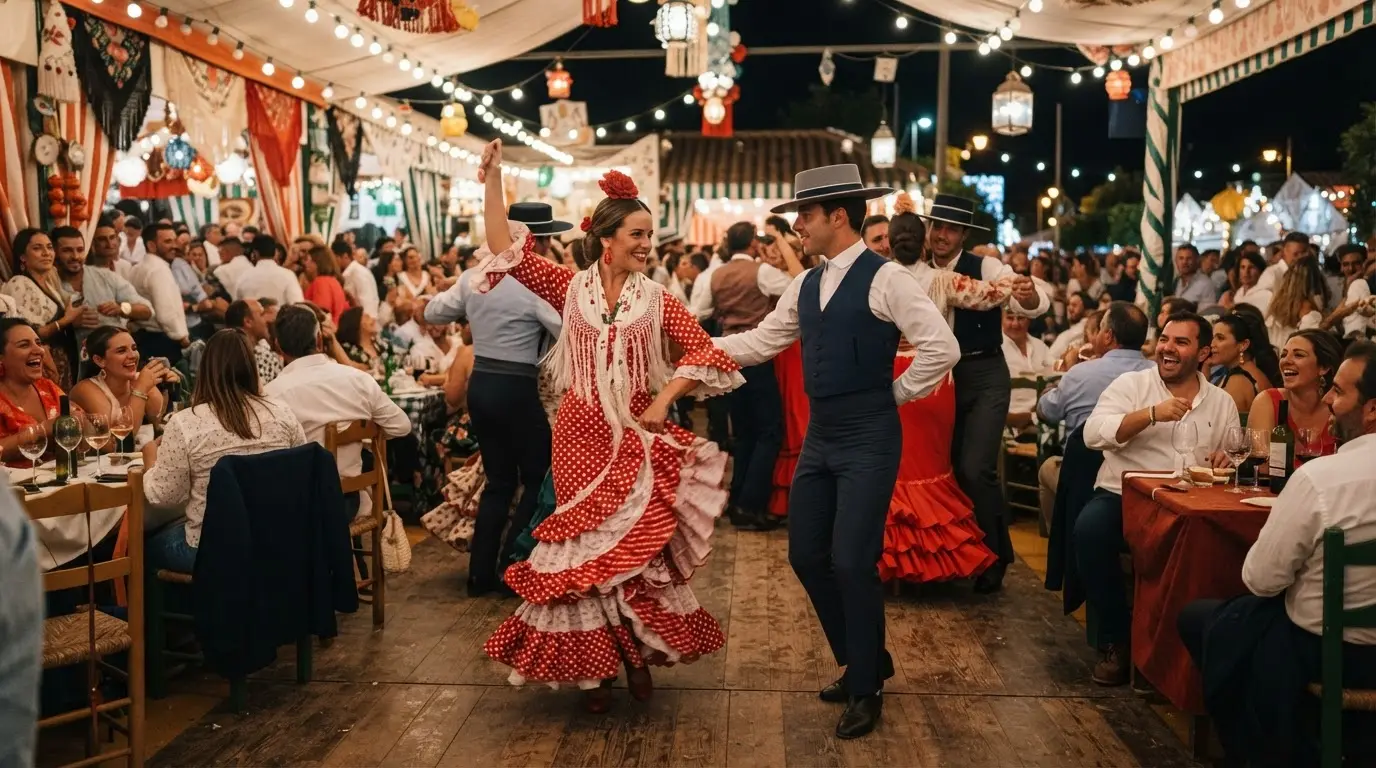
Primera copla (flirtation): The woman sets the tempo. The man approaches. The spacing is wide, the arms high, the gestures exploratory. Each partner is reading the other's rhythm before committing to shared movement.
Segunda copla (seduction): The distance closes. The careo becomes more sustained. Both dancers have found the shared beat; the courtship intensifies through footwork and held eye contact. The braceo (arm work) becomes more expressive here.
Tercera copla (mock anger): The dancers turn their backs. The zapateado footwork grows heavier, more percussive. This is the most dramatic section and also the one beginners find most disorienting, because the music sounds the same and the signal is physical.
Cuarta copla (resolution): Turns, reconciliation, a final approach. This is where the pasadas come closest and where the dance ends in a held position or an implied embrace.
Each copla contains four sub-movements: paseíllo (the opening walk), pasada (the crossing), careo (face-to-face), and remate (the end-phrase that closes the section). The music signals each transition. Beginners do not need to count bars; they need to listen for the phrase resolution, the moment the melody lands. It sounds different from the continuation phrases, and the body learns to distinguish it after three or four full run-throughs.
Three movements that build the dance
The full sevillana vocabulary runs to dozens of variations. These three form the core. Master them and you can navigate any copla without humiliating yourself.
Paso sevillanas is the foundational step. Weight shifts right-left with a punta-tacón (ball-heel) tap on each beat. The feet stay close to the floor; the sound is a metronome, not a drumroll. This step opens each copla and fills the transitions between movements. It is what a beginner's feet are doing 80% of the time on the floor. If you learn nothing else, learn this.
Pasada is the crossing movement. Partners weave around each other, front-to-back or back-to-front, trading places without touching. The drama is visual: two people orbiting the same point, the gap between them the width of a hand. In the primera copla, the pasada is tentative. In the cuarta, it is close. The variation in proximity is where most of the emotional arc lives.
Recommended tours
Tours are selected for quality, not commission. We earn a small fee if you book — at no extra cost to you.
Braceo is the arm work. Wrists circle outward, one hand leading the other. The mental image that teachers use most often: pick fruit from a tree, eat it, discard the skin. The arm extends (pick), the wrist circles inward (eat), the hand drops and opens (discard). It looks effortless when done well and looks exactly like what it is, a foreign gesture being consciously performed, when done badly. Braceo is the most neglected element by beginners, because the feet are already demanding full attention. It is also what separates someone dancing sevillanas from someone doing the movements of sevillanas.
Explore nearby · Monument
Caballerizas Reales de Córdoba
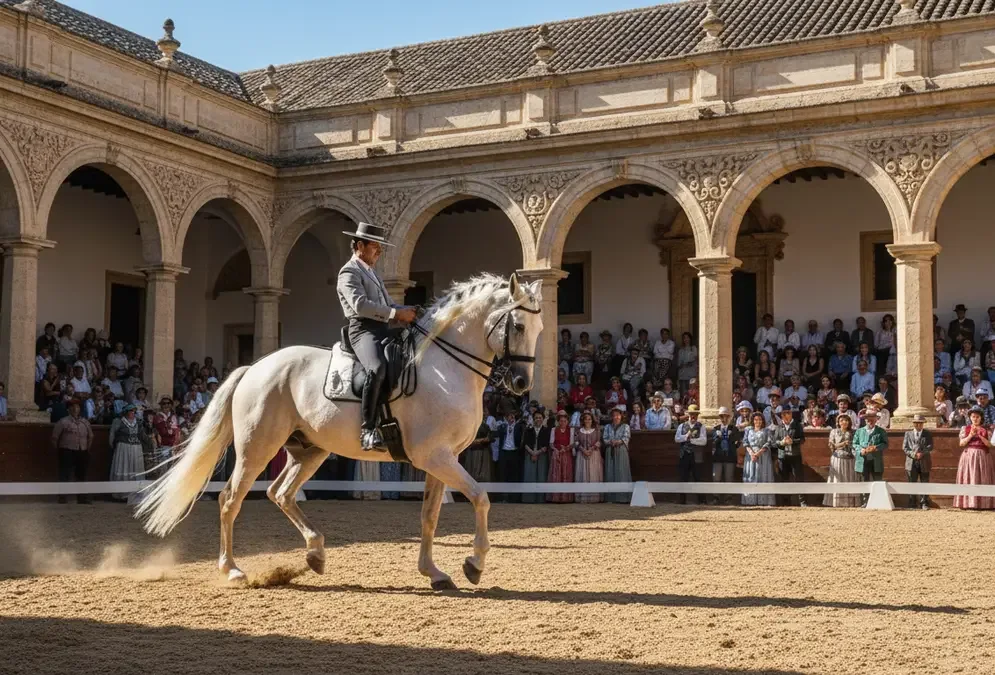
Philip II's 1568 Royal Stables, birthplace of the Andalusian horse. Evening show combining classical dressage, vaquera riding and flamenco. UNESCO heritage.
The practical sequence: spend the first hour on the paso. Add the pasada once the step is automatic. Leave the braceo until both feet and transitions are comfortable. Trying to coordinate all three at once is how people freeze on the floor.
Dancing at the Córdoba feria: what actually happens
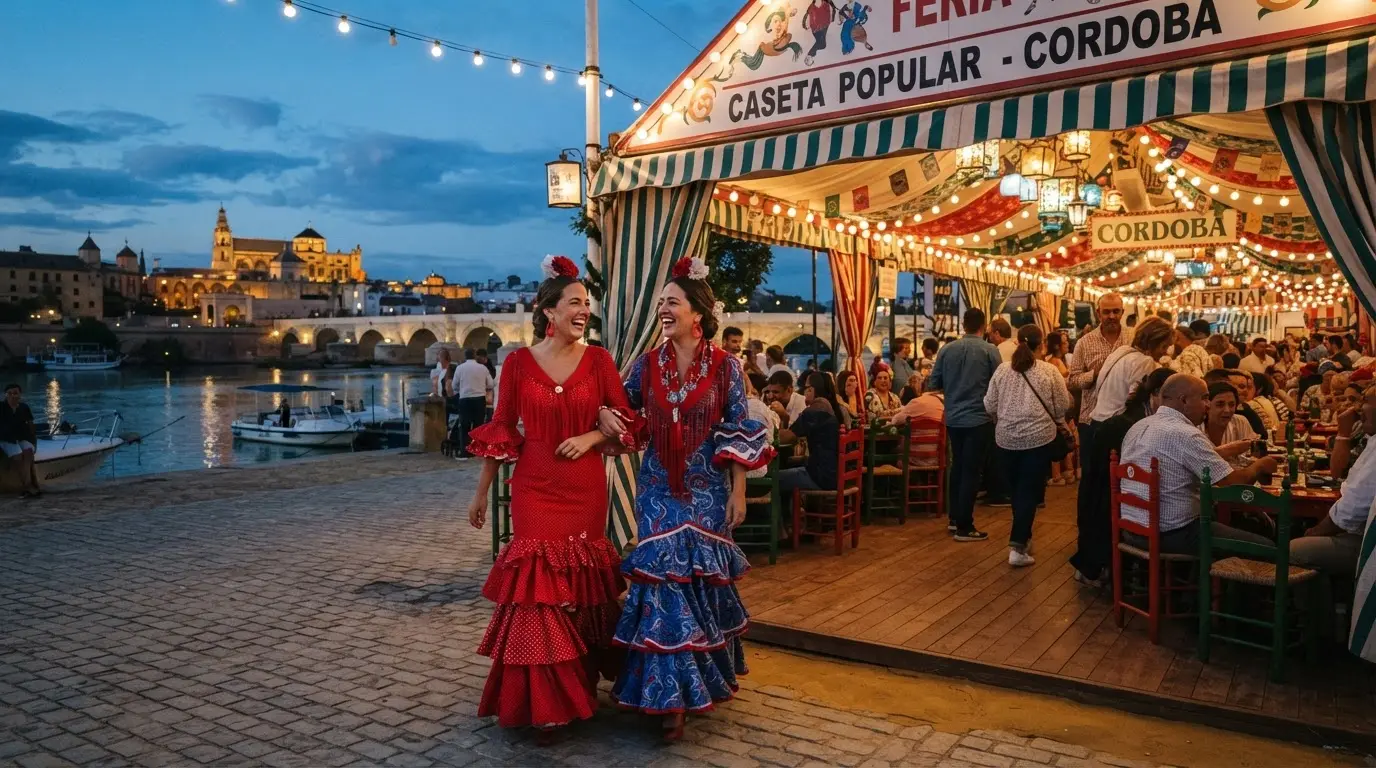
The Feria de Córdoba runs for eight days in late May at El Arenal, the fairground beside the Guadalquivir. 85 casetas are on site. Nearly all of them are open to anyone who walks in.[12]
That detail matters more than any advice about steps. In Seville, more than 90% of casetas are private and require an invitation. In Córdoba, the ratio inverts: neighbourhood associations, cultural groups, and peñas run public casetas as civic space. You walk in, find a table or a wall to lean on, order the fino-and-lemonade feria staple (3–5 EUR, fino mixed with lemonade over ice), and watch until you are ready to join. Nobody checks your name. Nobody cares about your dress code past the basic threshold of not wearing athletic gear.
The dancing starts around midday on weekdays but the floor is thin until early evening. Peak hour is 10pm to 2am, when the orchestras are live in the larger casetas and the floor is genuinely full. Tourists who arrive between 7 and 10pm find the easiest entry conditions: enough people dancing to follow, not so many that the floor is opaque.
The structure of any given caseta evening: sevillanas sets of 4–6 songs, short breaks, more sets. In the breaks, people return to their tables, refill glasses, talk. When the music starts again, anyone on the floor is implicitly inviting observation from anyone nearby. There is no formal rotation, but in neighbourhood casetas, regular partners drift toward each other and cycle through strangers without embarrassment. Full planning logistics are in the Córdoba feria guide.
Feria etiquette: how to join without looking lost
The phrase that opens every feria dance is "¿Bailamos?" You say it with your hand extended, palm up. The other person takes your hand or declines by shaking their head and gesturing toward their chair. Either response is complete. There is no implication beyond the single song.
Modern Córdoba casetas allow any gender combination to invite. Traditional pairings are mixed, but at open neighbourhood casetas this is loosely observed. Foreign visitors are given more latitude, not less.
Dress follows two parallel logics. Formal traje de flamenca (the ruffled dress) and traje corto (men's short jacket, tight trousers, and boots) are common on Thursday afternoon and the final Saturday. Casual festive dress, a summer dress or clean trousers, is fine for any evening, particularly during the first half of the week. What to avoid: athletic shoes, flip-flops, anything that looks like you are between transport stops. The caseta is a social space; dress as if you intended to be there.
Four mistakes beginners make reliably:
Deep dive · Article
Feria Córdoba vs Seville: The Real Differences
Córdoba's casetas need no invitation; Seville's 1,000+ are mostly private. Founded in 1284 vs 1847 — see how the two ferias compare, and why it matters.
- Forgetting the braceo. The arms hang, the upper body freezes, and the step looks mechanical.
- Dancing too close from the start. The first copla is meant to be distant.
- Setting a tempo that is too fast, racing the beat rather than riding it. The paso sevillanas is slow and grounded.
- The concentration face. Sevillanas is flirtatious; visible effort to remember the next movement kills the frame immediately. If you are not sure of the next move, slow down slightly rather than freeze.
"Estoy aprendiendo" (I'm learning) is enough explanation for anything that goes wrong. It is said, smiled at, and forgotten. The Córdoba feria is not a performance context; nobody is watching you except the person you are dancing with, and they are managing their own braceo.
Where the dance lives the rest of the year
Córdoba's dedicated flamenco museum documents the cante cordobés tradition: soleares cordobesas, alegrías cordobesas, the mountain fandangos of Lucena and Cabra. The collection is organised around Antonio Fernández Díaz, "Fosforito" (1932–2025), who took first prize in all categories at the Concurso Nacional de Arte Flamenco de Córdoba in 1956[19] and defined what cante from Córdoba's sierra meant. None of this is sevillanas directly, but it is the tradition that gives the dancing at the Córdoba feria its different weight compared to what happens in Seville's casetas.
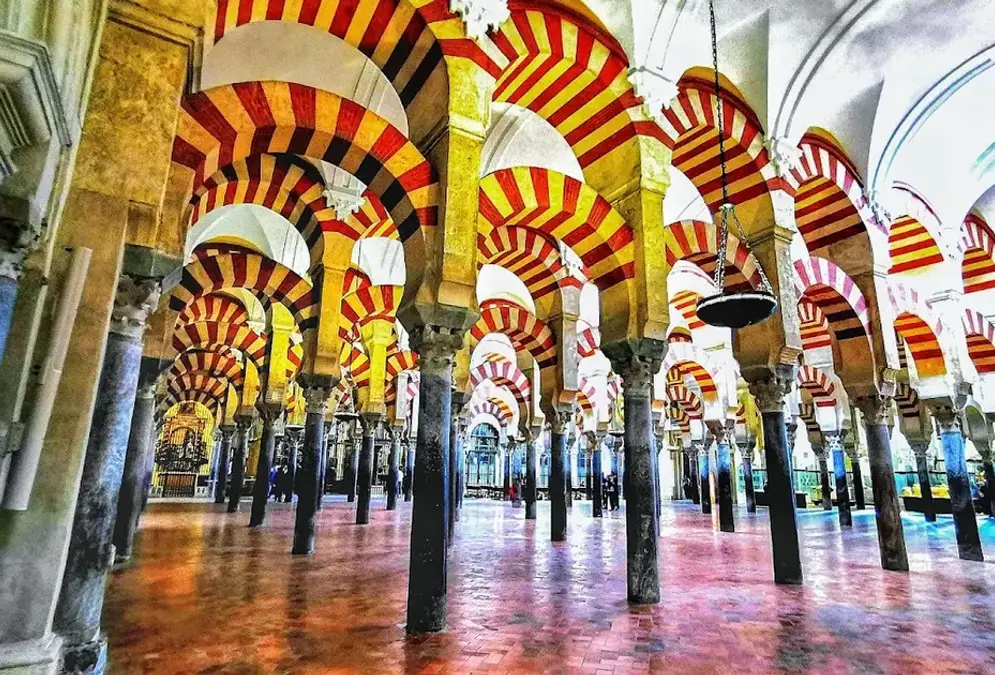
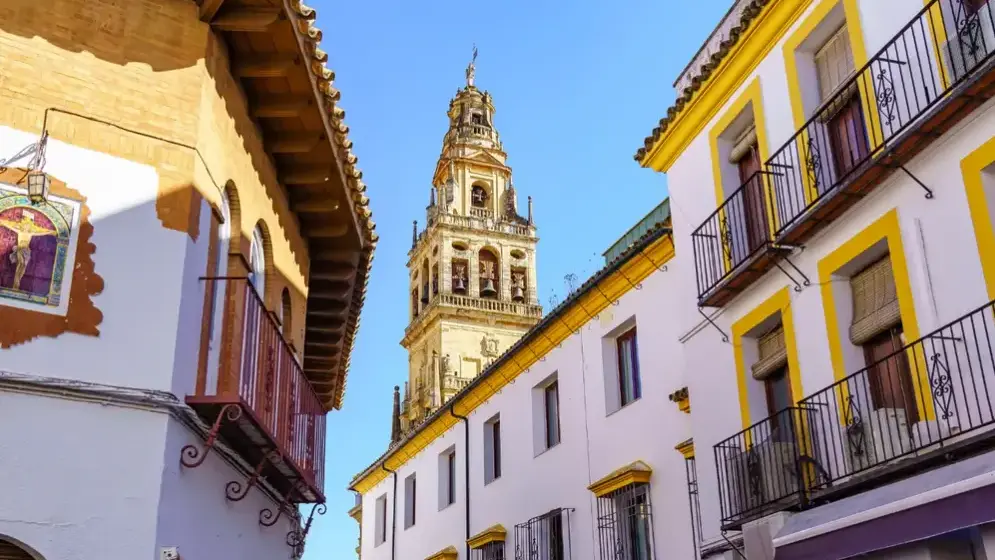
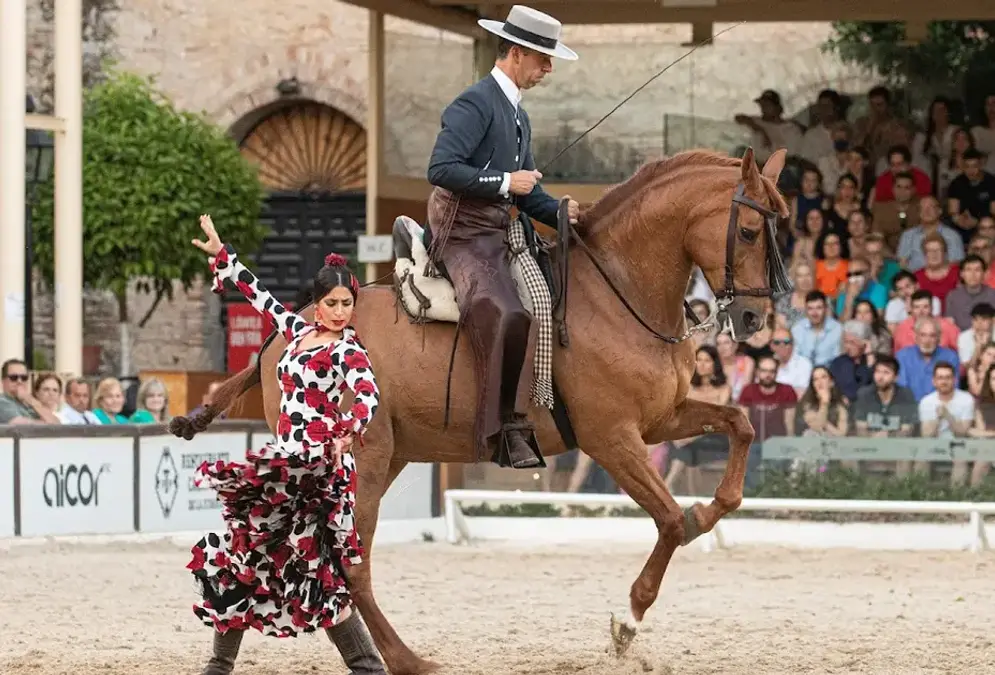
For live performance before or after the feria, the professional tablao by the Mezquita is where the city's professional flamenco schedule concentrates. The repertoire here is cante jondo rather than sevillanas, but watching a full tablao show before attempting the floor gives a calibration: you see what braceo looks like when the arms know what they are doing, and you hear the musical phrase structures that sevillanas borrows.
Read next · Activity
Flamenco Show at Tablao El Jaleo
Award-winning flamenco artists at Tablao El Jaleo, just 20 metres from the Mezquita in Córdoba's Jewish Quarter. Show with a drink from €30. Book ahead.
Each July, the Noche Flamenca de Zambra runs in the village of Zambra, a pedanía of the municipality of Rute in Córdoba province, at a sports venue beside the Anzur river[21] — not at the Alcázar de los Reyes Cristianos in Córdoba city, despite the shared name. The zambra itself is older than the feria circuit: the word comes from the Arabic zamr (oboe)[17], and the form carried connotations of Gitano ceremony, wedding ritual, and mountain village performance through the 16th and 17th centuries. Contemporary zambra at the Alcázar is theatrical, staged for summer tourists, but the form is genuine.
The Córdoba feria guide used to tell visitors to search YouTube to learn sevillanas. The casetas are already full of tourists who took that advice, and it shows. The ones who understood the four coplas before arriving were still on the floor at 2am. The others spent the same time watching from the edge, waiting for a moment that never felt right to join.