
The Hotel Viento10 occupies a former hospital on Calle Ronquillo Briceño, a quiet lane in the Judería. When the owners bought the building, they commissioned an archaeological survey before restoring it, and what came out from under the plaster was a Mudejar-style hospital dated to the 15th–16th centuries — the Hospital of the Holy Martyrs, according to the archaeologists who carried out the work. Centuries of cement had hidden the original structure; stripping it back revealed 16th-century columns still lining the central courtyard. The building became a seven-room boutique hotel in 2010. It's rated two stars officially, but that classification says nothing about what's actually inside.
What the Restoration Uncovered
The contrast is immediate at the entrance: stone walls, vaulted brick ceilings, original terracotta floors, and contemporary furniture with clean lines. Old and new alongside each other, neither apologising for the other. The 16th-century columns around the patio are the clearest surviving trace of the Mudejar hospital, and the reason this restoration reads as archaeology rather than decoration. The seven rooms are each different. The ground-floor rooms have the original stone floors and low arched ceilings; the upper rooms are lighter, with wooden beams and more natural light. All have air conditioning, essential from June to September, along with premium-quality bedding, whisper-quiet climate control, and marble bathrooms with good water pressure.
The top-floor room is the one to ask for: it has a private terrace with rooftop views over the Judería, large enough for two chairs and a table. Book it early.
Rooms Designed Room by Room
Each of the seven rooms was furnished individually rather than to a repeated template, with local textiles and artisan-made headboards rather than chain-hotel furniture bought in bulk. The ground-floor double has the lowest ceilings and the strongest sense of being inside a medieval structure, stone underfoot and brick overhead. The first-floor rooms catch more afternoon light and have views over the narrow lane below, which stays quiet after the day-trippers leave. All rooms include quality mattresses with 300-thread-count linen, bath robes, and minibar. The bathroom fixtures are contemporary, which means hot water that actually arrives quickly and showers with proper pressure. For couples, the hotel's size means there's no corridor noise, no slamming lift doors at midnight, no groups arriving late.
The Underground Spa in the Old Hospital Vaults
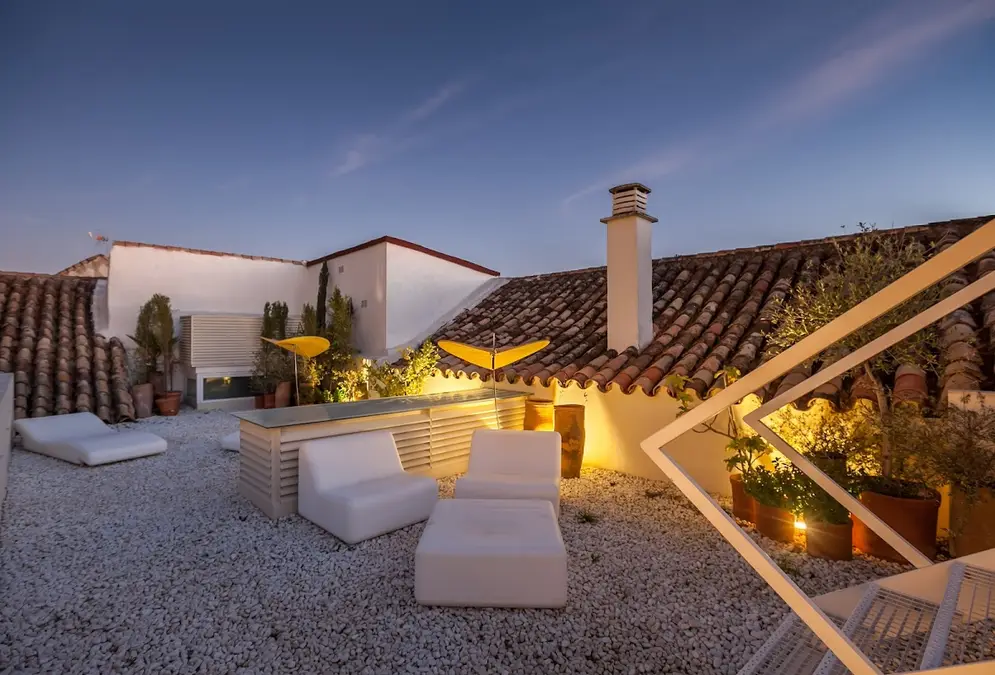
The sauna and jacuzzi sit in a vaulted underground chamber that feels like a grotto — the kind of space that only survives in a building this old, because nobody builds like this anymore. It's a deliberate use of what the hospital left behind rather than a bolted-on amenity. The session is included for guests and needs to be reserved at check-in for a time slot; massages are available by appointment. The rooftop terrace completes the arc from underground vault to open sky: private and quiet, with tile rooftops, white sunbeds and yellow umbrellas, and the Mezquita-Catedral 300 metres away.
On summer evenings, the rooftop is where guests drift after dinner. The air cools noticeably after 9 pm, and the lit towers of the Mezquita are visible from the terrace long after the monument closes. In spring, the scent of orange blossom rises from the streets below.
An Owner Who Lives on the Premises
The owner lives on site. There are never more than fourteen guests at once. The atmosphere is relaxed in a way that only happens at small hotels run by people who actually care about the place — closer to staying with someone who knows the neighbourhood than checking into a hotel. Breakfast can be arranged and delivered to the room or taken in the patio area. The owner knows which restaurants have changed recently and what's worth seeing that isn't in the guidebooks.
Check-in runs 15:00 to 20:00 on weekdays and weekends. This is worth noting if you plan to arrive by train from Madrid (the 5:30 pm AVE arrival works well) or are flying into Córdoba from Seville or Malaga. Early luggage storage can be arranged directly with the hotel.
The Calleja de las Flores is 2 minutes on foot, the Mezquita-Catedral 300 metres, about 4 minutes at a normal pace, and the Hammam Al Andalus 3 minutes. The Alcázar de los Reyes Cristianos is 10 minutes through the old city walls, and the Roman Bridge over the Guadalquivir is 8 minutes. The price point, from €80 per night, represents good value for a restored Mudejar building this close to the old city's core.