
familiesoutdoorcouples
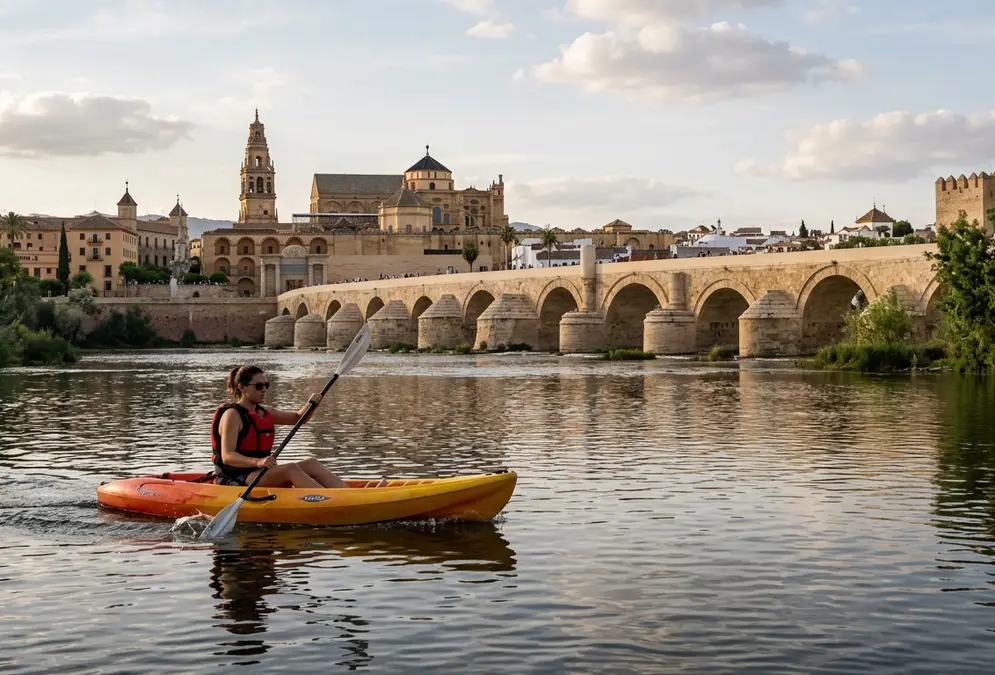
Kayak on the Guadalquivir river in Córdoba with the Roman Bridge and Mezquita in the background
Experience

Guadalquivir River Experience

Experiencia en el Río Guadalquivir

1.5–2 hours (kayak tour) or 45–60 min (riverside walk)
Kayak tours April to October, daily by booking. Riverside walk free access year-round; best April–October.
Guadalquivir Activo, Villafranca de Córdoba (15 min from central Córdoba by car)
Families Outdoor Couples Nature Entertainment

Two ways to experience the river

This page covers two distinct experiences: a guided kayak or canoe tour departing from Villafranca de Córdoba (15 min by car, €12–30, April–October), and a free self-guided walk along the Paseo de Córdoba starting at the Roman Bridge. Choose one, or combine both in a single morning.

Kayak & Canoe Tour

Duration
1.5–2 hours
Price
From €12 per person
Season
April to October
Departure
Villafranca de Córdoba (15 min by car)
Book
+34 626 941 988 (Guadalquivir Activo)
Group size
Small groups. Family & private bookings available.

Free Riverside Walk

Duration
45–60 minutes (3 km one-way)
Price
Free
Best time
Year-round — best April to October
Start point
Torre de la Calahorra, Roman Bridge south bank
Accessibility
Flat path, suitable for prams and wheelchairs

Getting there

The kayak departure point (Guadalquivir Activo) is in Villafranca de Córdoba, 15 minutes from the city centre by car. There is no city bus connection — arrange a car, taxi, or rental in advance. The riverside walk starts directly at the Roman Bridge and requires no transport.
Book this activity

The Guadalquivir River shaped Córdoba more than any ruler or architect. It powered the city's medieval water mills, carried its trade, and still frames the most photographed views of the Mezquita and the Roman Bridge. Getting on the water or along its banks puts you directly in that frame, looking back at 2,000 years of city-building from a perspective you simply cannot get from a stone pavement.

Kayak and canoe on the Guadalquivir

Guadalquivir Activo runs the main guided kayak and canoe routes on the river. Based in Villafranca de Córdoba, 15 minutes from the city centre, they send you out on 1.5 to 2-hour routes that follow the river's bend past the Mezquita's cathedral bell tower, the Roman Bridge arches, and the Torre de la Calahorra rising above the south bank. You also pass the aceñas, the medieval water mills whose stone foundations still break the surface mid-river.

All equipment comes with the booking: boat, paddle, life jacket, and helmet. Instructors are certified and the tours are designed for complete beginners. Price runs €12 to €30 per person depending on the route and season. Book by phone (+34 626 941 988) or through their website.

TNT Aventura offers a second option with similar kayak and canoe routes, also using the Roman Bridge and Mezquita stretch as the visual centrepiece.

The riverside walk: Paseo de Córdoba

For something free and entirely on your own schedule, the Paseo de Córdoba runs roughly 3 km one-way from the Roman Bridge south bank around to the Alcázar area. The path is flat, well-maintained, and wide enough that it never feels crowded outside peak summer weekends.

What you see along the walk: the Roman Bridge itself as a starting marker, the Torre de la Calahorra at close range, the aceñas in the river, white storks nesting in season on the riverside structures, and long views back toward the Mezquita and the old city rising behind the stone parapet. The riverside vegetation, poplars and eucalyptus, provides patches of shade that become essential by late morning in July and August.

Allow 45 to 60 minutes for the walk at a comfortable pace, or shorter if you turn back at any of the landmarks.

When to go

The river is at its best from April to October. The sweet spots are April to May and September to October: temperatures run 18 to 25°C, the light is good for photography, and the paths and tours are not crowded. July and August hit 35°C or more, which makes the riverside walk uncomfortable between 10 am and 6 pm. If you are visiting in high summer, do the kayak tour early morning or stick to the riverside walk around sunset.

For kayak tours, the season runs April to October. Book ahead for spring weekends, when local families fill the slots.

What you will see from the water

The kayak perspective is genuinely different from any land view. The Mezquita's mass reads differently from the water, its bell tower (built into the original minaret) aligned against the treeline. The Roman Bridge arches frame the city behind them. Wildlife on the Guadalquivir includes white storks, birds of prey riding thermals above the old city walls, and the native riverbank vegetation that lines both shores.

Practical logistics

Kayak departure point: Guadalquivir Activo's base in Villafranca de Córdoba, around 15 minutes by car from central Córdoba. Riverside walk access: start at the Torre de la Calahorra end of the Roman Bridge, where parking is available on Paseo de la Ribera. Bring water, sunscreen, and a hat for either option. A camera with a zoom lens makes the most of the Mezquita and bridge views from the water.

Combine the river morning with a visit to the Alcázar de los Reyes Cristianos, whose gardens back directly onto the Guadalquivir just upstream of the Roman Bridge.

Highlights

  • Kayak or canoe the Guadalquivir past the Roman Bridge and Mezquita from €12
  • Views of Torre de la Calahorra and medieval aceñas (water mills) from the water
  • Guided tours for beginners: all equipment provided, certified instructors
  • Free 3 km riverside walk along Paseo de Córdoba, flat and accessible
  • White storks and birds of prey visible from the river and banks
  • Best April–May and September–October for mild temperatures and fewer crowds
  • Combine with Alcázar gardens, Roman Bridge, and Mezquita in a single morning

Included

  • Kayak or canoe boat
  • Paddle, life jacket, and helmet
  • Professional guide with certified instructors
  • All safety equipment

Not included

  • Transport to departure point in Villafranca de Córdoba
  • Riverside walk (independent, free — not part of the guided tour)
  • Food and drinks
  • Wetsuit (not required in April–October)

When to Visit

Best season

April–May and September–October for kayak tours: mild temperatures, good photography light, and fewer crowds. July–August kayaks are possible only in early morning. Riverside walk is pleasant year-round except July–August midday heat.

Quietest hours

Book the 9 am kayak slot in spring for the best light and quiet water. The riverside walk is emptiest after 8 pm in summer when families head to dinner and the golden-hour light on the old city walls is the payoff.

Visit duration

2.5–3.5 hours for the kayak tour (including 15 min drive to Villafranca and 1.5–2 hours on the water). The riverside walk takes 1–1.5 hours self-paced from the Roman Bridge.

Reporter notebook

Insider tips

Best time

Book the kayak for 9 am in spring — the light on the Mezquita is best before 11

The early morning slot puts you on the water when the terracotta and stone of the Mezquita catch low-angle light. By midday the sun is overhead and the contrast flattens. April and May also mean cooler air temperatures and the river is quieter than July, when tour groups crowd the same stretch.

Photo spot

Shoot the Roman Bridge from the water, not from the bridge itself

Every tourist photograph of the Puente Romano is taken from the bridge looking toward the Torre de la Calahorra. From a kayak at water level, you get the full arch span with the Mezquita tower behind it — a composition almost no one has. Midmorning light from the south bank direction works best.

Crowd tip

The riverside walk empties out after 8 pm on summer evenings

July and August afternoons are genuinely unpleasant on the Paseo de Córdoba due to heat and weekend crowds. Come back at 8 pm: the temperature drops fast, families head to dinner, and you often have the Alcázar-to-Roman-Bridge stretch nearly to yourself. The golden-hour light on the old city walls at that time is the payoff.

Good to know before booking

  • No prior kayak or canoe experience required
  • Minimum age typically 6 years (confirm with operator)
  • Comfortable swimwear or quick-dry clothing recommended
  • Sunscreen and hat essential in spring and summer

Frequently asked questions

What water activities are available on the Guadalquivir in Córdoba?

The main option is guided kayak or canoe tours operated by Guadalquivir Activo (and TNT Aventura as a second operator). These 1.5 to 2-hour tours run along the stretch of river beside the Roman Bridge and Mezquita, passing medieval water mills (aceñas) and the Torre de la Calahorra. All equipment is provided and no prior experience is needed. Traditional boat tours departing from central Córdoba are very limited; kayak and canoe are the primary way to get on the water.

When is the best time to kayak or walk along the Guadalquivir?

April to May and September to October are the best months: temperatures sit at 18 to 25°C, crowds are manageable, and the river light is good for photography. July and August are hot (35°C or more) and less comfortable for the riverside walk, though early-morning kayak tours still work well in high summer. The kayak season runs April to October; the riverside walk is accessible year-round.

How do I get to the Guadalquivir Activo kayak departure point?

Guadalquivir Activo is based in Villafranca de Córdoba, about 15 minutes from central Córdoba by car. You need your own transport or a taxi to reach the departure point — it is not on the city bus network. Call ahead to confirm the exact meeting point and current availability: +34 626 941 988.

Is the Guadalquivir river activity suitable for families with children?

Yes. The kayak and canoe tours are designed for beginners and are suitable for families, with all safety equipment provided and certified instructors on the water. Confirm the minimum age for children with the operator when booking (typically from age 6). The riverside walk along Paseo de Córdoba is flat and easy for all ages, with no steps or difficult terrain along the main 3 km stretch.