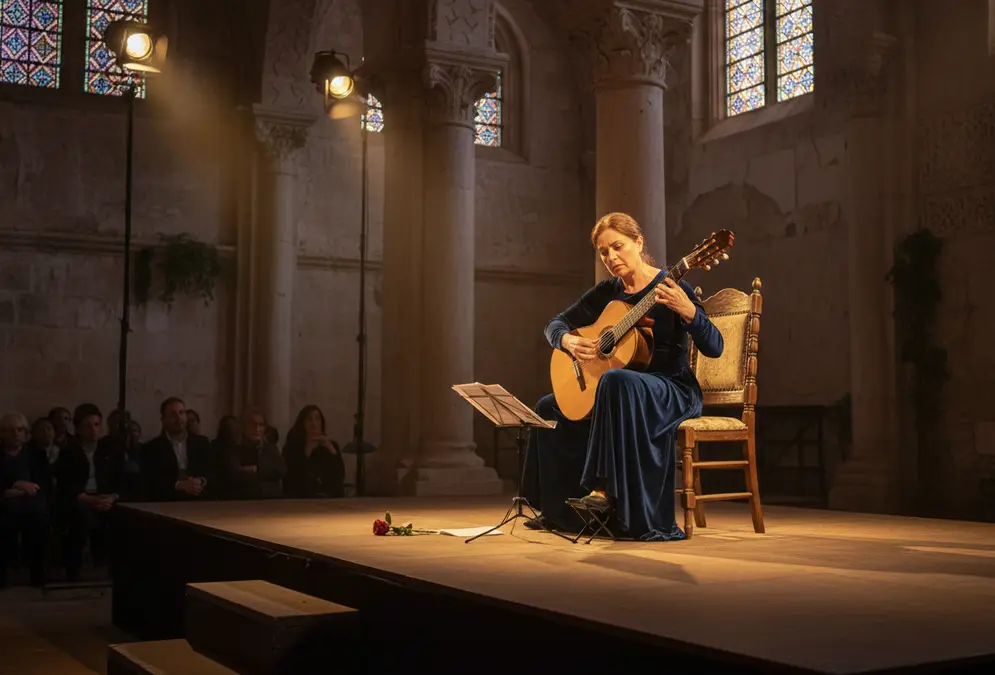
Late June – Early July · Since 1980
International Guitar Festival Córdoba
Two weeks when Córdoba becomes the guitar capital of the world. Flamenco, classical, jazz, rock: world-class artists across four venues, from late June to early July each year.

Written by
María Fernanda González Ten years covering Córdoba's UNESCO heritage sites, sourcing from Junta de Andalucía documentation.
Updated Published
At a glance
- Dates
- Late June – Early July (annually)
- Main venue
- Gran Teatro de Córdoba
- Tickets
- €10–45 per show; free outdoor concerts
- Styles
- Flamenco, classical guitar, jazz, world music
- Since
- 1980, one of the world's top guitar festivals
- Book ahead
- Top acts sell out weeks in advance
In this guide
Jump to a section
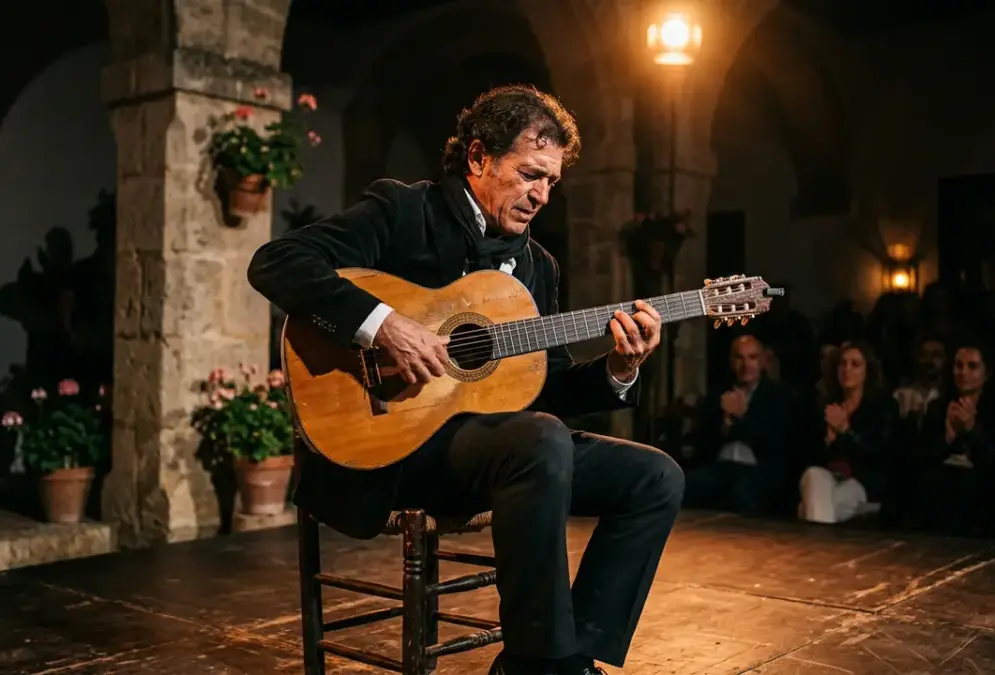
45 years in Córdoba
The International Guitar Festival of Córdoba started in 1980 with a specific idea: bring the world's finest guitarists to the city where Paco Peña was born, across a programme that would refuse to pick a lane. Flamenco, classical, jazz, blues, Latin, baroque: not one at a time but all together, because the guitar belongs to all of them.
The founding story runs through the Posada del Potro, the old inn on the square where Cervantes once slept. That is where the first intensive guitar courses were held, the seed from which the festival grew. Forty-five editions later, those courses survive as the masterclass programme at the Conservatorio Rafael Orozco.
Over the years the festival has hosted artists whose presence says something about how seriously it takes its mandate. Paco de Lucía, Tomatito, Gary Moore, Bob Dylan, Mark Knopfler, Pat Metheny, Carlos Santana: the list reads like a survey of guitar playing in the late 20th century. The guitar festival does not just showcase guitar; it has become part of the argument for why the guitar matters.
What makes it different from other music festivals
Most festivals organise around genre. The Guitar Festival organises around instrument. That single constraint (everything must involve the guitar) creates a programme with more internal variety than festivals three times its size. A classical recital at the Teatro Góngora at 8:30pm, then a rock concert at the Axerquía at 10:30pm: the guitar connects them, even if the audiences barely overlap.
The education strand matters too. Around 200 students from across the world attend masterclasses alongside the concerts, studying with the same artists who performed the night before. It changes the atmosphere of the city during those two weeks: Córdoba feels like it is thinking about music, not just hearing it.
See also: flamenco in Córdoba guide and the festival event page for updated programme details.
Flamenco at the festival
Flamenco is where the festival began, and it remains the emotional centre of the programme. The Gran Teatro and the Teatro Góngora divide the work between them: the larger house for the bigger names, the intimate Góngora for concerts where the proximity changes how you hear the music.
Past editions have featured flamenco guitarists of the highest calibre — names like Vicente Amigo, Juanfe Pérez, Paco de Lucía and Tomatito have all graced the festival stages. The Góngora flamenco nights are consistently the first to sell out: the 552-seat house fills within days of tickets going on sale.
Góngora flamenco nights: book these first. The 552-seat Teatro Góngora sells out within days of the programme going on sale, sometimes faster. This is the most intimate venue at the festival; proximity to a working guitarist at full concentration is something you cannot replicate in a larger house. Once those tickets are gone, they are gone.
Classical guitar
The classical programme runs mostly at the Teatro Góngora, where 552 seats and decent acoustics make the solo guitar audible in all the ways it deserves. The artists who perform here bring with them decades of international concert careers.
Previous editions have hosted classical masters such as David Russell, Manuel Barrueco, María Esther Guzmán and many others. The Góngora's intimate setting means you can see a player's hands, track the attack on every note — a very different experience from a larger concert hall.
Contemporary and rock
The Teatro Axerquía handles most of the contemporary programme: 3,934 seats with a semi-outdoor setup suited to summer evenings and high volumes. Concerts here start later (10:30pm and 11pm), so they work well after dinner. The Gran Teatro also takes some of the more theatrical contemporary acts.
Past editions have featured major Spanish contemporary acts including Love of Lesbian, Luz Casal, Loquillo, Siloé, and WarCry. These headline shows consistently sell out, so book as soon as tickets go on sale.
Sell-out alert: The biggest contemporary and rock acts consistently sell out. Book as soon as tickets go on sale at entradas.teatrocordoba.es.
The four venues
All venues are in or near the historic centre. Walking between the Gran Teatro and the Teatro Góngora takes about ten minutes. The Axerquía is a 20–30 minute walk from the centre, or a short taxi.
Gran Teatro de Córdoba
Avenida Gran Capitán 3 · 990 seats
Classical, flamenco, jazz, symphonic rock
Opened in 1873, the Gran Teatro has an Italian horseshoe auditorium that rewards the repertoire it hosts. The main festival venue. Tickets run €10–27.
Teatro Góngora
Near Plaza de las Tendillas · 552 seats
Classical guitar, intimate ensemble concerts
Named after the Córdoban poet Luis de Góngora. The smaller capacity works in favour of the music: classical and chamber concerts land differently here than they would in a bigger hall. Tickets €12–15.
Teatro de la Axerquía
Avenida Menéndez Pidal 1 · 3,934 seats
Contemporary, rock, indie, metal
A large semi-outdoor venue near Parque Cruz Conde. The open-air element suits summer evenings. The bigger capacity means tickets for rock and pop shows here are usually still available closer to the date, though the headline acts sell out first. Tickets €25–45.
Conservatorio Rafael Orozco
Córdoba city centre · Masterclass format
Masterclasses and workshops
Host of 20+ intensive masterclass sessions during the festival, running 10am–2pm daily. The venue where the education strand of the festival has always lived.
Venue comparison at a glance
| Venue | Capacity | Programme | Tickets |
|---|---|---|---|
| Gran Teatro | 990 | Classical, flamenco, jazz | €10–27 |
| Teatro Góngora | 552 | Classical, intimate sets | €12–15 |
| Teatro Axerquía | 3,934 | Rock, indie, metal, pop | €25–45 |
| Conservatorio | Masterclass | Workshops, courses | Varies |
Masterclasses and workshops
The education programme runs during the festival at the Conservatorio Rafael Orozco, with sessions daily from 10am–2pm. More than 20 masterclass sessions cover the full range of guitar traditions represented in the festival. Past teachers have included Manolo Sanlúcar and Tomatito, artists who have been coming to Córdoba for decades and who bring the same seriousness to teaching that they bring to performing.
Disciplines offered
- · Classical guitar technique
- · Flamenco guitar and cante
- · Jazz improvisation on guitar
- · Contemporary composition
- · Guitar lutherie (instrument making)
- · Flamenco accompaniment
- · Guitar and ensemble writing
When
During the festival
Daily, 10:00am–2:00pm
Where
Conservatorio Rafael Orozco
Córdoba city centre
Registration
Register online at guitarracordoba.es. Some demonstration sessions are open to the public without registration; check the official website for the current year's schedule.
Tickets and prices
Gran Teatro concerts
€10–27Classical, flamenco and jazz concerts. The most affordable tickets at the festival for the quality on offer.
Teatro Góngora concerts
€12–15Intimate classical and chamber concerts. The small capacity means these go fast; book as soon as dates are announced.
Teatro Axerquía concerts
€25–45Rock, indie, pop and metal. The larger venue means more tickets available, but headline acts sell out.
Season passes (abonos)
If you are attending multiple concerts, the festival offers two abono discounts:
- ·Same-venue abono (25% off): buy three or more concerts at the same venue and the discount applies automatically at checkout.
- ·À la carte abono (20% off): mix concerts across different venues; the discount kicks in at three or more shows selected across the programme.
Where to buy
Online: entradas.teatrocordoba.es, the primary booking system for all festival venues
Box office: 957 480 292 / 957 480 644
Email enquiries: comunicacion@guitarracordoba.es
Booking tips
- ·Book the headline acts first: these are consistently the first to sell out
- ·Teatro Góngora classical concerts (€12–15) sell quickly due to small capacity, so buy early
- ·Mix one classical and one contemporary evening; the contrast is worth planning for
- ·Axerquía is semi-outdoor. July evenings are warm (often still 28–30°C at 10pm), dress accordingly
Plan your evening
Classical concerts at the Gran Teatro and Góngora start at 8:30pm. That means dinner at 7pm works, with enough time to eat without rushing. Contemporary concerts at the Axerquía don't start until 10:30pm or 11pm, so you have the whole evening before you need to head there.
Suggested evening flow (classical concert)
7:00pm
Dinner at a restaurant in the historic centre; 90 minutes is comfortable
8:15pm
Walk to the Gran Teatro or Teatro Góngora (both within 10 min of the Mezquita)
8:30pm
Concert begins
10:30pm
Post-concert drink at a bar near the venue; the city is still very much awake in July
Suggested evening flow (Axerquía concert)
8:00pm
Early dinner or extended tapas crawl; you have time
10:00pm
Head to Teatro Axerquía (taxi recommended if walking in July heat)
10:30pm
Concert begins
Dinner options near the venues
Bodega Mezquita
Traditional tapas, a five-minute walk from the Gran Teatro. Reliable and popular; worth booking ahead during festival week.
Taberna de San Nicolás
Historic bodega with Montilla-Moriles wines. The fino is good, the atmosphere is genuinely local. Close to the historic centre.
Taberna Los Omeyas
Late-night tapas, which matters when your concert ends at midnight. In the Judería, close to the main festival venues.
See the Córdoba in summer guide for tips on visiting the city in summer, including how to handle the heat and which monuments to visit in the cooler early morning hours.
2026 edition highlights
The 45th edition (2026) featured a diverse programme across all three venues. Here is a look at the artists who performed — a good indication of the calibre and range you can expect from future editions.
Flamenco artists
Vicente Amigo
Flamenco Spanish
Gran Teatro
25–26 June 2026 · 20:30
€10–27
Born in 1967 in Guadalcanal, Andalusia, Vicente Amigo grew up in Córdoba and spent ten years studying under the legendary Manolo Sanlúcar. Pat Metheny called him the greatest player of the Spanish guitar. He won the 2001 Latin Grammy for Best Flamenco Album with 'Ciudad de Las Ideas'. His style pulls traditional flamenco into the present without letting go of its roots.
Juanfe Pérez
Flamenco Spanish
Teatro Góngora
7 July 2026 · 20:30
€12–15
Spanish flamenco guitarist known for emotional depth and authentic technique. His playing keeps the formal structures of traditional flamenco alive while giving them room to breathe.
Classical guitar artists
Manuel Barrueco
Classical Cuban
Teatro Góngora
2 July 2026 · 20:30
€12–15
Born in 1952 in Santiago de Cuba, Manuel Barrueco is among the most respected classical guitarists in the world. He studied at the Peabody Conservatory and went on to record Rodrigo's Concierto de Aranjuez with Plácido Domingo, a version that Classic CD Magazine called the finest on record. Grammy-nominated in 2007 for Best Instrumental Soloist Performance.
María Esther Guzmán
Classical / Flamenco Spanish
Teatro Góngora
5 July 2026 · 20:30
€12–15
A distinguished Spanish guitarist who works equally comfortably in classical and flamenco traditions. Her concerts tend to be precise where they need to be and loose where they should be, a balance that takes years to find.
David Russell
Classical British
Teatro Góngora
9 July 2026 · 20:30
€12–15
David Russell is one of the most consistently compelling classical guitarists performing today. Born in Scotland and raised in Spain, his interpretations are measured, unhurried, and entirely his own. His discography is extensive and widely admired.
Contemporary and rock artists
Love of Lesbian
Indie pop Spanish
Teatro Axerquía
1 July 2026 · 22:30
€25–45
Formed in 1997 in Sant Vicenç dels Horts near Barcelona, Love of Lesbian have spent nearly three decades building one of the most dedicated fanbases in Spanish music. Santi Balmes leads a band that has never lost its sense of playfulness, even when the songs get serious.
Sanguijuelas del Guadiana + Aslándticos
Rock / Alternative Spanish
Teatro Axerquía
2 July 2026 · 22:00
€25–45
A double bill pairing two acts from the Spanish independent rock circuit. Sanguijuelas del Guadiana are a rock band from Extremadura; Aslándticos bring an energetic alternative sound. Together they make for one of the more unpredictable evenings on the Axerquía programme.
Teddy Bautista
Symphonic rock Spanish
Gran Teatro
3 July 2026 · 20:30
€10–27
Eduardo 'Teddy' Bautista has been one of the more restless figures in Spanish music since the 1970s. His 1974 album 'Ciclos', which reworked Vivaldi's Four Seasons as symphonic rock, remains a landmark. He later played Judas Iscariot in the Spanish production of Jesus Christ Superstar. Concert title: El Periplo de las Heroínas.
José Antonio Rodríguez Quintet
Jazz / Flamenco fusion Spanish
Gran Teatro
4 July 2026 · 20:30
€10–27
A quintet built around one of Spain's most inventive jazz-flamenco guitarists. José Antonio Rodríguez's compositions move between both traditions without settling into either; the quintet format gives each element space to develop.
WarCry / Angelus Apatrida
Heavy metal Spanish
Teatro Axerquía
4 July 2026 · 22:00
€25–45
Two of Spain's leading heavy metal bands sharing one stage. WarCry from Asturias and Angelus Apatrida from Albacete, both with long records and devoted followings. The festival's most straightforwardly loud evening.
Siloé
Indie / Contemporary Spanish
Teatro Axerquía
5 July 2026 · 22:30
€25–45
Spanish indie and contemporary group representing the current independent music scene. A good choice for anyone wanting to hear where Spanish guitar-led music is heading.
Luz Casal
Pop / Rock Spanish
Teatro Axerquía
8 July 2026 · 21:30
€25–45
Luz Casal reached international audiences in 1992 through Pedro Almodóvar's film 'High Heels', where her version of 'Piensa en mí' became one of the most recognised Spanish songs abroad. She has sold over five million albums. Her 2009 record 'La Pasión' went platinum in France. Concert title: Luz Casal (with guests).
Loquillo
Rock Spanish
Teatro Axerquía
9 July 2026 · 22:30
€25–45
José María Sanz Beltrán started making records under the name Loquillo in the early 1980s and has not stopped. His urban rock (influenced as much by film noir and nocturnal Madrid as by American rock and roll) occupies its own corner of Spanish music. Concert title: Loquillo: Gira 2026.
Leo & Leo
Pop / Crossover Spanish / American
Teatro Góngora
10 July 2026 · 20:30
€12–15
A duo pairing Leonor Watling (Spanish actress and singer) with Leo Sidran (pianist and composer, son of Ben Sidran). Concert title: Leo & Leo (Leonor Watling & Leo Sidran). Their crossover set draws from pop, jazz, and contemporary composition.
La Reina Blanca
Tribute Spanish
Gran Teatro
11 July 2026 · 20:30
€10–27
The closing concert of the 45th edition: a tribute to Blanca del Rey, performed by a special ensemble assembled for the occasion. A fitting farewell for a festival that has always honoured the people who shaped it.
Frequently asked questions
Do you need to book tickets in advance, or can you buy at the door?
Book early across all three venues, and book the Teatro Góngora flamenco concerts first. The 552-seat Góngora sells out within days of going on sale; the small capacity means a single good review or social post can clear the remaining seats overnight. Tickets go on sale online roughly two months before the festival opens; Gran Teatro and Axerquía headline acts also sell out fast. Buy the moment the programme is announced. Do not wait to see how the schedule fills out.
Is there anything free at the festival?
Yes. The festival typically programmes a handful of free outdoor concerts in the city's squares and patios, usually scheduled for early evenings when the heat has dropped. Informal sessions also happen around the Judería and Plaza de las Tendillas during festival days: nothing ticketed, but worth being in that part of the city after 9pm. The conservatorio courtyard sometimes hosts informal pre-class recitals open to anyone passing through.
Can non-musicians attend the masterclasses as observers?
Generally yes. The masterclasses are open to general audiences as well as students, and watching a working guitarist receive feedback from a master teacher is one of the more instructive ways to spend a morning at the festival. Arrive a few minutes early: sessions run 10am–2pm daily during the festival and seating in the Conservatorio Rafael Orozco is limited. You are not expected to participate, but the atmosphere is closer to a working rehearsal than a concert.
How do you combine the festival with visiting Córdoba's monuments?
The evening concert schedule works naturally around Córdoba's monuments. The Mezquita opens from 8:30am in summer, so a morning visit leaves afternoons free before evening concerts. The festival's late June to early July window also puts you in the city after the main peaks of Semana Santa and the Patios Festival, meaning shorter queues at the Alcázar and Medina Azahara. Plan monuments for the morning, lunch and rest through the hottest hours (3–6pm), then the concert venue.
How far in advance is the festival programme announced?
The full lineup typically goes public in April or May, roughly 6–8 weeks before the festival opens in late June. Artist names sometimes appear on the festival's social channels a few weeks earlier. If you are travelling specifically for a particular artist, do not book flights before the programme is out: announced dates have shifted in past editions. Subscribe to the official newsletter at guitarracordoba.es to get the announcement directly.
Further reading
Sources
3 references Show Hide
- Official Festival Website (opens in a new tab)
Programme, masterclass registration, artist information
- Ticket Sales (opens in a new tab)
Official booking platform for all festival concerts
- IMAE (Festival Organiser) (opens in a new tab)
Instituto Municipal de las Artes Escénicas de Córdoba
In town outside festival dates? Flamenco in Córdoba, year round