Virgen de la Salud: The Story Behind Córdoba's Feria
Two plowmen, a marble-coped well, and 200 years of healing devotion: the 1665 discovery that made the Virgen de la Salud patroness of the Feria de Córdoba.
Art history background with eight years writing interpretive content on Córdoba's Caliphal heritage.
Updated Published
history-buffscouplessolo
Two plowmen uncovering a small stone-carved Virgin in a well near Puerta de Sevilla in 1665 is not, on the surface, a world-historical event. What followed over the next two centuries — pilgrims at the cistern, alms-funded construction, a healing-water cult embedded in popular devotion — elevated that discovery into the founding narrative of the city's annual feria. Understanding why the Virgen de la Salud matters to Córdoba requires tracing that chain of steps, not just reciting the legend.
In this article
Jump to a section
⌄
The well of 1665: Simón de Toro and the discovery
In the spring of 1665, two men named Simón de Toro and Bartolomé de la Peña were plowing adjacent land parcels near the Puerta de Sevilla, in the quarter then called Alcázar Viejo. Their plows struck the coping stones of an old well. Inside, in a crevice of the masonry, they found a small carved image of the Virgin Mary holding the Christ Child.[1] The image was not monumental. It fit in the hands.
The news moved fast. Córdoba in the mid-17th century was a city of tens of thousands of people, tightly organized around parish churches and neighborhood devotion. A found image in a well was not merely a curiosity: it followed a well-established pattern of Marian discovery stories, which the Church had codified as a devotional genre since the Reconquista. The image was read as a sign of divine favor at a specific place.
Sick pilgrims arrived within days. They came to drink from the well and to take water home in clay vessels. The reports that followed described recoveries attributed to the water. Whether these accounts were formally documented or transmitted through word of mouth, they gave the site its essential quality: a place where water from the ground had curative properties, presided over by a found image of the Virgin. The devotional logic was self-reinforcing. People came; some recovered; more came.
The well itself was old. Its stone coping suggested construction from an earlier period, possibly the Mozarabic centuries before the Christian Reconquista of 1236. Devotees named the image Nuestra Señora de la Salud, Our Lady of Health, after the healing claims attached to the water.[2] That name, with its direct reference to physical cure, set the character of the cult from the beginning.
Building the shrine: the 1673 hermitage
Simón de Toro did not simply preserve the site as an open well. Over the eight years following the discovery, he collected alms across Córdoba and in surrounding towns, building a fund sufficient to construct a proper hermitage on the spot. Construction began in 1673 with episcopal authorization from Bishop Francisco Díaz Alarcón y Covarrubias,[3] and the dedication ceremony was conducted by Diego de Alcudia Caballero.
The choice to build at the exact well site, rather than somewhere nearby, was theologically deliberate. The hermitage enclosed the cistern. The water remained accessible to devotees inside the building, which meant the healing-water practice could continue under ecclesiastical supervision. This was a common institutional move: popular devotion, once it generated a pilgrimage site, needed to be formalized before it grew beyond the church's ability to manage it.
Simón de Toro named Marcos de la Cruz administrator of the hermitage in his 1677 will, establishing a governance structure that would outlast the founder. This kind of lay-administered hermitage, funded by alms and governed by a named steward rather than a religious order, was typical of the smaller popular shrines of Andalusia. It gave the devotion durability without the institutional weight of a monastery or a parish.
The hermitage stands today, near the Salud cemetery in the southern reaches of the city. It is an active site of worship, not a museum or a heritage monument. Visitors will find a functioning chapel with votive offerings: the ex-votos (painted tiles, photographs, small personal objects) that mark sites where people have come for specific petitions over generations. The building has been modified across the centuries, but the original cistern that Simón de Toro enclosed in 1673 remains beneath it.
Two centuries of miraculous water
For more than 200 years after the hermitage opened, Cordobans maintained a practice that the historical sources describe with unusual consistency: they came to the cistern, filled vessels with water, and carried it home as medicine. Not as a symbolic gesture, not as a one-time pilgrimage, but as a practical resource. The water was described as "miraculous medicine for all ailments" in period accounts, and the language suggests that people treated it as a real therapeutic substance, not simply a devotional token.
This kind of healing-water cult is not unique to Córdoba or to Christianity. Sacred springs and wells with attributed medical properties are documented across the ancient Mediterranean and into the modern period. What gives the Virgen de la Salud case its particular character is the longevity. The practice persisted from 1665 through at least the 1840s, more than seven human generations, without requiring a formal institutional apparatus to sustain it. No religious order ran the site. No licensed physician endorsed the water. The devotion was self-perpetuating, driven by the social transmission of reported cures.
Recommended tours
Tours are selected for quality, not commission. We earn a small fee if you book — at no extra cost to you.
The theological logic the devotees used was clear, even if informal: the water was not itself miraculous but was made efficacious by proximity to the image. The Virgin interceded; the water carried the effect of that intercession. This distinction mattered because it avoided the theologically problematic claim that matter itself had power, while still justifying the act of taking the water home. A visitor to the hermitage was not purchasing a remedy; they were asking for intercession and taking back a physical reminder of that request.
By the early 19th century, the devotion to the Virgen de la Salud was so deeply embedded in Córdoba's popular religious culture that the hermitage functioned as a neighborhood anchor. The healing-water tradition had given it a functional identity that surviving churches and chapels in the city's historic core, which competed for the same devotional attention, did not always possess. The cult had a reason to persist that was immediately comprehensible to ordinary people: if you were ill, you went. This gave the hermitage its social gravity when the cholera crisis arrived.
Timeline
1665
Discovery at the well
Simón de Toro and Bartolomé de la Peña uncover a marble-coped well near Puerta de Sevilla. A small carved image of the Virgin is found inside. Pilgrims begin arriving within days to collect healing water.
1673
Hermitage constructed
Simón de Toro completes the hermitage using alms collected across Córdoba, enclosing the original cistern inside. Episcopal authorization comes from Bishop Francisco Díaz Alarcón y Covarrubias.
19th century
Patroness of the Feria de Córdoba
The Virgen de la Salud becomes formally identified as the titular patroness of the Feria de Córdoba — the city's annual May fair takes its full name, Feria de Nuestra Señora de la Salud, from her.
Every May
Annual procession
The Asociación de Caballeros y Damas de Nuestra Señora de la Salud leads the procession from the hermitage to the feria fairground in late May, opening the feria week — a custom maintained every year in honor of the feria's titular patroness.
Cholera, popular devotion, and the patroness of the feria
Asiatic cholera struck Córdoba several times across the 19th century — the Archivo Histórico Provincial de Córdoba records that the first wave reached the city in May 1834, infecting 2,548 residents and killing 981 between June and September of that year.[7] The disease killed primarily through dehydration from acute diarrhea; the city's open sewer system, densely occupied historic-center housing, and absence of effective medical response made it particularly lethal in successive outbreaks.
Through these crises, the Virgen de la Salud's healing-water cult gave her a specific resonance that more institutionally powerful religious sites lacked. When cholera spread, a Virgin already known for health intercession was the natural focus of petitions. Her hermitage near the Salud cemetery drew supplicants precisely because her name and her origins — the curative well, two centuries of reported recoveries — addressed the exact fear that cholera provoked.
By the mid-19th century the Virgen de la Salud had become firmly embedded as the titular patroness of the Feria de Córdoba,[5] the city's annual May fair. The feria carries her name in full: Feria de Nuestra Señora de la Salud. This designation is rooted in popular devotion, not a competing claim against the city's formal patrons — San Acisclo and Santa Victoria hold that title (feast day November 17), and San Rafael is Córdoba's custodio. What the Virgen de la Salud holds is a distinct domain: the feria itself, the festive heart of the civic calendar.
The political geography of this matters. Córdoba already had powerful established religious sites: the Mezquita-Catedral, the bishop's palace, the monastic complexes. The Virgen de la Salud hermitage was none of these. It was a small, alms-built structure in what was then a peripheral quarter. That a popular healing-water cult from the urban periphery became the presiding presence over the city's defining annual festival — rather than a cathedral saint — is part of what gives the story its local significance.
The late-May procession: what happens and when
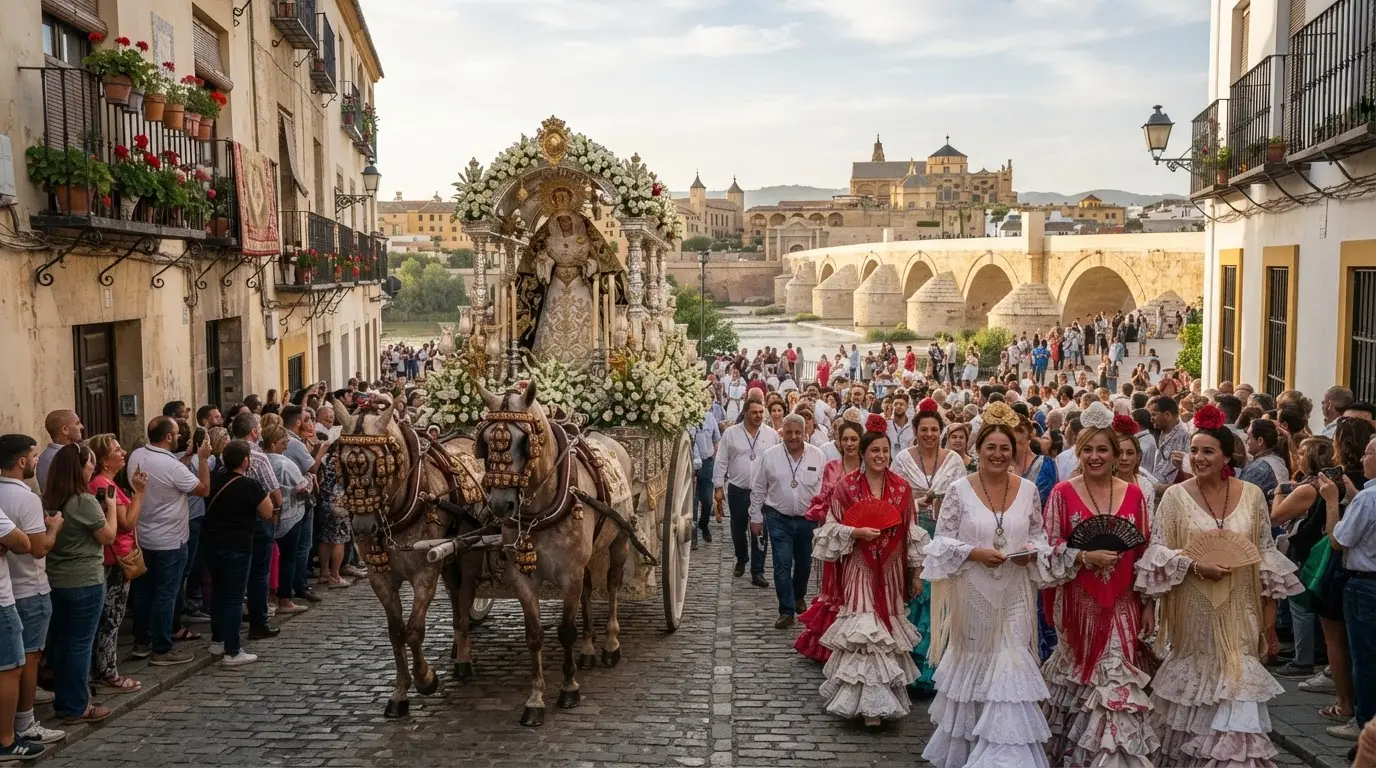
The annual procession of the Virgen de la Salud takes place in late May, opening the feria week. It is organized by the Asociación de Caballeros y Damas de Nuestra Señora de la Salud, the cofradía that has maintained devotion to the hermitage's image through the 20th and 21st centuries. The association organizes the event using horse-drawn carriages, which sets the visual register of the procession firmly within Andalusian feria culture rather than the solemnity of Semana Santa.
The sequence: devotional acts at the hermitage begin at 12:00 PM. The procession departs around 1:00 PM. The route moves through Avenida de los Custodios, turns along Ronda de Isasa, crosses the Puente de Miraflores, passes through the Parque de Miraflores, crosses the Puente del Arenal, and arrives at the Municipal Tent on the feria fairground around 2:00 PM. The total distance is roughly three kilometers.
The arrival at the fairground connects the procession directly to the city's spring fair. The hermitage procession is not simply a devotional act that happens to coincide with the feria calendar: it is the formal opening gesture of the feria weekend, the moment when the feria's titular patroness is brought to the grounds where the festival takes place. The religious and the festive are fused in the same route, which is the point.
The procession is free and open to the public. Families with children attend in numbers; it is one of the few feria events that runs in the early afternoon rather than late evening. The horse-drawn carriages, many decorated with flowers, follow the image of the Virgin as it is borne through the streets. The atmosphere is closer to romería (a community pilgrimage to the shrine, with music and festive dress) than to the silent columns of a Semana Santa procession.
For visitors who want to understand the relationship between Córdoba's Catholicism and its feria culture, this procession is the clearest demonstration available. The full comparison with Seville's feria traditions, where the religious and festive spheres are more formally separated, is in Feria Córdoba vs Seville.
How to attend: a visitor's guide to the procession
The procession route runs from the hermitage in the south of the city to the feria fairground near the Guadalquivir. Arriving by 11:30 AM secures a good viewing position at the bridge crossings, which are the visual highlights of the route. The Puente de Miraflores and the entry to the Parque de Miraflores offer clear sightlines as the horse-drawn carriages cross the water. These points draw the densest crowds; being there early means standing at the front rail rather than looking over other heads.
Dress follows feria norms. Casual festive attire is appropriate: clean summer clothes, a dress, or neat trousers. There is no strict dress code, but the Asociación members and many attendees come in traje de flamenca or the traje corto typical of Andalusian equestrian culture. The visual register of the event is explicitly feria. A visitor in ordinary summer clothes will not stand out, but someone in athletic or beach wear will. The procession moves into the fairground at arrival, so those who want to continue to the feria after the procession should dress accordingly. If flamenco shows are on your list while you're in town for feria week, our flamenco in Córdoba guide has the tablaos and history.
Photography is permitted throughout the route. The bridge crossings photograph well in morning light; from roughly 11:30 AM to 1:30 PM, the angle of the sun is favorable for the route sections along the river. The moments when the carriages slow to cross the bridges give a clear frame without motion blur.
Entrance to the procession and the feria grounds is free. Children are welcome, and families with strollers follow the route without difficulty along the riverside sections. For the feria grounds themselves, full logistics and a guide to the caseta culture, opening hours, and the week's schedule are in the Córdoba feria guide.
The procession is a single-morning commitment: from arrival at 11:30 AM to the image reaching the fairground at approximately 2:00 PM. That timing leaves the afternoon open for the feria itself, or for visiting the hermitage before the procession departs, which several tour groups do specifically to see the cistern and the ex-votos inside the chapel before the crowds reach the bridges.
Frequently asked questions
Who is the Virgen de la Salud and why is she important to Córdoba?
The Virgen de la Salud is the titular patroness of the Feria de Córdoba — the city's annual May fair carries her name in full: Feria de Nuestra Señora de la Salud. Her origin is a 1665 discovery story: two plowmen, Simón de Toro and Bartolomé de la Peña, found a small carved image of the Virgin in a well near the Puerta de Sevilla. The well water was attributed healing properties, and the site drew pilgrims for more than 200 years. Her association with the feria gives the festival a religious foundation that distinguishes Córdoba's fair from purely secular celebrations. Córdoba's city patrons are San Acisclo and Santa Victoria; San Rafael is the city's custodio.
Where is the hermitage of the Virgen de la Salud in Córdoba?
The hermitage is located in the southern part of the city near the Salud cemetery, south of the historic center. It was built in 1673 by Simón de Toro on the exact site where the original well was discovered in 1665. The building is an active chapel, not a museum, and is open for worship throughout the year. It contains the original cistern beneath the floor and typical Andalusian ex-votos left by devotees over generations. The procession departs from this hermitage every May.
When is the Virgen de la Salud procession?
The procession takes place in late May, at the start of the feria. Devotional acts at the hermitage begin at 12:00 PM, and the procession departs around 1:00 PM. The route runs via Avenida de los Custodios and Ronda de Isasa, crosses the Puente de Miraflores, passes through the Parque de Miraflores, crosses the Puente del Arenal, and arrives at the Municipal Tent on the feria fairground at approximately 2:00 PM. Entry is free. Visitors should arrive by 11:30 AM to secure a viewing position at the bridge crossings.
What is the connection between the Virgen de la Salud and the Feria de Córdoba?
The connection is civic and historical, not merely liturgical. The feria takes its full name — Feria de Nuestra Señora de la Salud — from the Virgen de la Salud, whose cult grew from the 1665 well discovery into a deeply embedded popular devotion over two centuries. The annual procession, which carries her image from the hermitage to the feria fairground, functions as the religious opening of the feria. The route ends at the fairground rather than at a church, making the transition from procession to festival explicit. This is why the feria bears a Catholic devotional identity that Seville's feria, despite its own religious elements, expresses differently.
Why is the Virgen de la Salud the patroness of the Feria de Córdoba?
Her association with the feria grew from the depth of popular devotion that developed around the 1665 well discovery. Over two centuries, her healing-water cult became one of the most embedded forms of popular religious practice in the city. When cholera struck Córdoba repeatedly in the 19th century — the first recorded wave reaching the city in 1834 — her name and her origins as a health intercessor made her the natural focus of collective petition. This sustained devotion, rooted in popular practice rather than institutional designation, is why the feria carries her full name: Feria de Nuestra Señora de la Salud. The city's formal patrons are San Acisclo and Santa Victoria; she is the titular patroness of the fair specifically.
What were the ex-votos and healing practices at the hermitage?
For over 200 years after the hermitage opened in 1673, Cordobans came to the cistern to collect water they described as healing medicine. They carried it home in clay vessels and used it for illness. Theologically, they understood the water's efficacy as deriving from the Virgin's intercession, not from the water itself. The practice sustained the site as a folk-medicine resource across generations. The hermitage today still holds ex-votos typical of Andalusian healing shrines: painted tiles, photographs, and small personal objects left by people who came seeking petitions. These offerings document the cult's continuity from the 17th century into the present.
What is the best viewing spot for the Virgen de la Salud procession?
The Puente de Miraflores and the entry to the Parque de Miraflores offer the clearest sightlines as the horse-drawn carriages cross the water. These are the visual highlights of the route and draw the largest crowds. Arriving by 11:30 AM, about 90 minutes before the procession reaches the bridges, secures a front position. The morning light from the south is favorable for photography at those points between approximately 11:30 AM and 1:30 PM. The route's final section along the Puente del Arenal, approaching the fairground, is less crowded and offers a different angle.
Is the Virgen de la Salud procession suitable for families and children?
Yes. The procession runs in the early afternoon, departing around 1:00 PM, which is better suited to children than the late-evening feria schedule. Entry is free. The route along riverside sections accommodates strollers without difficulty. The atmosphere is festive rather than somber: horse-drawn carriages, flowers, traditional Andalusian dress. It is closer in character to a romería, a community pilgrimage with festive elements, than to the silent columns of a Semana Santa procession. Families with young children constitute a significant portion of the procession's regular attendance.
Who organizes the Virgen de la Salud procession?
The procession is organized by the Asociación de Caballeros y Damas de Nuestra Señora de la Salud, the cofradía (religious brotherhood) that maintains devotion to the hermitage and its image. The association has roots in the lay-governed hermitage tradition established when Simón de Toro named Marcos de la Cruz administrator in his 1677 will. The cofradía coordinates the horse-drawn carriages, the devotional acts at the hermitage before departure, and the formal presentation of the image at the feria fairground.