Year-round guide
Mezquita at Sunrise: Photographer's Timing Guide
The Torre del Alminar goes orange-warm for 15 minutes at first light. Here's where to stand, when to arrive, and what the interior actually looks like before the crowds.
Mezquita visitor info
Free at 8:30am · No tripods inside

Written by
María Fernanda González Ten years covering Córdoba's UNESCO heritage sites, sourcing from Junta de Andalucía documentation.
Published
On this page
Jump to a section
At a glance
7:15–8am sunrise window (seasonal)
8:30am free interior entry opens
24mm+ recommended interior lens
No tripods handheld only inside
Sunrise exterior: Roman Bridge and tower
The Mezquita-Catedral tower (the Torre del Alminar) catches the first direct sun before anything else at street level. The minaret base is a 9th-century structure; the belfry was added centuries later on top. At first light the stone goes a particular warm orange, distinct from how it looks in the flat mid-morning glare. That colour lasts about 15 to 20 minutes.
Best position: the midpoint of the Puente Romano, lens facing north. The bridge is free and open around the clock. From there, the tower rises above the roofline with the Guadalquivir in the foreground. At the midpoint, you have enough distance from the near buildings to include the full tower without tilting the lens sharply up. A tilted lens introduces keystoning and cuts off the base.
Sunrise timing by season
- June–August ~7:15am
- March–May / Sept–Oct ~7:30–8am
- November–February ~8–8:30am
Setup checklist
- Arrive at the bridge 20 min before sunrise to find your position
- Face north from the midpoint; the tower is framed between buildings at ~50mm
- The south end of the bridge (Calahorra Tower side) gives a second angle: the river facade from below
The 15-minute window
The tower is in direct sun 10 to 15 minutes before the streets below. That gap closes fast once the sun clears the hills to the east. Set an alarm using a sunrise calculator app (Photopills or Sun Surveyor both work well) set to Córdoba's coordinates: 37.879°N, 4.779°W.
Interior shots: inside the Mezquita
The nave is dim regardless of the hour. No windows face the main prayer hall and the natural light comes indirectly. What changes with timing is not the light quality but the crowd density. The free entry window (8:30–9:30am, Monday to Saturday) is the quietest the interior gets (no reservations accepted, queue only). If you miss that slot, paid entry opens at 10am; buy online in advance to skip the queue for that session.
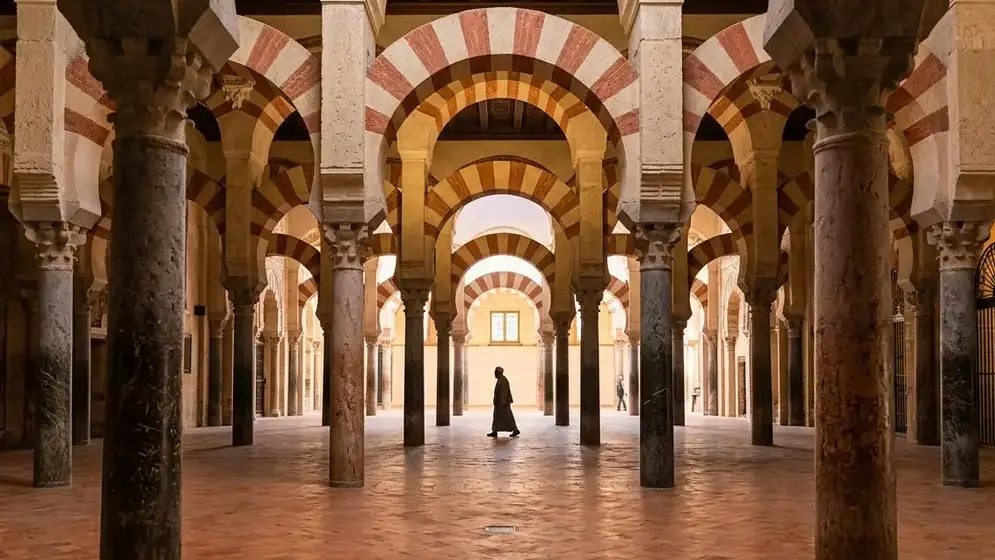
The 856 columns of jasper and marble are the obvious subject. A 24mm or wider lens (full-frame equivalent) reads the double-tiered arches as a receding series rather than a wall. Shoot toward the far columns, not at the arch directly above you. The red-and-white stripe pattern repeats in every direction; finding an angle where three or four arches align creates depth.
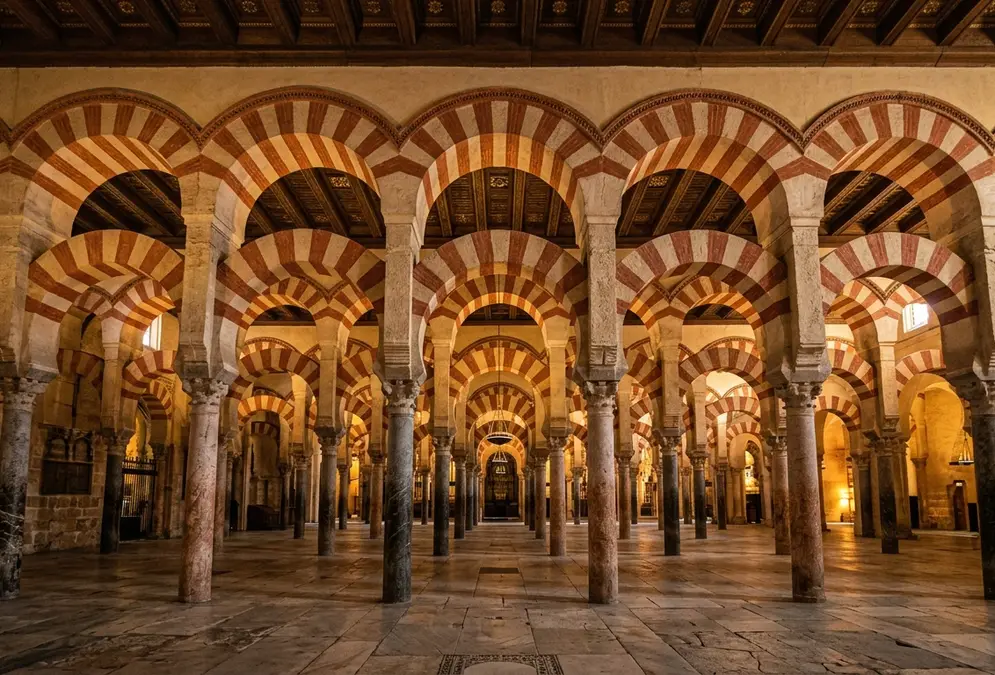
The double-tiered arches recede in every direction. A 24mm or wider lens is the minimum to capture the series; anything longer reads as a single arch rather than a forest.
Camera settings (handheld in dim light)
- ISO 3200–6400
- Aperture f/1.8–f/2.8 (wide open)
- Shutter speed 1/60s minimum (handheld)
- White balance Tungsten / ~3200K
What to shoot and in what order
- The mihrab first (it crowds by 10am)
- Column-forest receding shots toward the south wall
- The Renaissance Capilla Mayor: high-contrast vaulted ceiling
- The carved choir stalls (natural light from the skylights above)
- Exit into the courtyard last, once the interior thins out
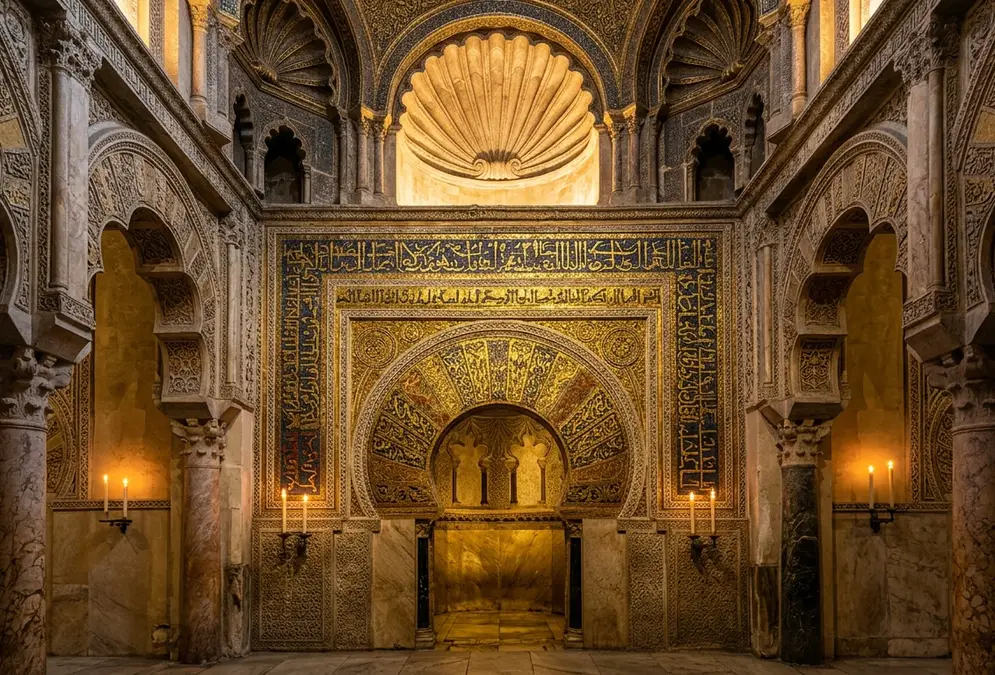
The mihrab's Byzantine mosaics were made by craftsmen sent from Constantinople by the emperor at the request of Caliph Al-Hakam II. The gold tessera catch light differently depending on where you stand; move left and right before settling on a position.
No tripods, no selfie sticks
Tripods and monopods are not permitted anywhere inside the Mezquita-Catedral. Selfie sticks are also banned. Personal photography with a handheld camera or phone is fine throughout. Flash is generally discouraged during religious services; check if a service is in progress when you enter.
Orange tree courtyard
The Patio de los Naranjos opens at 8:30am and is free. Morning light enters from the east and slants through the orange trees at a low angle until around 10am. After that, the courtyard fills with flat overhead light and more visitors.
The best shot is from the far south end of the courtyard, looking north toward the Torre del Alminar. From there, the tree rows line up and the tower frames above the final arch. The long shadows cast by the trees in early morning run parallel to the irrigation channels, which are original 8th-century stonework still in the same positions.
01
Best light: 8:30am to 10am
The low eastern sun creates long shadows. Orange blossom season (March to May) adds scent and white flowers in the frame. The trees fruit visibly from November onward; they stay on the branch through winter.
02
Far south end, facing north
Stand at the far south wall, use a 24–35mm lens, and let the tree rows converge toward the tower. The Puerta del Perdón (main gate to the courtyard) is in the north wall, with the tower directly above and slightly behind it.
03
Ground-level detail shots
The stone irrigation channels and root-lifted paving make good detail shots in low-raking light. In spring, fallen blossom collects in the channels.
“In April the courtyard smells of orange blossom before you see it. The scent drifts through the Puerta del Perdón gate from 30 metres away.”
Practical photography rules
The rules are straightforward, and enforced. Get them wrong and staff will ask you to put the equipment away.
| Equipment | Status | Note |
|---|---|---|
| Phone camera | Permitted | Everywhere inside and out |
| Mirrorless / DSLR (handheld) | Permitted | Personal use only |
| Tripod / monopod | Not permitted | Inside the building; fine on the Roman Bridge |
| Selfie stick | Not permitted | Inside and in the Patio |
| Flash | Generally permitted | Avoid during active services |
| Commercial / professional shoot | Advance permission | Contact Cabildo Catedral directly |
Commercial photography
Any shoot with commercial intent (including video, tripods, or studio lighting) requires written permission from the Cabildo Catedral de Córdoba in advance. The process takes at least a week — contact their administration office directly.
Building your morning
A photography morning at the Mezquita runs from pre-dawn to around 10:30am. After that, coach groups are arriving and the interior has lost its calm. Here is a sequence that covers all three areas with minimal overlap between sessions.
01
T minus 20 min: Roman Bridge
Walk to the midpoint of the Roman Bridge. Set up your composition. The pre-dawn light on the water gives a blue-hour option before the tower goes orange.
02
Sunrise: tower golden window (15–20 min)
The tower lights up, then the roofline, then the river facades. Walk south to the Calahorra Tower end for the alternate angle. Total bridge time: 30–40 minutes.
03
8:30am: Queue for free interior entry
Cross the bridge and walk to Puerta de las Palmas (5 minutes). The free window opens at 8:30am and closes at 9:30am. Be at the entrance before 8:15am in April to October. Shoot the mihrab first.
04
Exit into the Patio de los Naranjos
Move into the courtyard as you leave; the morning light is still good until 10am. From there, walk south 300 metres to the Alcázar gardens for a different architectural register, or continue east to the Judería for the narrow street shots that work well in the first hour of full daylight.
Which months give the best exterior light?
October and November. The sun angle is lower than in summer, which means longer shadows and warmer tone on the stone at any hour of the morning, not only at sunrise. The crowds are thinner from mid-September onward. In spring, the orange blossom in the Patio (March to May) is worth a separate visit; arrive at exactly 8:30am for the scent and the light together.
For full practical details on tickets, hours, and dress code, see the Mezquita-Catedral visitor guide. For the complete ticket booking process, see the Mezquita tickets guide.
Frequently asked questions
When is the best time to photograph the Mezquita?
For exterior shots, arrive at the Roman Bridge 20 minutes before sunrise. The Torre del Alminar catches the first light and goes orange-warm for about 15 to 20 minutes before the rest of the city brightens. In summer that window opens around 7:15am; in winter around 8am. For interior shots, the free entry period (8:30–9:30am, Monday to Saturday) gives you the quietest nave of the day. The light inside is low-contrast throughout; early morning gives you fewer people, not better light.
Are tripods allowed inside the Mezquita?
No. Tripods are not permitted inside the Mezquita-Catedral. You shoot handheld in a dim nave. Set your ISO to 3200–6400 and use a wide aperture. The free morning slot gives you fewer people to blur into the background, which makes a real difference on long handheld exposures.
What lens is best for Mezquita interior shots?
A wide-angle lens of 24mm or wider (full-frame equivalent) is the standard choice for the column forest. The double-tiered arches need width to read as a receding series. For the mihrab, a normal or short telephoto (35–50mm) lets you isolate the mosaic detail without distortion. Phone cameras work well here: their computational modes handle the low light better than many compact cameras.
Can I photograph the Mezquita from outside at sunrise?
Yes, and it is free. The Roman Bridge is open 24 hours. Stand at the midpoint, face north toward the Torre del Alminar, and you get the tower above the rooftops with the Guadalquivir in the foreground. The tower catches the first direct sun roughly 10 to 15 minutes before street level; that gap is the window. The Calahorra Tower on the south side of the bridge gives a different angle: the whole river facade from slightly below.
Do I need permission to photograph inside the Mezquita?
Personal photography with a phone or handheld camera is permitted inside. Tripods, monopods, and selfie sticks are not allowed. Commercial photography or any shoot requiring specialist equipment needs advance permission from the Cabildo Catedral. Contact them directly through the official Mezquita-Catedral website.
What is the best spot to photograph the Mezquita's exterior?
The Roman Bridge midpoint is the classic position for the tower. The Calahorra Tower (south end of the bridge) gives a different angle toward the river facade. For the courtyard exterior, stand at the far south end of the Patio de los Naranjos early in the morning: the light slants through the orange trees from the east and you get the Torre del Alminar framed above the trees.
A skip-the-line tour gets you through the entrance in under 10 minutes — which matters when the free slot fills before 8:30am in high season and the paid queue stretches to two hours by 10am. An audio guide tour lets you move at your own pace and still skip the queue.
Skip the Queue — Book a Tour
Tours are selected for quality, not commission. We earn a small fee if you book — at no extra cost to you.
16,773+ verified reviews · Priority entry · Free cancellation
Best Seller
Best Seller
Best Seller
Mosque-Cathedral Skip-the-Line Guided Tour
Skip the queue and explore the Mezquita-Cathedral with a knowledgeable local guide. Discover 13 centuries of layered history in one of Spain's most iconic monuments.
Skip the line 1.5 hours
From €29
4.7 (7,293 reviews)
Reserve Your Spot
✓ Verified GetYourGuide reviews
Books up weeks ahead in peak season
Mosque-Cathedral Skip-the-Line Guided Tour
Beat the crowds with skip-the-line access and enjoy an expert-led tour through the breathtaking arches, mihrab, and cathedral choir of Córdoba's most visited monument.
Skip the line 1.5 hours
From €28
4.6 (5,758 reviews)
Reserve Your Spot
✓ Verified GetYourGuide reviews
Books up weeks ahead in peak season
Mosque-Cathedral E-Ticket with Audio Guide
Explore the Mosque-Cathedral at your own pace with a detailed audio guide that brings every arch, mihrab, and chapel to life. Skip the ticket queue with your e-ticket.
Self-guided
From €18.50
Less than a restaurant lunch
4.2 (3,722 reviews)
Reserve Your Spot
✓ Verified GetYourGuide reviews
Books up weeks ahead in peak season